
Recalibrating the Pakistan–United States Strategic Dialogue: A Geopolitical Assessment of the Latest Shifts

In the first quarter of 2026, the relationship between Pakistan and the United States entered a phase of recalibration that signals a deeper and more strategically nuanced engagement. This moment in the bilateral relationship cannot be understood through isolated events or transactional diplomacy. Instead, it represents a confluence of evolving geopolitical imperatives, shifting global priorities in Washington, and a redefinition of Islamabad’s strategic agency in the broader international system. The recent moves between Pakistan and the United States mark a departure from the primarily reactive posture that characterized much of their interactions over the previous decade. What we witness today is a conscious effort on both sides to explore avenues of cooperation that extend beyond counterterrorism, traditional security alignments, and episodic engagement. The evolution of this dialogue must be understood within the wider contexts of South Asian and West Asian power balances, American strategic priorities in the Indo‑Pacific, global economic realignments, and the complex interplay of domestic political calculus in both capitals.
At the heart of this shift is the recognition by U.S. strategists that the traditional frameworks through which Washington engaged with Pakistan no longer suffice to address the multifaceted challenges of the present moment. The global strategic environment has undergone profound change, driven by intensifying great power competition, emerging security challenges, and economic interdependencies that cut across regions and issue areas. The United States, having recalibrated its focus toward strategic competition with major powers, sees in Pakistan a partner with unique geopolitical leverage, particularly in relation to Afghanistan’s stabilization, regional connectivity, and diplomatic engagements with actors such as Iran, Central Asian republics, and the Gulf states. Equally, Islamabad appears to recognize that a recalibrated engagement with Washington offers pathways to diversify its strategic partnerships, attract economic investment, and enhance its international diplomatic profile in ways that align with its own long‑term national interests.
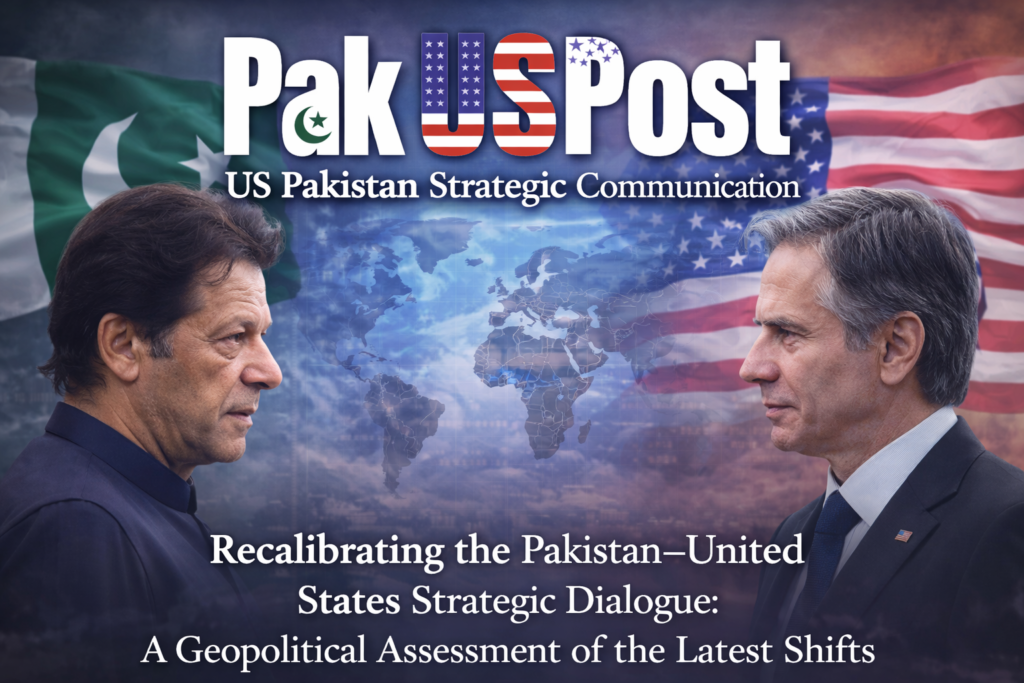
The most visible marker of this evolving relationship occurred in early 2026 when Pakistan, under active diplomatic direction from its foreign policy leadership, facilitated indirect communications between the United States and Iran. This role did not emerge spontaneously; it was the product of months of quiet diplomacy and calibrated outreach across regional capitals. Islamabad’s ability to serve as a conduit for messages between Washington and Tehran reflects a broader willingness to engage in strategic diplomacy that transcends the traditional security partnership narrative. In taking on this role, Pakistan positioned itself as a constructive interlocutor capable of contributing to de‑escalation efforts in a conflict that carries significant implications for regional stability. For Washington, this offered a valuable channel to test back‑channel engagement strategies with Iran while managing broader regional risk. The move therefore signified not only a tactical diplomatic shift but also a deeper conceptual shift in how both states perceive the utility of their bilateral engagement.
From a strictly geopolitical perspective, the implications of this development are nuanced and far‑reaching. The geopolitical landscape of South Asia and the Middle East is shaped by overlapping spheres of influence, competitive alignments, and an ever‑present undercurrent of strategic competition between the United States and China. For the United States, the challenge in this environment is to maintain and strengthen its strategic foothold without overcommitment, while simultaneously managing relationships with regional actors whose interests may not align neatly with Washington’s. Pakistan’s geographic position — bridging South Asia, Central Asia, and the Middle East — makes it a time‑tested crossroads of strategic interests. Historically, this position has brought both opportunity and complexity to Pakistan–U.S. relations. Today, that same position offers a strategic advantage, particularly as the U.S. seeks diversified pathways for influence that do not depend solely on formal alliance structures.
In the current geopolitical moment, the United States is acutely aware of the limitations of its traditional security alliances and is exploring more fluid, issue‑specific partnerships that align with its global strategic imperatives. This includes an emphasis on diplomacy that leverages regional actors as intermediaries in managing security dilemmas, mitigating conflict spillovers, and countering destabilizing forces without resorting to large‑scale deployments or expanded military commitments. Pakistan’s recent diplomatic role vis‑à‑vis Washington and Tehran fits within this framework. It positions Islamabad as a relevant actor on matters of regional risk management, thereby deepening its relevance in strategic discussions that extend beyond narrow bilateral concerns.
For Pakistan, engaging in this diplomatic role serves multiple strategic interests. First, it counters narratives that seek to confine Pakistan’s international role to reactive security postures. Instead, Islamabad can project an image of proactive diplomacy and responsible international engagement. Second, participation in these processes grants Pakistan strategic leverage in its broader foreign policy — particularly in relationships with neighboring states and regional power centers. Third, this diplomatic involvement aligns with Islamabad’s long‑standing interest in de‑escalation and regional stability, which it perceives as essential to its own security environment. In this sense, the recent move in the Pakistan–U.S. dialogue encapsulates an interplay of interests that converges around stability, regional risk mitigation, and the pursuit of influence in an evolving geopolitical order.
While geopolitical calculus offers a broad framework for understanding the strategic significance of these moves, it is equally important to consider the geo‑economic dimension of the evolving Pakistan–United States relationship. In the past, economic engagement between the two countries was largely overshadowed by security cooperation and bilateral development assistance. Today, however, economic linkages are emerging as a central pillar of bilateral engagement. Washington’s broader economic strategy, particularly in the post‑pandemic, post‑Ukraine war world, emphasizes diversification of supply chains, access to critical resources, and the integration of emerging markets into resilient economic networks. In this context, Pakistan presents not only a gateway to regional markets but also a potential partner in sectors that align with U.S. economic interests.
In 2025, Pakistan and the United States signed a comprehensive trade and energy cooperation agreement that marked a significant departure from conventional economic arrangements. The agreement reduced tariff barriers on select industrial and agricultural goods, expanded cooperation on energy exploration projects, and established mechanisms for investment facilitation. For Islamabad, the agreement provided an opportunity to attract American investment, spur export growth, and signal a readiness to align with global economic networks. For Washington, it represented a pragmatic approach to engaging a strategically located emerging economy, supporting U.S. interests in economic connectivity, and providing alternatives to China‑centric economic models. This agreement also reflected a shared interest in advancing economic collaboration that generates mutual benefit while aligning with broader strategic priorities.
The geo‑economic dimension of this engagement is not without challenges. Pakistan’s economic landscape has faced longstanding structural issues, including fiscal imbalances, currency volatility, and reliance on external financing. Integrating into wider economic frameworks requires sustained domestic reform, regulatory stability, and predictable governance structures. From Washington’s perspective, economic engagement is contingent on transparent policies, protection of investor rights, and alignment with international economic norms. The interplay of these expectations underscores the complexity of deepening economic ties in a manner that is both strategically constructive and practically sustainable. Nonetheless, the shift toward a more integrated economic partnership reflects a mutual recognition that economic interdependence can provide a stabilizing complement to diplomatic and strategic cooperation.
Strategic considerations extend beyond the geopolitical and economic realms into the traditional domain of security cooperation. While counterterrorism remains a shared concern, the nature of security dialogue between Pakistan and the United States has evolved. Rather than focusing solely on narrow tactical cooperation, discussions have broadened to encompass shared regional stability objectives, crisis management frameworks, and cooperative approaches to emerging security challenges such as transnational crime, cyber threats, and border security dynamics. This broadening reflects an understanding that security in the 21st century is increasingly multidimensional and cannot be addressed through narrow militaristic lenses alone.
For Washington, engaging Pakistan in broader security dialogues offers a pathway to manage regional risks without the need for extensive military entanglements. It allows for a pragmatic distribution of responsibilities where regional actors contribute to stability in their immediate environments, while the United States provides strategic support, intelligence cooperation, and capacity building as required. For Islamabad, such dialogues reaffirm its position as a key regional security partner, capable of contributing to stability beyond its borders. They also align with domestic security priorities that emphasize managing internal threats, protecting borders, and ensuring long‑term peace and development.
Political dynamics within both the United States and Pakistan influence how these strategies are articulated and operationalized. In Washington, the recalibrated engagement with Pakistan reflects a strategic calculation shaped by legislative oversight, executive foreign policy priorities, and competing demands on American strategic bandwidth. The shift toward more nuanced engagement with Islamabad is part of a broader trend in U.S. foreign policy that prioritizes strategic flexibility, diversified partnerships, and issue‑specific cooperation. This approach allows Washington to advance its interests in multiple theaters without becoming overly reliant on rigid alliance structures that may constrain strategic autonomy.
In Pakistan, the evolving relationship with the United States has triggered significant political discourse. Stakeholders across the political spectrum are engaging with questions about the direction of foreign policy, the balance of strategic partnerships, and the implications of closer economic and diplomatic alignment with Washington. These debates are not merely rhetorical; they reflect deeper considerations about sovereignty, national interests, and the role of Pakistan in a rapidly changing global order. In this context, managing domestic expectations while advancing foreign policy objectives requires a careful balancing act that accommodates competing narratives without undermining strategic clarity.
The impact of these developments is also being felt in the social and media environment of both countries. In Pakistan, mainstream media, opinion leaders, and social platforms are interpreting the recalibrated engagement with the United States in diverse ways. For some, the shift represents an opportunity for economic growth, enhanced diplomatic stature, and greater influence in regional affairs. For others, it raises questions about strategic autonomy and the potential for external dependency. In the United States, media narratives tend to frame the engagement within broader debates about America’s role in the world, resource allocation, and the strategic utility of partnerships with countries like Pakistan. These narratives shape public perceptions and inform policy discourse, underscoring the importance of effective communication strategies that accurately reflect the complexities of international engagement.
The role of technology and digital transformation cannot be overlooked in understanding contemporary diplomatic engagement. Digital platforms, data analytics, and communication technologies are increasingly central to how states conduct diplomacy, shape public narratives, and manage international information flows. Both Washington and Islamabad are adapting to this reality by incorporating digital diplomacy into their engagement strategies. This includes using social media channels to communicate policy positions, engaging with global audiences in real time, and monitoring information environments to anticipate and respond to emerging narratives. The technological dimension of diplomacy reflects broader shifts in how states project influence and manage strategic relationships in an interconnected world.
Trans‑normative dynamics — the ways in which international norms adapt to evolving geopolitical realities — are also at play in the recalibration of the Pakistan–United States relationship. Issues such as mediation roles, constructive engagement in conflict resolution, and respectful management of sovereignty illustrate how normative frameworks can evolve in response to pragmatic state interests. Pakistan’s involvement in facilitating communication between Washington and Tehran challenges traditional assumptions about neutrality, mediation, and strategic agency. It suggests that norms governing diplomatic engagement are not static but can be reshaped through context‑specific practice that aligns with shared interests in stability and risk mitigation.
Yet, despite the promise of this recalibrated engagement, critical issues remain. Trust deficits, divergent long‑term objectives, and regional rivalries continue to shape the contours of the bilateral partnership. For the United States, balancing its strategic interests with Pakistan against competing priorities in South Asia, the Middle East, and the Indo ‑Pacific demands sustained, careful diplomacy. For Pakistan, leveraging its role effectively without becoming entangled in broader geopolitical rivalries requires astute policy judgment and strategic coherence. The relationship’s future trajectory will depend on both capitals’ ability to navigate these challenges while capitalizing on opportunities for constructive cooperation.
In conclusion, the latest shifts in the Pakistan–United States strategic dialogue represent a moment of strategic recalibration that transcends traditional categories of engagement. These moves reflect a convergence of geopolitical reasoning, economic interdependence, strategic security interests, political dynamics, social narratives, technological transformation, and normative evolution. The significance of this development lies not merely in isolated gestures or diplomatic overtures but in the broader recognition by both states of the value of a more sophisticated, multifaceted partnership. As the global strategic landscape continues to evolve, the Pakistan–United States relationship stands at a critical juncture — one that offers opportunities for deeper cooperation, mutual strategic benefit, and constructive engagement in managing regional and global challenges. The way forward will require sustained commitment, clarity of purpose, and an adaptive approach that recognizes the complexities of a rapidly changing world.
A Public Service Message