
Pakistan’s Diplomatic Agency in the US–Iran War: Strategic Mediation and Sovereign Autonomy

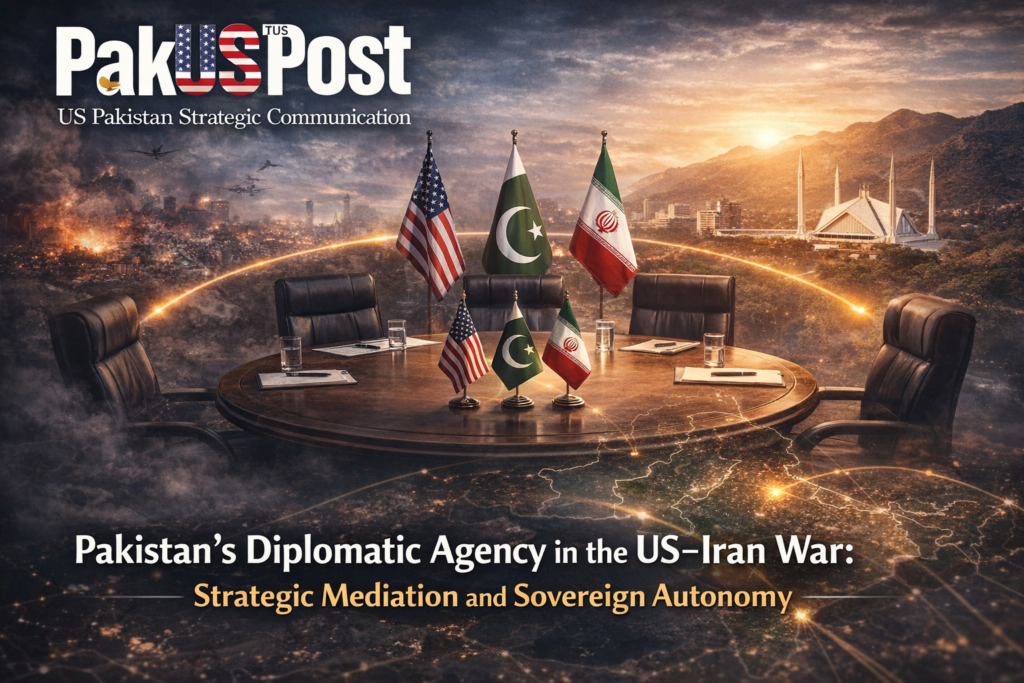
In the spring of 2026, Pakistan has undertaken a diplomatic initiative of considerable strategic significance by seeking to play a mediating role in the escalating conflict between the United States and the Islamic Republic of Iran. Islamabad’s efforts to broker or facilitate peace between two major global actors engaged in hostilities reflect a conscious and calculated repositioning of its foreign policy, from a historically reactive orientation to a more proactive role in regional and global affairs. This effort aligns with Pakistan’s long‑standing interest in stabilizing its neighborhood, securing economic lifelines linked to Gulf energy and expatriate labor remittances, and ensuring that external conflicts do not spill over into domestic instability. Pakistan’s diplomatic activism also aims to assert sovereign agency at a time when international power plays often relegate smaller states to peripheral roles rather than central interlocutors in global disputes.
The current conflict, triggered by joint United States‑Israeli strikes against Iranian strategic assets and followed by reciprocal Iranian attacks, has not only altered the security landscape of the Middle East and the Gulf but has also disrupted global energy markets and elevated geopolitical tensions across multiple fault lines. In this context Islamabad’s proposition formalized in cooperation with Beijing through a jointly proposed five‑point peace initiative seeks an immediate cessation of hostilities, the commencement of direct negotiations, and the safe passage through strategic chokepoints such as the Strait of Hormuz. This framework underscores Pakistan’s intent to anchor momentum toward diplomacy while addressing core issues that threaten regional stability and economic continuity.
Pakistan’s mediation effort is not occurring in a vacuum but rather against a backdrop of competing requirements and strategic imperatives. Islamabad shares a more than 900‑kilometer border with Iran and has deep historic ties, social linkages, and economic interdependencies with Tehran. At the same time, Pakistan values its strategic relationship with Washington, which oscillates between cooperation and cautious engagement depending on broader geopolitics. The sustained hostilities risk exacerbating energy insecurity, increasing fuel prices, and threatening the interests of millions of Pakistani expatriate workers in Gulf Cooperation Council (GCC) states. These dynamics furnish Islamabad with both incentive and urgency to act as a diplomatic bridge between conflicting parties
Pakistan’s efforts have taken shape in multiple concrete ways. Islamabad has hosted regional foreign ministers, including counterparts from Saudi Arabia, Türkiye, and Egypt, in talks aimed at de‑escalation and confidence‑building. Pakistan’s Foreign Minister has publicly stated that both Washington and Tehran have “expressed confidence” in Pakistan’s capacity to facilitate discussions toward an end to hostilities and have endorsed Islamabad’s willingness to create conditions conducive to negotiations. These diplomatic engagements are emblematic of Pakistan’s attempt to carve out a niche as an honest broker who prioritizes dialogue over conflict and who is prepared to shoulder the attendant complexities that such mediation entails.
Despite these efforts, the mediation process has encountered immediate challenges that illuminate the structural limitations and profound complexities of the circumstances. Iranian officials have publicly downplayed or rejected Pakistan’s mediation role at various junctures, clarifying that Tehran has not directly engaged in peace talks through Pakistani intermediaries and reaffirming their commitment to protecting national sovereignty in the face of conflict. Simultaneously, Tehran has expressed skepticism regarding the earnestness of Washington’s diplomatic overtures, describing the US approach to negotiations as lacking genuine commitment to a peaceful resolution. These controversies highlight the fragile and contested nature of mediation when the principal actors themselves are ambivalent or estranged from direct dialogue.
Furthermore, Pakistan’s diplomatic initiative operates in a climate where military escalations continue, including US troop deployments to the Gulf and ongoing strikes that target critical infrastructure across the region. The persistence of hostilities challenges Islamabad’s capacity to sustain its role as a neutral mediator and heightens the risk of being perceived as aligned with one side or the other. Strategic ambiguity, while a diplomatic asset in some contexts, can also dilute Pakistan’s leverage if it is not backed by substantive progress toward de‑escalation.
In this intricate geopolitical theatre, Pakistan’s engagement with China to jointly propose a five‑point peace initiative lends additional weight and reflects a broader strategic calculus. The partnership with Beijing grounded in existing strategic cooperation and mutual interest in regional stability suggests a multidimensional approach to diplomacy that seeks to unify influential global actors around common goals. A coordinated initiative with China strengthens Pakistan’s diplomatic platform and underscores the importance of multilateralism in addressing conflicts that transcend bilateral disputes. Yet, this partnership also introduces its own sets of expectations and complexities, particularly as China maintains substantial economic interests in the region and seeks to safeguard energy supply routes vital to its own economic growth.
The strategic assumption underpinning Pakistan’s mediation is that diplomatic engagement remains the most viable pathway to halting hostilities and managing the cascading consequences of an extended war. The initiative appeals to shared interests such as humanitarian access, protection of civilians, and resumption of commercial navigation through key maritime zones and frames the crisis as one where constructive dialogue are necessary to restore order. By prioritizing these shared concerns, Pakistan seeks to align its national interests with broader global imperatives for conflict resolution and economic stability.
However, this strategic pivot toward mediation demands significant diplomatic finesse, institutional capacity, and sustained engagement. It requires Pakistan to reconcile divergent expectations from Washington and Tehran, manage pressures from allied and regional states, and maintain an image of impartiality conducive to facilitating talks. The complexity of these requirements underscores the intrinsic tension between normative aspirations of peace and the gritty realities of geopolitical competition, where strategic interests often supersede diplomatic overtures.
Looking ahead, the trajectory of Pakistan’s mediation will have far‑reaching implications for its foreign policy identity and global standing. If Pakistan can contribute meaningfully to a negotiated de‑escalation or open channels for substantive dialogue, it would signify a notable elevation of its diplomatic authority and strategic relevance. It could reinforce Islamabad’s credibility on the international stage and strengthen bilateral and multilateral partnerships that value stability and cooperation. Conversely, if mediation fails or is marginalized by sustained conflict dynamics, Pakistan may face reputational costs, diminished leverage, and the prospect of being drawn inadvertently into adverse geopolitical alignments.
For Pakistan to consolidate its role as a constructive mediator and enhance its sovereign autonomy, it must pursue several policy imperatives. It is essential to institutionalize diplomatic efforts with clear mechanisms for sustained engagement between conflicting parties and to invest in diplomatic capacities that are agile and informed by deep contextual understanding of regional dynamics. Pakistan should also calibrate its external partnerships balancing relations with major powers like the United States and China without being excessively tethered to any single geopolitical bloc. In doing so, Islamabad can resist perceptions of partiality and reinforce its position as a credible interlocutor whose primary commitment is to peace, stability, and national interest.
Simultaneously, Pakistan’s mediation strategy must be complemented by diversified economic and security policies that insulate the country from the destabilizing effects of regional conflicts. Enhancing energy security, protecting expatriate labor interests, and fostering economic resilience will bolster Pakistan’s capacity to engage in high‑stakes diplomacy without compromising domestic stability. These measures, alongside principled advocacy for dialogue and respect for sovereignty, will enable Pakistan to contribute genuinely to conflict resolution while safeguarding its strategic autonomy and long‑term national interests.
In conclusion, Pakistan’s endeavor to act as a mediator in the US–Iran conflict represents a bold reconfiguration of its foreign policy posture, predicated on the belief that diplomatic agency can yield strategic dividends. While formidable challenges persist, the pursuit of mediation reflects Islamabad’s aspiration to assert itself as an agent of peace in a volatile geopolitical landscape. Whether this aspiration can be realized will depend on Pakistan’s ability to navigate the complex interplay of power, interest, and diplomacy with clarity, coherence, and resolute commitment to constructive engagement.
A Public Service Message