Oceans Shape Pakistan’s New Strategic Balance In Asia

Pakistan’s strategic vocabulary has long been written in the grammar of land wars, contested borders, mountain frontiers and short warning crises. Its security doctrine emerged from partition trauma, repeated conflict with India, alliance cycles with great powers and the persistent requirement to defend territorial integrity under asymmetric conditions. Yet the geography of power is changing faster than the institutions built to interpret it. The centre of gravity in Asian competition is moving from plains and passes toward ports and sea lanes, from armoured manoeuvre to logistics endurance, from static deterrence to networked coercion, and from visible alliances to layered technological dependence. For Pakistan, this transformation demands not a cosmetic revision of doctrine but a strategic rewrite. If Islamabad continues to think in twentieth century templates while rivals organise twenty first century capabilities, deterrence may remain intact on paper while influence erodes in practice.
The immediate trigger for reassessment is the deepening India United States defence partnership. What began as cautious rapprochement has evolved into a broad strategic compact rooted in shared concerns over China’s rise, supply chain resilience, defence innovation and maritime order in the Indo Pacific. Intelligence cooperation has widened. Defence industrial collaboration has become more serious. Exercises have normalised interoperability. Sensitive technologies once difficult to transfer are now discussed with fewer inhibitions. Washington does not formally endorse India against Pakistan, yet the cumulative effect of empowering India as a larger strategic actor inevitably alters South Asian balances. Even when agreements are framed in China related language, capabilities are fungible. Surveillance systems, aerospace integration, cyber tools and industrial scale all strengthen India’s overall posture.
Pakistan should resist the temptation to interpret every India United States development through a purely bilateral lens. That reaction has historically produced defensive reflexes rather than strategic adaptation. The more consequential reality is that India seeks to become a system shaping power, not merely a regional rival. It wants manufacturing heft, naval reach, digital scale and diplomatic optionality. Its partnership with Washington serves that ambition while preserving autonomy. Pakistan therefore confronts an India that is increasingly embedded in wider global architectures. Matching such an actor solely through conventional balancing would be fiscally exhausting and strategically incomplete.
At the same time, the Gulf security order is no longer as predictable as it once seemed. For decades, Pakistan could assume that Gulf monarchies remained anchored almost exclusively to United States protection, with energy rents underwriting familiar strategic relationships. That model is changing. Gulf states are diversifying partnerships, investing in Asia, hedging among powers and prioritising economic transformation. They buy Western defence systems, engage China commercially, explore regional diplomacy with Iran and increasingly assess security through the lens of resilience rather than permanent confrontation. Their sovereign funds shape markets. Their ports shape logistics. Their energy decisions shape inflation worldwide. Their technology choices shape future infrastructure.
This matters profoundly for Pakistan. Millions of Pakistanis work in Gulf economies. Remittances remain critical. Financial support has periodically stabilised Pakistan during external account stress. Yet the next phase of Gulf relevance is not charity or episodic deposits. It is investment, connectivity, food security partnerships, energy storage, digital infrastructure and industrial relocation. If Pakistan approaches the Gulf only as a lender of last resort, it will miss the larger opportunity. Strategic doctrine must therefore integrate economic statecraft. Security in the modern era includes reserve adequacy, supply chain access, port efficiency and investor confidence.
China forms the third pillar of this changing environment. Beijing’s relationship with Pakistan remains uniquely consequential, but it too is evolving. China is no longer merely a source of diplomatic support or conventional military hardware. It is a technological power, capital provider, infrastructure builder and maritime actor. Across the Indian Ocean, China has sought access through ports, logistics agreements and dual use facilities that can serve commercial functions in peace and strategic functions in crisis. Whether every project becomes a military node is less important than the fact that China now thinks in terms of sustained presence. Pakistan sits at the intersection of this maritime logic through Gwadar, overland corridors and Arabian Sea access.
For Islamabad, proximity to China offers leverage but also responsibility. Pakistan cannot assume that geography alone guarantees benefit. Corridors require governance. Ports require cargo. Industrial zones require power reliability, legal certainty and skilled labour. Strategic partnerships require predictable execution. If Pakistan wants to remain central to Chinese westward connectivity, it must become administratively credible. Otherwise, alternative routes through Central Asia, the Gulf or Iran will attract greater attention.
What then should recalibrated Pakistani doctrine look like. First, deterrence must remain credible but become broader. Nuclear stability still prevents large scale war and remains a central pillar of security. Yet deterrence today also concerns cyber disruption, economic strangulation, maritime blockade, information warfare and satellite denial. A state can be coerced without crossing traditional red lines. Pakistan therefore needs integrated deterrence capabilities suited to multiple domains. This does not mean mirroring larger powers platform for platform. It means imposing costs intelligently through denial, redundancy and resilience.
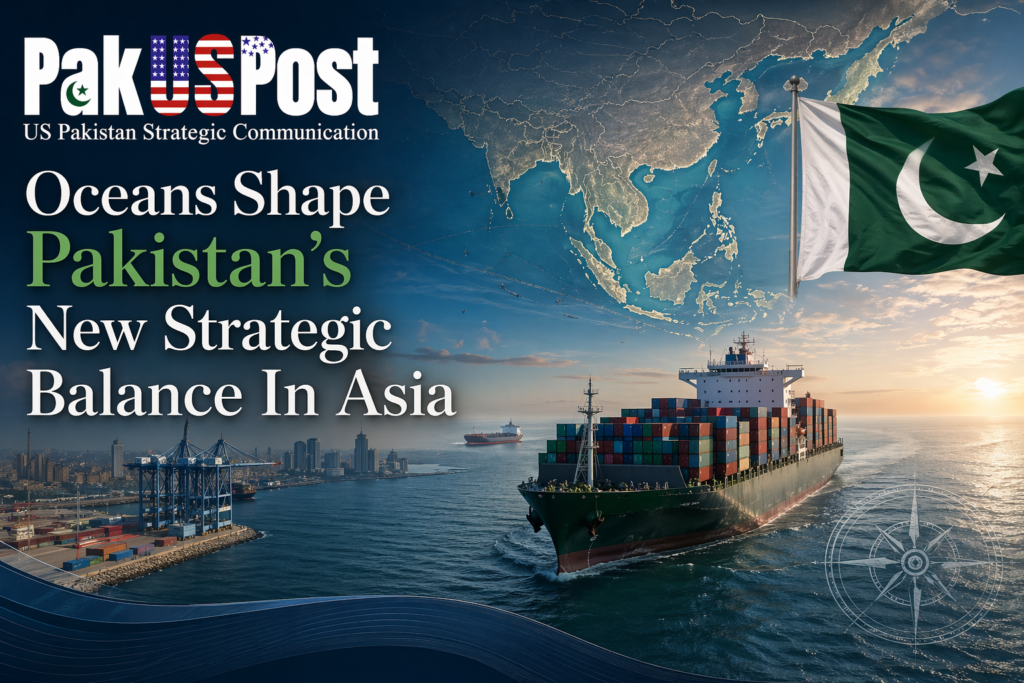
In maritime terms, Pakistan has historically underinvested relative to the strategic significance of its coastline. That is increasingly untenable. The Arabian Sea connects Pakistan to energy imports, trade flows and strategic partnerships. A stronger navy need not chase prestige fleets. It should prioritise sea denial, coastal surveillance, anti submarine awareness, unmanned systems, mine countermeasures and protection of commercial traffic. Partnerships with friendly navies can enhance training and interoperability without sacrificing autonomy. Maritime diplomacy should become routine rather than episodic.
Gwadar deserves special attention. Too often it is discussed in extremes, either as a miraculous future metropolis or as a failed symbol. Serious strategy requires neither romance nor cynicism. Gwadar’s realistic value lies in phased functionality. It can become an energy storage and transshipment point, a fisheries and processing hub, a maintenance node, a logistics option for western China and a platform for commercial diversification. But ports compete. They do not succeed by proclamation. Customs efficiency, hinterland connectivity, municipal services and investor protections matter more than slogans. Pakistan should treat Gwadar as a commercial discipline project as much as a geopolitical asset.
On land, Pakistan must manage the western frontier with sober realism. Afghanistan’s internal fragility, militant spillovers and humanitarian stress can drain resources and attention. Strategic recalibration therefore requires frontier modernisation. Border management, trade formalisation, intelligence coordination and selective engagement with Afghan stakeholders are essential. Endless instability on the western flank weakens Pakistan’s capacity to respond elsewhere.
Technology policy is now security policy. India’s scale advantage in digital markets and manufacturing ecosystems will be difficult to replicate quickly. Pakistan should instead focus on niches where strategic returns are possible. Secure telecoms, fintech regulation, agricultural technology, cyber defence services, drone manufacturing and targeted semiconductor assembly chains offer more realistic pathways than grandiose imitation. Human capital becomes central here. Without education reform, vocational depth and research incentives, strategic autonomy will remain rhetorical.
Relations with the United States should also be reconsidered without nostalgia or grievance. Washington’s priorities have changed. Pakistan is no longer a frontline theatre in the same sense as during the war on terror. Yet the relationship still holds value in trade, finance, higher education, health cooperation, climate resilience and selective security dialogue. Pakistan should pursue a mature agenda based on practical interests rather than emotional cycles of disappointment. It need not choose between Washington and Beijing if it can articulate differentiated partnerships with each. Many middle powers already do so.
Domestic political stability is the hidden variable in all grand strategy. Investors read institutional coherence. Allies read continuity. Adversaries read division. Pakistan’s recurring turbulence imposes strategic costs that are often underestimated because they accumulate gradually. Delayed reforms, inconsistent taxation, contested mandates and polarised politics reduce the state’s ability to sustain long term plans. National security debates often focus on external threats while underweighting internal governance. Yet no doctrine can compensate indefinitely for economic fragility and institutional drift.
Media narratives matter more than many officials admit. Pakistan’s discourse often oscillates between triumphalism and victimhood. Every foreign visit becomes a breakthrough. Every external pressure becomes a conspiracy. Such framing obscures the harder truth that states rise through competence. Strategic communication should become more disciplined, evidence based and future oriented. Citizens can handle realism. Markets reward seriousness. Partners prefer predictability.
For readers in the United States, Pakistan should be understood not as a problem to be managed but as a consequential middle power at the junction of South Asia, the Gulf and western China. It possesses nuclear capability, a large population, a strategic coastline and influence over critical transit spaces. Neglecting Pakistan does not remove it from the map. Nor does viewing it only through crisis episodes. A steadier relationship centred on trade access, energy transition, climate adaptation and regional de escalation would better serve American interests than episodic securitised engagement.
For Pakistan, the central strategic insight is simple. Geography remains an advantage only when converted into institutions. Sitting between regions is not enough. States must move goods, secure seas, train workers, enforce contracts and manage risks. The coming decade will reward countries that fuse security planning with economic competitiveness. Those that separate them will struggle.
The old deterrence arc of Pakistan ran from mountains to missile ranges. The new deterrence arc stretches from data centres to deep water ports, from currency stability to coastal radar, from export credibility to crisis signalling. Nuclear weapons may still prevent invasion, but they cannot generate growth, attract capital or protect supply chains. Strategic doctrine must therefore expand from preventing defeat to enabling relevance.
Pakistan does not lack options. It has relations with China, access to Gulf markets, a working if uneven channel with the United States, a young population and a location others cannot replicate. What it lacks is sustained conversion of potential into capacity. That gap is the real national security challenge.
If Islamabad embraces maritime seriousness, economic discipline, technological pragmatism and diplomatic balance, it can navigate the harsher currents of Asian competition with greater confidence. If it clings to older templates, it may preserve symbols of power while losing the substance of influence. In the twenty first century, oceans, networks and institutions will shape strategic balance as much as armies ever did. Pakistan still has time to adapt, but adaptation delayed often becomes leverage surrendered.
A Public Service Message