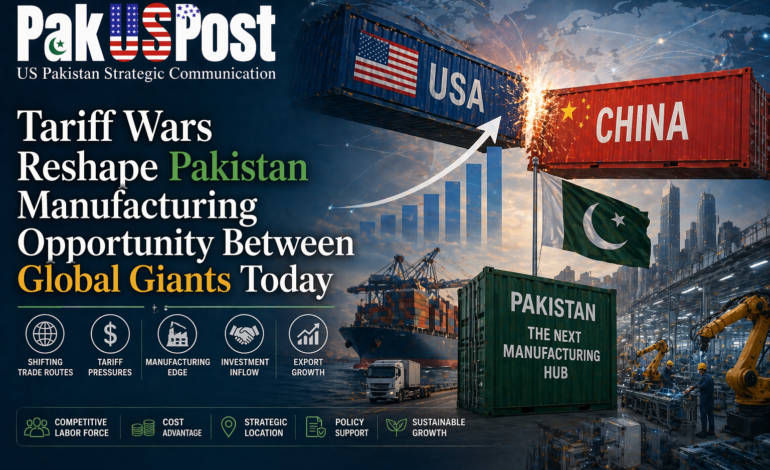
Tariff Wars Reshape Pakistan Manufacturing Opportunity Between Global Giants Today


The global trading system is again entering a phase of strategic fragmentation, where tariffs are no longer merely instruments of commercial policy but tools of geopolitical engineering. The renewed tensions between the United States and China are not isolated episodes of economic disagreement; they represent a structural recalibration of how industrial power, technological sovereignty and supply chain resilience are being redistributed across regions. In this shifting landscape, Pakistan finds itself neither at the centre of the rivalry nor entirely outside it, but rather in a liminal space where opportunity and inertia coexist in uncomfortable proximity.
At first glance, tariff wars appear to be distant phenomena for Pakistan, more relevant to Washington, Beijing or Brussels than to Islamabad. Yet this perception is increasingly misleading. As multinational firms reassess their exposure to concentrated manufacturing bases, particularly in China, they are gradually developing multi hub production strategies. These strategies are not driven by ideology but by risk management. The logic is simple. Concentration of supply chains in a single geopolitical sphere creates vulnerability, and tariffs are only one expression of that vulnerability. Sanctions risk, shipping disruption, energy volatility and political uncertainty all feed into the same recalibration. Within this global restructuring, secondary manufacturing destinations gain incremental relevance.
Pakistan’s structural position in this evolving map is complex. On the one hand, it possesses a large labour force, geographical proximity to major Asian production networks, and established experience in textiles, surgical instruments, sports goods and agricultural processing. On the other hand, it suffers from persistent macroeconomic instability, energy inefficiencies, regulatory unpredictability and a weak export diversification base. The tension between these two realities defines its current industrial identity. It is a country frequently discussed in investment briefings but rarely selected in final allocation decisions.
The tariff escalation between the United States and China over the past several years has already produced visible supply chain shifts. Vietnam has expanded its electronics and garment exports significantly. Bangladesh has consolidated its position in ready made garments. Mexico has benefited from nearshoring dynamics linked to North American supply chains. Even countries such as Indonesia and Malaysia have leveraged industrial policy coherence to attract components manufacturing. Pakistan, by contrast, has largely remained at the periphery of this reallocation process. The question is not whether Pakistan is excluded by design, but whether it has failed to convert structural opportunity into institutional readiness.
A recurring argument in Pakistan’s policy discourse is that geography alone should guarantee economic advantage. The country sits at the intersection of South Asia, Central Asia and the Middle East, with maritime access to global shipping lanes. Yet geography without execution rarely translates into competitiveness. Modern manufacturing relocation decisions are driven less by maps and more by ecosystems. These ecosystems include customs efficiency, logistics predictability, contract enforcement, infrastructure reliability, workforce skills and policy continuity. In these domains Pakistan’s performance remains uneven and often fragmented.
The idea that tariff wars automatically benefit peripheral economies is also overly simplistic. In reality, global firms do not merely relocate; they reoptimize. They shift to jurisdictions where cost advantages are reinforced by institutional stability. Low wages alone are insufficient if offset by energy shortages or administrative delays. Similarly, trade preferences are limited in impact if exporters cannot meet quality certification standards or maintain delivery timelines. Pakistan’s challenge is therefore not to identify opportunity but to qualify for it.
The Special Economic Zones associated with the China Pakistan Economic Corridor were initially presented as instruments for industrial transformation. In practice, their progress has been slower than anticipated. Infrastructure development has advanced more visibly than industrial clustering. The gap between physical construction and productive utilisation reflects a broader pattern in Pakistan’s economic development, where projects are often completed but ecosystems remain incomplete. Without integrated supply chains, skilled labour pipelines and export linkages, industrial zones risk becoming isolated enclaves rather than dynamic production hubs.
Energy remains a central constraint. Manufacturing relocation decisions are highly sensitive to energy reliability and cost predictability. Pakistan’s energy mix continues to face structural inefficiencies, circular debt pressures and transmission losses. Even when electricity is available, its cost volatility undermines long term planning for export oriented industries. In contrast, competing economies have increasingly invested in renewable integration, industrial tariff rationalisation and grid stabilisation to support manufacturing competitiveness.
Currency instability adds another layer of uncertainty. Exporters require predictable exchange rate environments to plan pricing strategies and contract negotiations. Frequent currency adjustments, often driven by external financing cycles, create uncertainty that discourages long term investment. While devaluation can temporarily enhance export competitiveness, it does not substitute for productivity growth. Without productivity gains, currency adjustments merely redistribute instability across sectors.
Labour dynamics present both opportunity and constraint. Pakistan’s demographic profile suggests a large and relatively young workforce, yet skill mismatches remain significant. Modern manufacturing increasingly demands technical proficiency, digital literacy and compliance awareness. Traditional vocational systems have not fully adapted to these requirements. Countries that successfully integrated into global value chains invested heavily in technical education aligned with industry needs. Pakistan’s vocational ecosystem remains underdeveloped relative to its labour potential.
Logistics infrastructure further shapes competitiveness. Efficient ports, predictable customs procedures and integrated transport networks are essential for export oriented manufacturing. While Pakistan has made investments in port infrastructure, inland logistics and customs digitisation still lag behind regional benchmarks. Delays in clearance, inconsistent documentation processes and fragmented regulatory oversight increase transaction costs for exporters. In global supply chains, even small inefficiencies accumulate into significant competitive disadvantages.
Media narratives surrounding tariff wars in Pakistan tend to oscillate between optimism and detachment. At times, the discourse portrays global trade tensions as opportunities waiting to be harvested. At other times, they are treated as distant geopolitical theatre with limited domestic relevance. Both interpretations miss the structural point. Tariff wars are not episodic events but symptoms of a deeper reconfiguration of global capitalism. They reshape investment flows, redefine risk geography and redistribute industrial capacity. For Pakistan, the challenge is not commentary but calibration.
The Chinese role in Pakistan’s industrial landscape adds another layer of complexity. Chinese firms are themselves part of the global relocation process, particularly in labour intensive manufacturing segments. However, their relocation decisions are often influenced by supply chain integration within broader Chinese led networks. This means that Pakistan’s integration into Chinese industrial ecosystems does not automatically translate into diversification away from China centric production. Instead, it may reinforce dependency unless accompanied by broader export market diversification.
Western firms, meanwhile, evaluate Pakistan through a risk weighted lens. Security perceptions, regulatory predictability and contract enforcement influence investment decisions as much as labour cost considerations. Even where sectoral interest exists, execution risk often delays final commitments. The perception gap between potential and predictability remains one of Pakistan’s most persistent economic challenges.
Agricultural processing presents a relatively underutilised opportunity within the broader manufacturing narrative. Agritech related value addition, including packaging, cold chain logistics and food processing, could allow Pakistan to move beyond raw commodity exports. However, this requires integration between rural production systems and industrial supply chains. Without such integration, agricultural surplus remains structurally under monetised.
Textiles remain Pakistan’s dominant export sector, yet even here competitiveness is increasingly conditional. Global buyers are shifting toward sustainability compliance, traceability standards and environmental certification. These requirements are becoming non negotiable entry conditions rather than optional upgrades. Countries that fail to align with these standards risk gradual exclusion from premium supply chains.
The broader geopolitical environment reinforces the urgency of adaptation. Supply chain nationalism is replacing pure globalisation. States are increasingly concerned not only with efficiency but with resilience. This dual objective creates space for diversified production hubs but also raises entry barriers. Only countries that can offer both cost competitiveness and institutional reliability will benefit from redistribution effects.
Pakistan’s policy response has historically been reactive rather than anticipatory. Industrial policy has often been fragmented across ministries, with limited long term coherence. Investment promotion efforts frequently focus on attracting capital rather than retaining it. Sustained industrial transformation requires continuity, not episodic incentives.
Taxation remains another structural constraint. A narrow tax base places disproportionate burden on formal sectors, particularly manufacturing. Informalisation undermines competitiveness by distorting cost structures and discouraging formal investment. Countries that successfully integrated into global value chains expanded their tax base in parallel with industrialisation, creating fiscal space for infrastructure and skills development.
The financial sector also plays a critical role in industrial competitiveness. Access to long term credit, export financing and risk mitigation instruments determines whether firms can scale production. In Pakistan, short term liquidity constraints often dominate financial planning, limiting the ability of firms to invest in capacity expansion or technological upgrading.
Environmental considerations are increasingly shaping global manufacturing decisions. Carbon intensity, water usage and sustainability compliance are becoming part of procurement criteria. Pakistan’s industrial base must therefore adapt not only to cost pressures but also to environmental constraints. Failure to do so risks exclusion from future oriented supply chains.
Despite these challenges, the structural opportunity remains real. The fragmentation of global manufacturing is not temporary. It is part of a longer transition toward multipolar production networks. Countries that position themselves strategically during this transition can secure durable gains. Those that delay risk marginalisation.
For Pakistan, the central question is not whether tariff wars create opportunity, but whether domestic systems can convert external volatility into internal capability. Manufacturing relocation is not a gift offered by global disruption. It is a competitive outcome earned through institutional readiness.
The next phase of global trade will reward adaptability over scale, reliability over rhetoric, and ecosystem depth over isolated incentives. Pakistan stands at a critical juncture where it can either remain a marginal participant in global value chains or attempt a structured entry into mid tier manufacturing networks. The outcome will depend less on external conditions and more on internal coherence. Tariff wars may open the door, but only domestic reform can ensure that Pakistan is able to walk through it and remain inside.
A Public Service Message