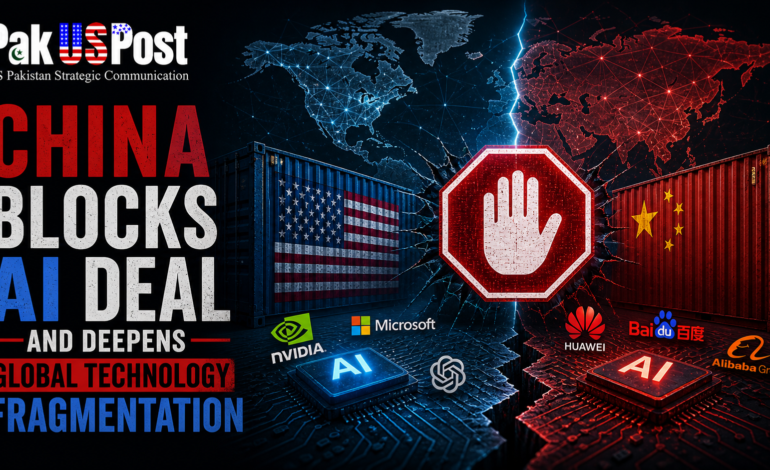
China Blocks AI Deal and Deepens Global Technology Fragmentation

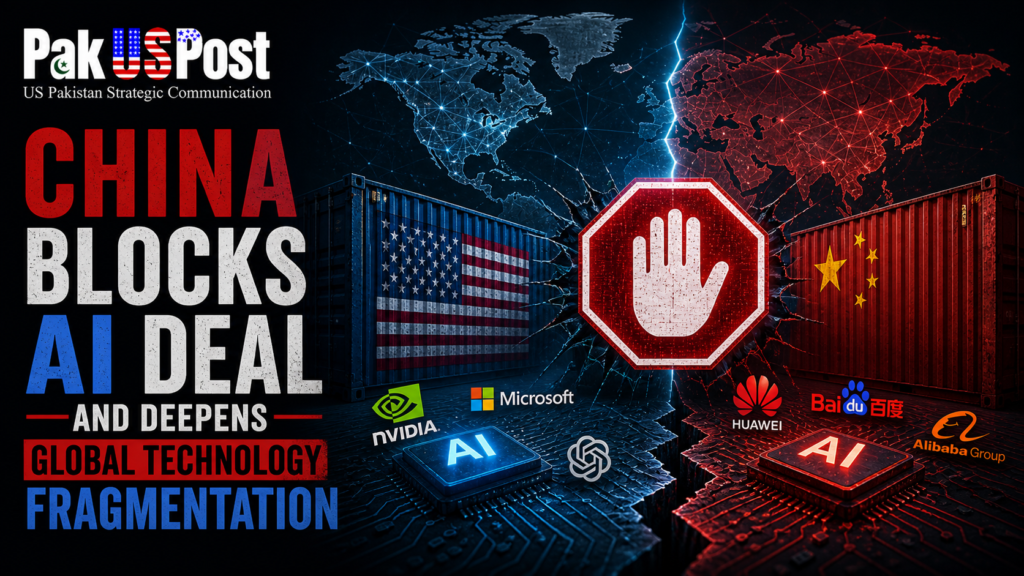
The decision by China to block a major artificial intelligence acquisition involving Meta Platforms reflects a firm consolidation of technological sovereignty as a central pillar of state power. This move is not an isolated regulatory action but part of a wider strategic shift in which control over data, algorithms, and digital infrastructure is treated as a matter of national security and long term geopolitical positioning.
The intervention signals a clear intention to prevent external control over sensitive technological capabilities. Artificial intelligence is no longer viewed as a purely commercial domain; it is now directly linked to economic competitiveness, military capability, and governance capacity. By restricting foreign acquisition of domestic AI assets, China is reinforcing internal control over innovation pathways and ensuring that core technologies remain embedded within national institutional structures.
This policy reflects intensifying global competition in advanced technology sectors. Artificial intelligence, semiconductor development, cloud infrastructure, and data governance have become central arenas of strategic rivalry between major powers. The blocking of cross border acquisitions is one mechanism through which technological ecosystems are being separated into distinct spheres of influence. Instead of open integration, the global system is moving toward selective access, where participation is shaped by political alignment and security considerations.
The result is a gradual fragmentation of the global technology landscape. Previously interconnected supply chains and innovation networks are increasingly being reorganised into parallel systems. Each system is defined by its own regulatory frameworks, standards, and institutional controls. This reduces interdependence while increasing duplication of effort, as states and firms invest in building independent capabilities rather than relying on shared global infrastructure.
At the centre of this transformation is the concept of technological sovereignty. This principle asserts that control over digital infrastructure, data flows, and advanced computation is essential to state security. In practice, it leads to tighter regulation of foreign investment, increased scrutiny of cross border mergers, and stronger state involvement in guiding innovation. China’s decision is consistent with this broader pattern, in which strategic technologies are increasingly insulated from external influence.
The implications for global innovation are significant. On one hand, fragmentation may slow the diffusion of technology across borders, reducing efficiency and increasing costs. On the other hand, it may accelerate domestic innovation within competing systems, as states prioritise self reliance and internal capability building. This creates a more competitive but less integrated global environment, where technological advancement occurs within parallel ecosystems rather than a unified global market.
For the United States and its allies, this development reinforces existing concerns about technological security and supply chain dependence. In response, policies such as export controls, investment screening, and domestic industrial subsidies have become more prominent. These measures are designed to protect critical technologies and reduce vulnerability to external restrictions. The result is a reciprocal process in which both sides impose constraints on technological exchange, further deepening systemic separation.
For middle powers and developing states, including Pakistan, this fragmentation introduces structural complexity. Access to advanced technology may increasingly depend on alignment with specific ecosystems rather than participation in a single global market. States must therefore navigate multiple technological spheres, balancing access, dependency, and strategic autonomy. This requires institutional capacity in regulation, cybersecurity, and digital governance, as well as diplomatic flexibility in managing competing partnerships.
The policy challenge becomes one of managing dual exposure. Engagement with multiple technological systems can provide opportunities for diversification and leverage, but it also increases the risk of regulatory conflict and compatibility constraints. Decisions regarding digital infrastructure, cloud services, and artificial intelligence adoption will increasingly carry geopolitical implications, rather than being purely technical or economic choices.
Over time, the global system is likely to evolve toward a multipolar technology order. In such a structure, no single set of standards or platforms will dominate universally. Instead, multiple competing frameworks will coexist, each supported by different states and alliances. This will reshape global trade, innovation flows, and industrial development, as companies and governments adapt to fragmented but interlinked systems.
China’s decision to block the AI acquisition therefore represents a broader structural signal. It indicates that technological globalisation is being replaced by a model of controlled interdependence, where cooperation exists but is increasingly conditional and regulated. The emphasis is shifting from openness to security, from integration to managed separation, and from global efficiency to strategic resilience.
In conclusion, the blocking of the artificial intelligence acquisition illustrates the consolidation of technological sovereignty as a defining feature of contemporary geopolitics. It accelerates the fragmentation of global innovation systems, reshapes the structure of technological competition, and creates new strategic challenges for states navigating this evolving environment. For Pakistan United States policy analysis, it highlights the necessity of adapting to a divided technological order in which access, alignment, and autonomy are increasingly interconnected determinants of national capability and strategic positioning.
A Public Service Message