Sanctity, Science, and Sovereignty in a Fragmented World

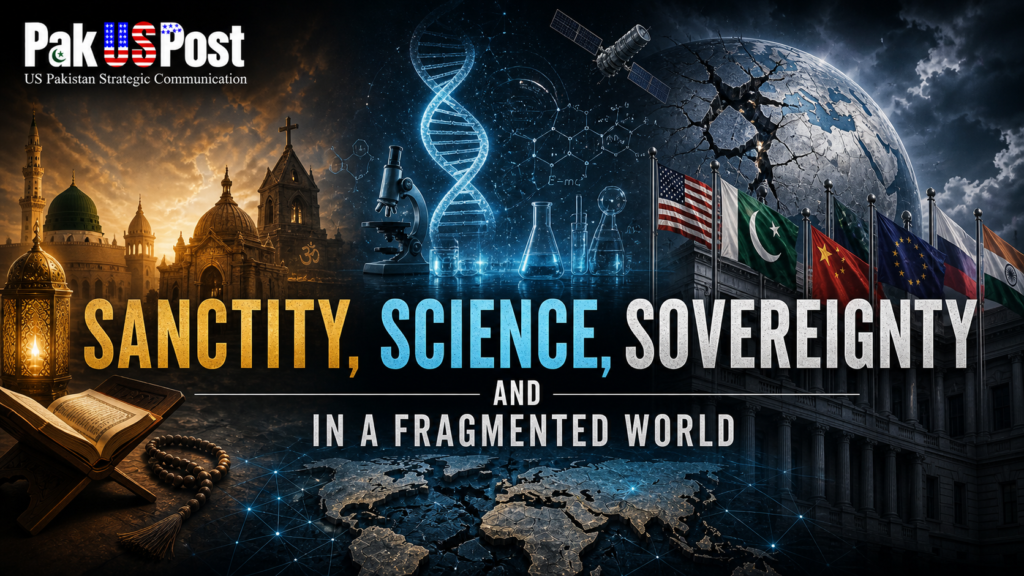
In the contemporary epoch, the question of what constitutes the “natural” has ceased to be a stable ontological category and has instead become a contested epistemic terrain where biology, governance, and technological intervention co-produce new regimes of truth. The emergence of biotechnology as a decisive force in shaping life itself, coupled with the expanding authority of public health infrastructures and the intensification of geopolitical competition over biological resources, has fundamentally destabilized older moral distinctions between the given and the made, the sacred and the engineered, the governed and the self-governing. What was once understood as the sanctity of the natural order is now increasingly refracted through the lens of optimization, intervention, and control.
To speak of sanctity in such a context is no longer to invoke a transcendent moral order untouched by human manipulation, but rather to confront a paradox: sanctity itself has been absorbed into the technological imagination. The body, once perceived as a boundary of inviolable dignity, is now a site of continuous recalibration through genomic editing, pharmaceutical enhancement, and predictive epidemiological modelling. In this transformation, science does not merely describe life; it actively reconstitutes its conditions of possibility. Yet this reconstitution is never neutral. It is embedded within structures of sovereignty that determine whose bodies are optimized, whose vulnerabilities are managed, and whose biological futures are rendered expendable or valuable.
The global governance of health, particularly through institutions such as the World Health Organization, reflects an unprecedented attempt to harmonize biological risk across disparate political orders. However, this harmonization is not merely administrative; it is ontological. It presumes that life itself can be rendered legible through standardized metrics of immunity, infection, and resilience. In doing so, it abstracts the living subject into a calculable entity, a data point within a planetary health architecture. The moral consequence of this abstraction is profound: it redefines the human not as a bearer of inherent sanctity, but as a node in a global system of biosecurity.
Yet sovereignty resists this flattening. States continue to assert control over biological borders, vaccine distribution, genomic data, and health surveillance systems. The result is a fragmented global order in which biological life is simultaneously universalized and territorialized. On one hand, viruses, pandemics, and genetic information disregard borders; on the other, responses to them are deeply inscribed within national strategies of control and geopolitical assertion. This tension produces what may be called a biopolitical paradox: the more universal life becomes in its biological vulnerability, the more fragmented it becomes in its political governance.
Biotechnology intensifies this paradox by dissolving the distinction between intervention and creation. Gene editing technologies such as CRISPR have rendered the genome no longer a fixed text to be read but a malleable script to be rewritten. In this sense, life is no longer merely treated; it is authored. The ethical question, then, is no longer confined to whether such interventions are permissible, but whether the category of “natural life” retains any normative force at all. If disease can be pre-emptively removed from the genetic code, and if enhancement becomes indistinguishable from therapy, then the boundary between healing and redesign collapses into a continuum of biotechnological choice.
Public health, traditionally grounded in the collective management of disease, now operates at the intersection of surveillance and prediction. Epidemiological systems increasingly rely on real-time data aggregation, artificial intelligence, and behavioural modelling to anticipate biological threats before they manifest. This shift from reactive care to anticipatory governance marks a profound transformation in the moral logic of health. The subject is no longer simply ill or healthy, but probabilistically at risk. Risk itself becomes the primary object of governance, and with it emerges a new ethical regime in which potentiality is treated as actuality.
In this regime, the sovereign power of the state is no longer exercised solely through law or force, but through the modulation of biological probabilities. Vaccination campaigns, quarantine protocols, travel restrictions, and genomic surveillance constitute a dispersed apparatus of control that operates not by prohibiting life, but by organizing its conditions of circulation. The result is a form of governance that is both intimate and expansive: it penetrates the cellular level of existence while simultaneously extending across planetary networks of information and mobility.
This dual movement toward molecular precision and global integration—produces a crisis in moral language. Traditional ethical categories such as dignity, autonomy, and sanctity struggle to accommodate a world in which life is continuously engineered, monitored, and optimized. The question is not merely whether biotechnology is good or bad, but whether our inherited moral vocabulary is adequate to describe a condition in which life itself has become an object of design.
The fragmentation of moral boundaries is further complicated by geopolitical competition over biotechnological supremacy. Nations now invest heavily in genetic research, vaccine development, and bioinformatics not only as instruments of public health, but as strategic assets in global power struggles. Biological innovation becomes a form of sovereignty projection, a means of securing influence in a world where biological crises can reshape economic and political hierarchies overnight. The COVID-19 pandemic revealed this dynamic with stark clarity: vaccine distribution became an arena of diplomatic leverage, intellectual property a site of contestation, and public health a language of geopolitical negotiation.
In such a context, sanctity is no longer located outside the domain of power; it is produced within it. What is deemed worth protecting, enhancing, or preserving is determined through a complex interplay of scientific authority and political interest. The moral status of life becomes stratified, differentiated by access to technology, institutional capacity, and geopolitical positioning. Thus, the fragmentation of the world is not merely spatial but ethical: different forms of life are assigned different degrees of visibility, protection, and value.
Yet it would be a mistake to interpret this transformation solely as a narrative of loss. The expansion of biotechnological capability also opens new possibilities for alleviating suffering, extending life, and addressing historically entrenched health inequities. Genetic therapies offer hope for previously incurable diseases; digital health infrastructures enable broader access to medical care; global surveillance systems can detect and contain outbreaks with unprecedented speed. The ethical tension, therefore, lies not in rejecting these developments, but in understanding the conditions under which they are deployed.
The central philosophical question becomes: who defines the horizon of the “improvable” human? And on what grounds is such definition justified? If enhancement is guided primarily by market logic or geopolitical advantage, then the moral architecture of biotechnology risks reproducing existing inequalities in more sophisticated forms. Conversely, if guided by a genuinely universal commitment to human flourishing, it may serve as a vehicle for expanding the very meaning of dignity.
To navigate this tension requires rethinking sovereignty itself. Traditional notions of sovereignty presuppose a bounded political subject exercising control over a defined territory. Yet in the age of biotechnology, sovereignty becomes increasingly distributed across networks of expertise, data infrastructures, and transnational institutions. Biological governance cannot be confined within national borders, nor can it be fully centralized. It exists instead as a layered assemblage of authority, negotiation, and contestation.
This distributed sovereignty raises a deeper philosophical question about the locus of moral responsibility. If decisions about life and health are made through interconnected systems involving scientists, policymakers, corporations, and international organizations, then accountability becomes diffused. The ethical subject is no longer an isolated decision-maker but a node within a complex system of co-determination. In such a system, the very idea of moral agency must be reconsidered.
At the same time, the human body remains the irreducible site where these abstractions are ultimately realized. Despite all technological mediation, suffering, illness, and mortality continue to assert the material limits of control. The body resists full incorporation into systems of optimization. It remains unpredictable, fragile, and irreducibly singular. In this sense, sanctity reappears not as metaphysical abstraction, but as embodied vulnerability.
It is precisely this vulnerability that challenges the logic of total governance. No system of biotechnology, no regime of public health, and no geopolitical structure can fully eliminate uncertainty from biological life. The aspiration toward complete control thus encounters its own ontological limit. Life exceeds its own engineering.
The contemporary world, therefore, is not simply one of scientific domination over nature, but of continuous negotiation between control and excess, design and emergence, governance and contingency. Within this negotiation, sanctity is neither abolished nor preserved in its traditional form; it is reconfigured as a recognition of limits within the very project of mastery.
To think philosophically about biotechnology, public health, and sovereignty is to confront the instability of categories that once appeared fixed. Nature is no longer purely given; it is co-produced. Science is no longer merely descriptive; it is constitutive. Sovereignty is no longer singular; it is fragmented and distributed. In this transformed landscape, moral reasoning must become equally adaptive, capable of engaging with systems that operate across scales from the molecular to the planetary.
The future of global order will not be determined solely by technological capability, but by the ethical frameworks through which that capability is interpreted and governed. Whether biotechnology becomes an instrument of emancipation or stratification, whether public health becomes a medium of solidarity or surveillance, and whether sovereignty becomes a mechanism of protection or exclusion, will depend on how societies negotiate the fragile boundary between sanctity and control.
Ultimately, the fragmentation of the world is not merely a geopolitical condition but a metaphysical one. It reflects the breakdown of a unified conception of nature and its replacement with a plural, contested, and engineered reality. In this reality, the question is no longer what is natural, but what kinds of naturalness we are willing to produce, preserve, or refuse. And within that question lies the enduring task of philosophy: to illuminate the ethical stakes of worlds we are continuously making, even as we struggle to understand their consequences.
A Public Service Message