Narratives of Electoral Violence and Global Framing Intervention Politics Dynamics

Electoral violence in contemporary political systems is no longer merely a physical manifestation of contestation over power. It has increasingly become a mediated construct, filtered through institutional reporting practices, algorithmically curated information flows, and geopolitical interpretive frameworks that determine how such events are understood, prioritized, and acted upon at the international level. Within this evolving communicative ecology, violence associated with elections is not simply observed; it is narrated, categorized, and strategically positioned within broader global discourses on democracy, stability, and legitimacy. The consequence is that electoral violence acquires a dual existence: one grounded in local political realities and another constructed through transnational media systems that assign meaning far beyond the immediate geographic and political context.
In this sense, the framing of electoral violence is not a secondary interpretive layer but a constitutive force in shaping global political response. Media institutions, particularly those operating within global North information economies, play a decisive role in determining whether electoral violence is perceived as episodic disorder, systemic democratic failure, or evidence of deeper state fragility. These framings are rarely neutral. They are embedded within historically produced epistemologies that tend to privilege certain political systems as normative benchmarks while positioning others as sites of deviation or instability. As a result, electoral violence in parts of the Global South is frequently interpreted not as a discrete political phenomenon but as symptomatic of broader governance incapacity.
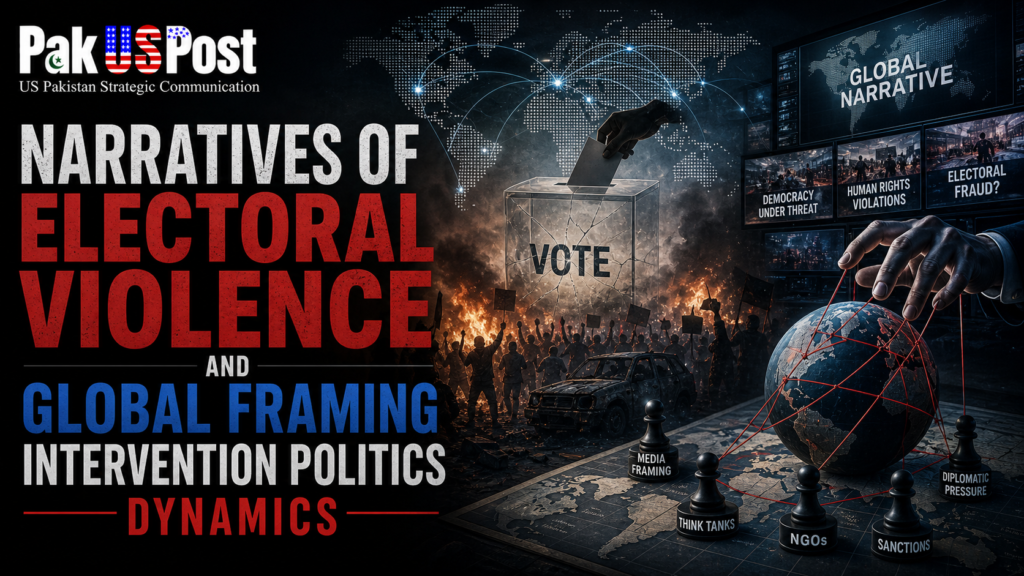
The framing process operates through several interconnected mechanisms. First, there is selective event visibility, whereby certain incidents of electoral violence are amplified while others are minimized or excluded entirely from global news cycles. Second, there is narrative labeling, in which complex political conflicts are reduced to simplified categories such as unrest, chaos, or democratic breakdown. Third, there is attributional framing, which assigns responsibility either to state institutions, opposition actors, or generalized societal conditions, often without deep contextualization of historical grievances, institutional evolution, or external influences. Together, these mechanisms produce a structured interpretive environment in which audiences receive not merely information but a preconfigured understanding of political reality.
In the case of Pakistan, as well as other politically dynamic states in South Asia, electoral violence is frequently embedded within a broader narrative of institutional fragility and recurring instability. While incidents of electoral contestation and localized violence are real and empirically observable, their global representation often lacks proportional contextual grounding. The result is a persistent tension between lived political complexity and externally constructed narrative simplification. Within Pakistan–US informational and diplomatic exchanges, this tension becomes particularly significant, as media framing can indirectly influence policy perception, aid conditionality discussions, and diplomatic engagement priorities.
The concept of intervention hierarchies becomes critical in this context. International responses to electoral violence are rarely uniform or automatic; they are structured through layered thresholds of concern that are deeply influenced by how events are framed in global discourse. When electoral violence is framed as evidence of systemic democratic breakdown, it tends to trigger heightened international attention, including election monitoring missions, diplomatic statements, and governance reform recommendations. Conversely, when similar levels of violence are framed as internal political contestation or localized disruption, the likelihood of sustained international engagement diminishes significantly. This creates an uneven global governance architecture in which perception mediates response more than empirical equivalence of events.
Such asymmetry is further reinforced by the political economy of global media systems. News organizations operating within competitive attention markets prioritize narratives that align with established geopolitical expectations or resonate with audience familiarity. Consequently, electoral violence in politically prominent states often receives rapid and sustained coverage, while similar or even more severe incidents in less geopolitically central regions may receive episodic attention. This imbalance does not merely reflect editorial priorities; it actively constructs hierarchies of political significance in which some democratic processes are continuously scrutinized while others remain intermittently visible.
Digital platforms have intensified this dynamic by introducing algorithmic amplification mechanisms that privilege emotionally charged, conflict-oriented content. Electoral violence, by its nature, is highly compatible with such engagement-driven systems. However, algorithmic distribution does not inherently contextualize or verify political complexity. Instead, it accelerates the circulation of simplified narratives that can quickly become dominant interpretive frames. In this environment, initial framing by legacy media or influential digital actors can have disproportionate long-term effects on how electoral events are globally understood.
The implications for international intervention logic are substantial. Policy actors, including diplomatic institutions and multilateral organizations, increasingly operate within informational environments shaped by these mediated narratives. While formal policy decisions are based on a combination of intelligence, field assessments, and strategic interests, public justification and political feasibility are heavily influenced by media-defined perceptions. Thus, framing becomes an indirect but powerful determinant of intervention thresholds, shaping when and how external actors choose to engage with electoral violence in sovereign states.
From a Pakistan–US analytical perspective, this raises important questions about informational asymmetry and narrative sovereignty. Pakistan, as a politically significant but often externally interpreted state, exists within a global media environment where its electoral processes are frequently narrated through external lenses. This does not imply absence of domestic challenges, but rather highlights the disproportionate influence of external framing in defining those challenges for global audiences. The United States, as both a major media producer and policy actor, participates in this narrative construction through its journalistic ecosystem, think tank discourse, and diplomatic communication practices. The interaction between these narrative systems influences bilateral perception even when official diplomatic language remains carefully calibrated.
A critical dimension of this phenomenon is the moral economy of democracy promotion. Electoral violence framed as undermining democratic legitimacy often becomes a justification for external advisory interventions or governance reform agendas. However, such interventions are not evenly distributed across geopolitical contexts. Instead, they are selectively activated based on strategic interest alignment and narrative salience. This creates a situation in which similar political phenomena are subject to different levels of international scrutiny depending on their framing within global discourse networks.
Furthermore, the securitization of electoral violence in media narratives often leads to its interpretation through security-centric policy frameworks. This shifts analytical focus away from structural political economy factors such as inequality, institutional development, and historical conflict trajectories, and toward immediate stabilization and control measures. While such approaches may address short-term disruption, they risk overlooking underlying causal dynamics that generate recurring cycles of electoral contestation and violence. In policy terms, this produces an intervention logic oriented toward symptoms rather than structural transformation.
At the domestic level, the feedback effects of global framing are equally significant. Political actors within states often adapt their strategies in anticipation of international perception. Electoral violence may therefore be both a local political tactic and a globally mediated performance, where actors are aware that their actions will be interpreted through external lenses that may influence diplomatic or economic consequences. This creates a recursive relationship between local political behavior and global narrative structures, further complicating efforts to separate empirical reality from mediated representation.
In the contemporary media environment, where real-time reporting intersects with historical narrative accumulation, electoral violence becomes part of a longer discursive chain. Past representations influence present interpretations, and present framing reshapes future expectations. Over time, this produces a sedimented narrative structure in which certain countries or regions become persistently associated with instability, regardless of evolving political conditions. Breaking or revising such narrative sedimentation requires sustained counter-framing efforts, institutional credibility, and consistent empirical engagement.
From a policy standpoint, particularly within Pakistan–US relations, there is a growing need to recognize the epistemic dimension of electoral violence. This involves acknowledging that how events are described is not separate from how they are governed. It also requires a more reflexive approach to international reporting and diplomatic communication, one that distinguishes between immediate event reporting and longer-term structural analysis. Without such differentiation, there is a risk that policy responses will remain reactive to narrative cycles rather than grounded in comprehensive political understanding.
Ultimately, the study of electoral violence framing reveals a broader transformation in global political communication. Power is no longer exercised solely through material or institutional means but also through the ability to define interpretive frameworks within which political events are understood. In this sense, narrative construction becomes a form of geopolitical influence, shaping not only perceptions but also the architecture of intervention, engagement, and legitimacy.
The challenge for contemporary policy and media systems is therefore not simply to report electoral violence more accurately, but to develop interpretive frameworks that resist oversimplification, acknowledge contextual complexity, and reduce the gap between local political realities and global narrative constructions. Without such recalibration, the risk remains that electoral violence will continue to function less as an empirical category and more as a flexible geopolitical signifier, deployed unevenly across the international system to justify varying levels of attention, concern, and intervention.
A Public Service Message