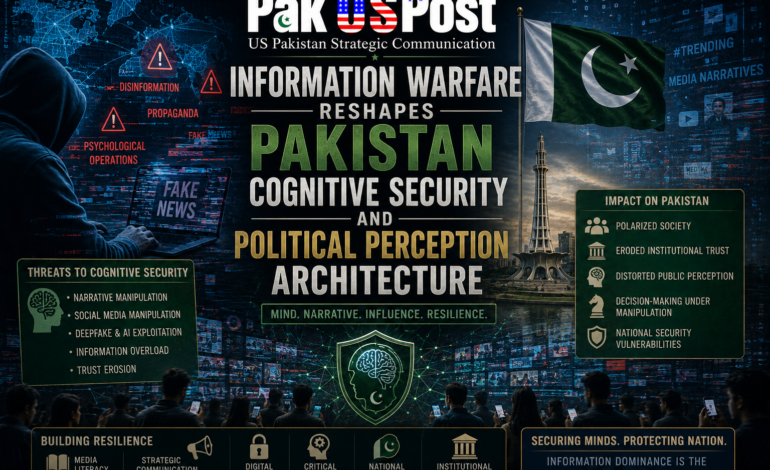
Information Warfare Reshapes Pakistan Cognitive Security and Political Perception Architecture

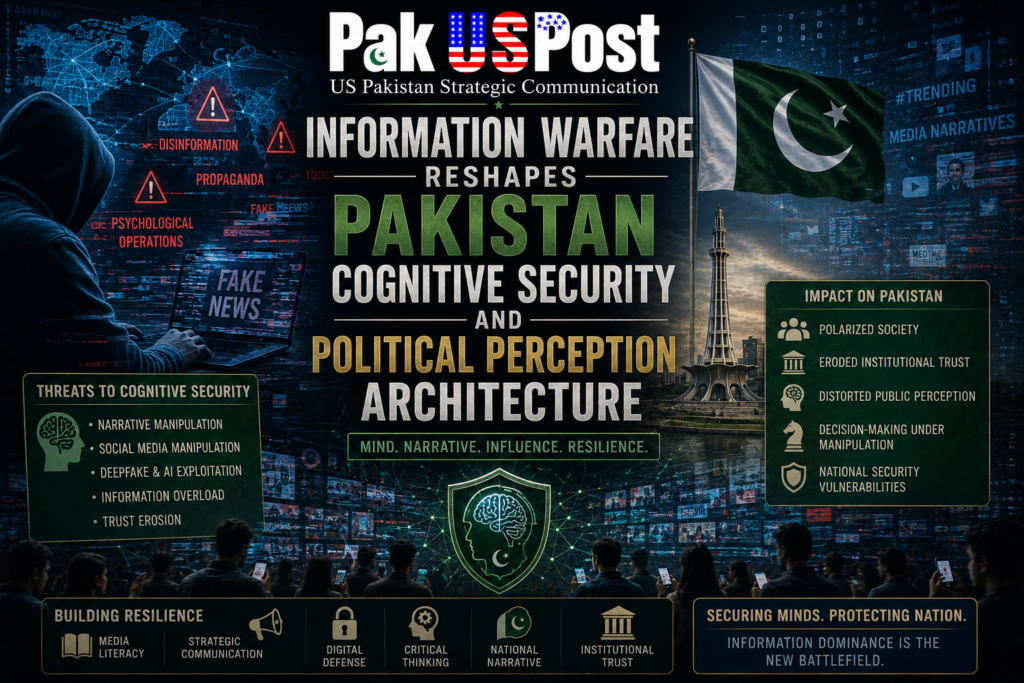
In the evolving grammar of twenty first century geopolitics, the theatre of conflict has migrated from territorial frontiers to cognitive landscapes, where perception, attention, and narrative coherence function as decisive instruments of influence. Pakistan, situated at the intersection of regional instability, strategic competition, and digital hyper connectivity, finds itself increasingly embedded within an informational ecosystem where meaning is not merely communicated but actively constructed, curated, and algorithmically distributed. The consequence is not simply an expansion of media exposure but a profound transformation in how political legitimacy, state capacity, and societal cohesion are perceived both internally and externally. In this emerging order, information warfare does not resemble traditional propaganda campaigns; rather, it manifests as a continuous, decentralised, and systemically embedded process of narrative engineering, in which global media platforms and digital infrastructures act as invisible intermediaries of cognitive governance.
The Pakistani informational environment is now shaped by a complex interplay of domestic political volatility, transnational media flows, and platform driven amplification mechanisms that privilege emotional intensity, conflict framing, and simplified binaries over contextual depth. Within this structure, political discourse is increasingly filtered through external attention economies that reward spectacle rather than substance. Consequently, internal political perceptions are no longer insulated from global narrative architectures; instead, they are recursively shaped by them. Domestic actors, political institutions, and even state narratives are compelled to operate within a feedback loop in which external visibility becomes a determinant of internal legitimacy.
At the core of this transformation lies the structural dominance of global digital platforms whose algorithmic systems function as de facto arbiters of informational relevance. These systems, while formally neutral in design, embed implicit hierarchies of visibility that privilege certain geopolitical narratives over others. In the case of Pakistan, this often results in the amplification of crisis oriented content, security centric framing, and episodic political instability, while simultaneously marginalising slower, structural, and developmental narratives that might otherwise present a more nuanced portrait of the state. The effect is a persistent narrowing of representational bandwidth, where complexity is sacrificed at the altar of algorithmic efficiency.
This condition generates what may be described as cognitive asymmetry, a situation in which the production of meaning is decoupled from the lived socio political realities of the state and instead reconstituted through externally mediated interpretive frameworks. Cognitive asymmetry does not operate through overt manipulation but through subtle distortions of attention. It is not that information is absent, but that its relative weighting, sequencing, and visibility are systematically reorganised in ways that reshape perception at scale. Over time, this produces a form of narrative entrapment, in which Pakistan is repeatedly framed through a limited set of global scripts, often centred on instability, securitisation, or crisis management.
Internally, this external narrative pressure feeds into domestic political dynamics in increasingly complex ways. Political actors, media institutions, and civil society organisations are no longer insulated from global narrative cycles; instead, they actively respond to them, anticipate them, and in some cases strategically align with them. The result is a form of reflexive politics, where domestic legitimacy is partially negotiated through external validation. This phenomenon is particularly evident in the rapid circulation of political content across social media platforms, where domestic events are immediately refracted through global interpretive lenses, often stripping them of local nuance and historical specificity.
The implications for cognitive security are profound. Cognitive security, understood as the capacity of a society to maintain coherent, resilient, and self determined interpretive frameworks, is increasingly under strain in environments where informational sovereignty is fragmented. In Pakistan’s case, cognitive resilience is challenged not only by external narrative pressures but also by internal structural vulnerabilities, including political polarisation, media fragmentation, and uneven digital literacy. These factors converge to create an informational ecosystem that is highly susceptible to amplification cascades, misinformation spirals, and episodic narrative volatility.
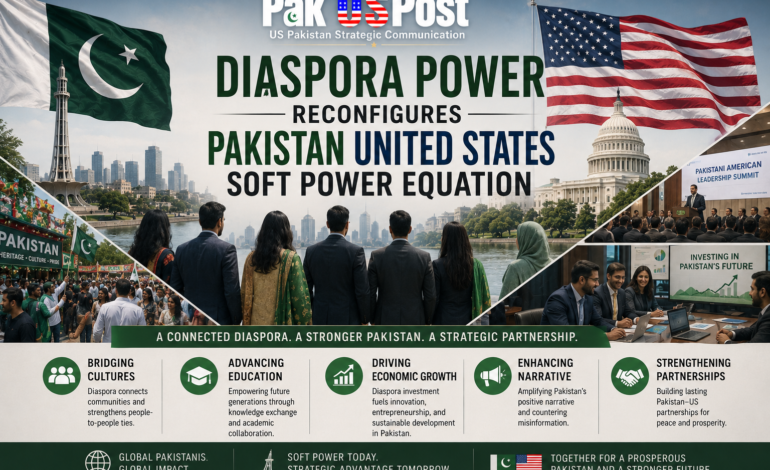
Yet it would be analytically insufficient to frame this condition solely in terms of vulnerability. Pakistan is not merely a passive recipient of global informational flows; it is also an active participant in shaping regional and transnational narratives. Its strategic significance, demographic scale, and diasporic networks ensure that it remains a persistent object of global attention. However, the asymmetry lies in the terms of representation, not in the absence of representation itself. The challenge is therefore not visibility per se, but the conditions under which visibility is produced and sustained.
The role of diasporic communities further complicates this landscape. Pakistani diasporas, particularly in Western information ecosystems, function as intermediary nodes through which narratives are both transmitted and transformed. These communities often occupy dual epistemic positions, simultaneously embedded within host country media environments and emotionally or politically connected to the Pakistani state. This duality enables them to act as amplifiers, translators, or in some cases contesters of dominant narratives. However, their influence is uneven and frequently shaped by the same platform dynamics that govern broader information flows, including algorithmic prioritisation and engagement driven visibility.
In parallel, traditional media institutions, both domestic and international, are undergoing structural reconfiguration. The rise of digital first journalism, the decline of legacy gatekeeping mechanisms, and the increasing reliance on real time content distribution have collectively accelerated the pace at which narratives are produced and consumed. This acceleration reduces the temporal space available for contextualisation, thereby privileging immediacy over depth. For Pakistan, this means that complex political or socio economic developments are often reduced to simplified narrative units that circulate rapidly but decay just as quickly in informational relevance.
The strategic consequences of this environment extend beyond perception management. In a global order increasingly defined by narrative competition, the ability to sustain coherent and credible informational ecosystems becomes a form of soft power. States that can effectively project narrative stability, developmental continuity, and institutional resilience are better positioned to shape international opinion and policy discourse. Conversely, states that are persistently framed through instability centric narratives face structural disadvantages in diplomatic engagement, investment flows, and geopolitical positioning.
For Pakistan, this necessitates a recalibration of its cognitive security architecture. Traditional approaches to information management, often rooted in reactive communication strategies or episodic public diplomacy initiatives, are insufficient to address the systemic nature of algorithmically mediated information warfare. Instead, what is required is a comprehensive framework that integrates narrative resilience, digital sovereignty, and institutional coherence. This includes the development of indigenous content ecosystems capable of producing high quality, globally legible narratives that reflect the complexity of Pakistan’s socio political landscape.
Equally important is the need to engage with global technology platforms not merely as communication intermediaries but as strategic actors within the informational domain. These platforms operate at the intersection of data, attention, and behavioural influence, and thus occupy a quasi sovereign position in shaping global perception regimes. Engaging with them requires a shift from content regulation paradigms to structural negotiation frameworks that address issues of algorithmic transparency, visibility equity, and representational fairness.
At the domestic level, strengthening cognitive security also demands investment in media literacy, critical thinking infrastructure, and educational reform. Societies that are better equipped to interpret informational complexity are less vulnerable to narrative manipulation and more capable of sustaining pluralistic discourse. In Pakistan’s context, this involves not only expanding access to digital technologies but also enhancing the epistemic capacity to interpret and contextualise them.
Ultimately, the challenge of information warfare is not merely technological but ontological. It concerns the very conditions under which reality is perceived, interpreted, and stabilised within a society. For Pakistan, navigating this challenge requires moving beyond defensive postures and towards the construction of a proactive cognitive sovereignty framework. Such a framework would recognise that in the contemporary geopolitical environment, power is increasingly exercised not only through military or economic means but through the capacity to shape the architecture of perception itself.
In this sense, cognitive security becomes inseparable from national security. The stability of the state is no longer determined solely by its physical borders but by the resilience of its informational boundaries, the coherence of its narrative structures, and the autonomy of its interpretive frameworks. As global information systems continue to evolve, Pakistan’s strategic imperative will lie in ensuring that its cognitive architecture remains self determining, resilient, and capable of articulating its own complexity within an increasingly contested informational world.
A Public Service Message