
Pakistan Security Reform Beyond Crisis Command Systems

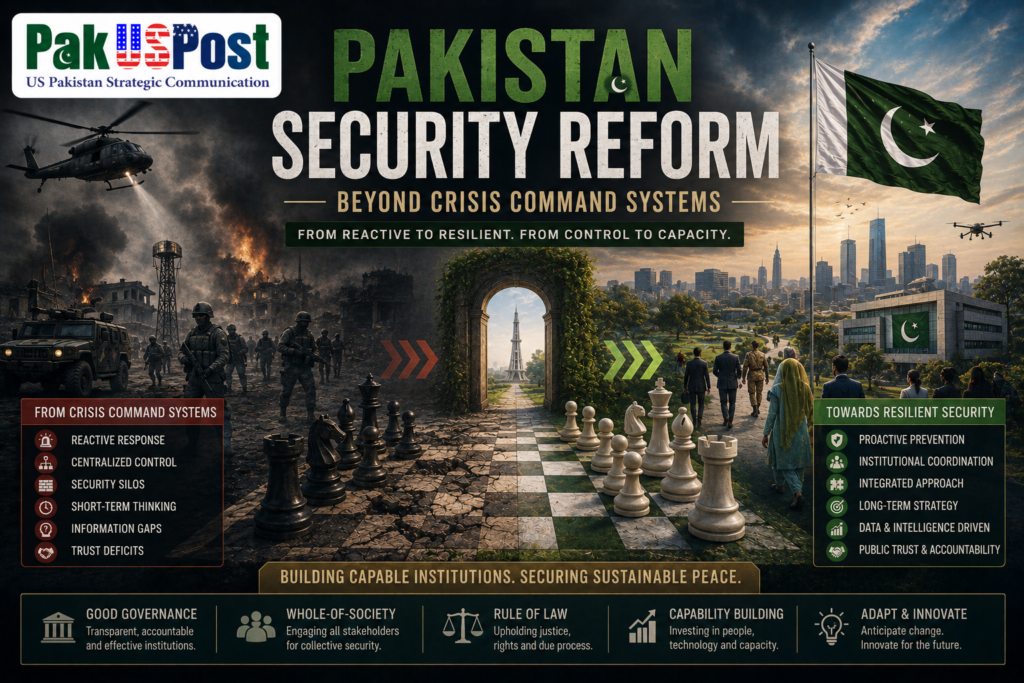
Pakistan’s internal security architecture is increasingly being tested by a pattern of compounding shocks rather than isolated crises. Militancy in its residual but adaptive forms, cyber intrusions that blur the boundary between crime and strategic signalling, financial volatility linked to external adjustment cycles, climate emergencies that overwhelm district administration, and disinformation cascades that erode public trust all converge into a single operational reality: the state is now required to think, decide, and act at a tempo that its institutional design was never originally engineered to sustain. Yet the deeper challenge is not speed alone. It is whether acceleration can be achieved without further centralising authority in ad hoc command structures that bypass civilian governance and weaken constitutional equilibrium.
Historically, Pakistan’s crisis response model has oscillated between two imperfect poles. On one side stands bureaucratic proceduralism, which preserves legality and administrative continuity but often reacts too slowly to fast-moving threats. On the other side stands improvised command coordination, typically triggered during security emergencies, where authority is concentrated in a narrow decision loop that prioritises speed but weakens institutional depth and civilian oversight. Neither model is adequate for a security environment that is simultaneously distributed, digitised, and transnational.
The emergence of hybrid threats has fundamentally altered the grammar of national security. A border incident may now be preceded by digital mobilisation. An economic shock may be amplified by narrative warfare. A cyber breach may coincide with diplomatic signalling designed to exploit uncertainty in markets. These overlaps compress response time and increase the cost of institutional delay. Yet they also make purely military or purely bureaucratic responses structurally insufficient. What is required instead is an integrated decision system that fuses intelligence, economic policy, provincial administration, cyber capability, and strategic communication into a coherent operating framework.
At present, Pakistan’s institutional architecture remains segmented across functional silos. Intelligence agencies operate with high tactical effectiveness but limited cross-sectoral integration. The interior ministry manages internal security but lacks real-time fusion with economic and digital systems. The National Security Division exists as a coordination node but does not yet function as a fully empowered operational hub. Provinces hold constitutional authority over key domains of governance but are often structurally disconnected from federal strategic planning cycles. The result is not absence of capability, but fragmentation of capability.
This fragmentation becomes particularly visible during crisis moments. Responses tend to be sequential rather than simultaneous. Security action is taken first, followed by economic stabilisation measures, then communication management, and only later diplomatic framing. In complex threat environments, however, sequencing creates lag. By the time the state completes one phase of response, the information environment has already shifted. This mismatch between linear governance and non-linear threat evolution is now a core vulnerability.
International observers, including Pakistan’s strategic partners such as the United States, increasingly interpret this issue not merely as an operational limitation but as a structural governance constraint. From their perspective, the predictability of crisis management is as important as its effectiveness. External partners prefer institutional continuity over personality-driven coordination because it reduces uncertainty in bilateral engagement, investment flows, and security cooperation. In this sense, Pakistan’s internal decision architecture has become a variable in external strategic calculations.
The central question, therefore, is not whether Pakistan needs faster crisis response, but whether it can construct a system that is simultaneously faster and more civilianised. This dual requirement appears contradictory only if speed is equated with centralisation. In modern governance systems, speed can also be achieved through pre-structured coordination, distributed authority, and real-time data integration. The challenge lies in institutional design rather than institutional concentration.
A potential pathway involves the evolution of a permanent national security coordination architecture that functions continuously rather than episodically. Instead of activating ad hoc committees during emergencies, Pakistan would benefit from a standing strategic coordination mechanism capable of integrating threat intelligence, economic signals, cyber monitoring, and provincial risk assessments into a unified situational picture. Such a system would not replace existing institutions but would sit above them as an integrative layer.
However, the creation of such a mechanism raises important questions about civil-military balance and constitutional legitimacy. Pakistan’s security governance has historically relied on strong military leadership during crises, often because civilian institutions lacked the analytical depth or coordination capacity required for complex threat environments. Any redesign must therefore avoid two extremes: excessive militarisation of decision-making and ineffective bureaucratisation of urgency. The objective should be functional integration under civilian constitutional oversight, not institutional substitution.
One possible model is a revitalised National Security Division with enhanced analytical and executional capacity, supported by a multi-domain fusion centre that integrates intelligence, finance, cyber, and provincial data streams. This would require not only institutional redesign but also a cultural shift in how information is shared across departments. At present, information asymmetry between institutions slows decision-making and encourages silo-based interpretations of risk. A fusion-based model would prioritise shared situational awareness over departmental ownership of data.
Another dimension involves provincial integration. Security in Pakistan is no longer exclusively a federal domain. Urban policing, counter-extremism narratives, disaster response, and cyber awareness increasingly operate at the provincial and municipal levels. Yet coordination between federal strategic planning and provincial execution remains uneven. A modern security architecture would need to institutionalise provincial participation in national risk assessment cycles, not as consultative actors but as embedded nodes in a continuous planning system.
Technology plays a central role in enabling this transformation. Artificial intelligence driven analytics, satellite-based monitoring systems, financial transaction mapping, and digital communication tracking can significantly reduce response latency if integrated into a unified command architecture. However, technology alone does not solve institutional fragmentation. Without governance reform, digital tools risk becoming additional layers of complexity rather than instruments of clarity.
Economic security must also be fully incorporated into the national security framework. Currency volatility, energy shortages, and fiscal pressure are no longer separate from internal stability. They directly shape public sentiment, urban unrest potential, and external vulnerability. A modern security system must therefore include economic forecasting as a core input into strategic decision-making. This represents a departure from traditional security paradigms that treated economics as a parallel domain rather than an integrated variable.
Information management is another critical frontier. Disinformation campaigns, whether externally amplified or domestically generated, now operate as force multipliers in crisis environments. Strategic communication can no longer be treated as a reactive function. It must be embedded within the decision architecture itself, ensuring that narrative positioning evolves in parallel with operational responses. Failure to do so results in perception gaps that undermine even technically successful interventions.
The United States and other strategic partners observe this dimension closely because information stability directly affects alliance predictability. In environments where narrative volatility is high, external actors face difficulty in assessing policy continuity and institutional reliability. For Pakistan, improving information coherence is therefore not only a domestic governance requirement but also a diplomatic asset.
Yet institutional redesign alone will not succeed without addressing underlying incentive structures. Bureaucratic systems tend to resist integration because coordination reduces departmental autonomy. Military institutions may be cautious about diffusion of authority in domains where they have historically ensured rapid response. Provincial governments may resist centralised data architectures if they perceive them as encroachments on constitutional space. These tensions are not technical but political in nature, and they require negotiated institutional settlement rather than administrative decree.
A further complication lies in capacity asymmetry. Even if integration frameworks are established, their effectiveness depends on the quality of underlying data, analytical expertise, and operational discipline. Without investment in training, digital infrastructure, and inter-agency mobility, integrated systems risk becoming symbolic rather than functional. This is why institutional reform must be accompanied by human capital development within security governance itself.
The broader strategic implication is that Pakistan is entering a phase where governance speed and governance legitimacy must be co-optimised. Faster decision-making without legitimacy risks institutional backlash. Legitimate decision-making without speed risks operational failure. The challenge is to design systems that do not force a trade-off between the two.
One promising direction is scenario-based governance, where multiple threat simulations are continuously updated and used to pre-align institutional responses before crises occur. This reduces the need for improvisation during emergencies and allows pre-approved coordination pathways to activate automatically when thresholds are crossed. Such systems are already used in varying forms in advanced security architectures globally and could be adapted to Pakistan’s institutional context with appropriate safeguards.
Ultimately, the question is whether Pakistan can move from a reactive crisis management model to a predictive resilience model. The former relies on authority concentration during emergencies. The latter relies on continuous coordination during normalcy. The shift is not merely administrative. It is conceptual. It requires redefining security not as episodic response but as continuous governance.
For external partners, including the United States, the significance of such a transition is considerable. A Pakistan that operates through stable institutional channels offers greater predictability in counterterrorism cooperation, regional stability management, and crisis de-escalation mechanisms. Conversely, reliance on ad hoc command systems increases uncertainty and limits the scope of structured engagement.
In conclusion, Pakistan’s security governance challenge is not the absence of institutions but the absence of integration. The next phase of reform will be defined not by the creation of new agencies but by the ability to connect existing ones into a coherent decision ecosystem. The objective is not to replace civilian governance with rapid command structures, nor to slow down security response in the name of procedure, but to construct a system where speed is embedded within institutional legitimacy.
If achieved, such a transformation would mark a significant evolution in Pakistan’s governance trajectory, shifting it from episodic crisis management to sustained strategic resilience. If not, the country risks remaining trapped in a cycle where each new shock demands improvisation rather than preparation, and where institutional learning is perpetually outpaced by the velocity of events.
A Public Service Message