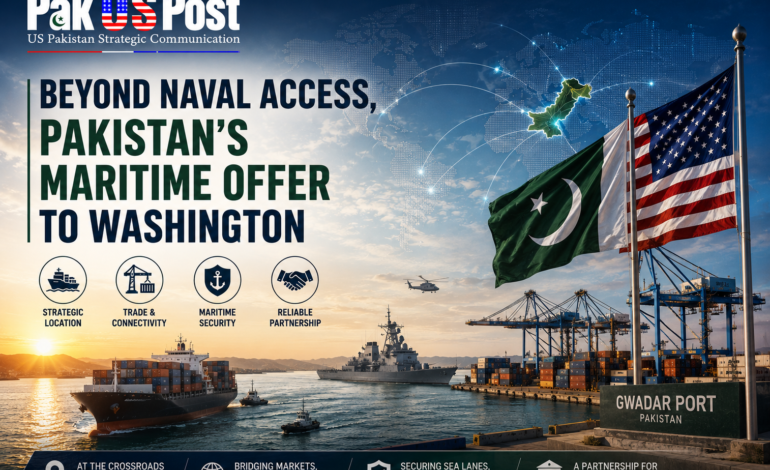
Beyond naval access, Pakistan’s maritime offer to Washington


Pak US Post must treat the Arabian Sea not as a peripheral naval theatre but as a consequential resilience zone connecting Pakistan’s ports, Gulf energy flows, Red Sea shipping, commercial insurance markets, undersea communications and the wider western Indian Ocean. Pakistan’s strategic proposition to Washington should therefore extend well beyond access to ships, exercises or port calls. Its more durable contribution lies in converting geographical proximity into usable maritime awareness, disciplined information exchange and crisis management capacity without transforming Pakistani waters into an overt extension of American military operations. That distinction is increasingly important. The August 2026 deterioration around the Gulf of Oman and Red Sea has already demonstrated how rapidly attacks on commercial shipping can acquire economic, humanitarian and geopolitical consequences. Reuters reported on August 11 that four crew members, including three Pakistanis, were killed in an attack on an Egyptian owned cargo ship near the Bab el Mandeb, while shipping movements through the Bab el Mandeb and Strait of Hormuz had fallen sharply amid escalating military confrontation. For Islamabad, maritime security is consequently no longer reducible to fleet protection. It is a question of national economic continuity.
Pakistan has already articulated the conceptual basis for such a policy. The Foreign Ministry has described the northern Arabian Sea as a critical element of national security, connectivity, food and energy security, while identifying piracy, terrorism, trafficking, cyber vulnerabilities affecting port infrastructure, pollution and climate related coastal risks as multidimensional maritime threats. In June 2026, Pakistan and the United States also discussed expanding maritime cooperation, investment, port development, logistics and the blue economy, with both sides agreeing in principle to establish a joint working group. The policy opportunity is therefore already visible. The missing element is a sufficiently precise architecture defining what Pakistan can offer, what Washington actually needs, what information can be exchanged, which institutions should control it and how cooperation can remain commercially useful without becoming strategically inflammatory.
The central proposition should be maritime information rather than military access. Pakistan possesses a valuable vantage point between the Gulf of Oman, Arabian Sea approaches and major commercial routes leading towards Karachi and Port Qasim. Its Joint Maritime Information Coordination Centre already functions as a national and international information sharing hub, maintaining links with international information fusion centres and coordinating maritime awareness among numerous stakeholders. This existing institutional asset should become the foundation for a carefully compartmentalised Pakistan US maritime resilience mechanism. Washington does not necessarily require unrestricted access to Pakistani naval systems. It needs reliable, time sensitive and appropriately classified information that can improve the recognition of suspicious vessel behaviour, emerging navigational hazards, piracy indicators, trafficking patterns, cyber incidents and threats to commercial shipping.
The distinction between raw intelligence and maritime safety information should be codified. Pakistan could establish three information tiers. The first would contain openly releasable material, including navigational warnings, verified hazards, weather disruptions, port closures, shipping lane restrictions and selected vessel safety notices. The second would consist of controlled operational information concerning suspicious maritime activity, anomalous vessel movements, piracy indicators, smuggling patterns and verified incidents. The third would contain highly sensitive intelligence that should remain under Pakistani sovereign control and be released only through case specific authorisation. Such compartmentalisation would reassure Washington that information has operational value while preventing the gradual erosion of institutional boundaries that can occur when intelligence cooperation expands without an agreed governance framework.
Maritime domain awareness should become the technical spine of the arrangement. The International Maritime Organization defines effective maritime domain awareness through situational awareness, threat awareness and response awareness, meaning that information must not merely be collected but correlated with potential threats and linked to available response capabilities. Pakistan should consequently avoid building another isolated information platform. Instead, JMICC should be connected through secure interfaces to relevant maritime, customs, coast guard, port, shipping, aviation, fisheries and law enforcement databases. A Pakistan US interface could then exchange structured alerts rather than indiscriminate data streams. Each alert should carry a timestamp, confidence assessment, originating authority, geographic reference, classification level and recommended response window.
Satellite tracking offers another area where cooperation can produce disproportionate strategic value without requiring permanent foreign presence. Automatic Identification System data, synthetic aperture radar imagery, commercial satellite observations and vessel registry information can be fused to identify discrepancies between declared and observed maritime behaviour. A vessel that disables its transponder, changes course without commercial explanation, approaches restricted waters or repeatedly loiters near critical infrastructure should trigger an analytical review rather than an automatic presumption of hostile intent. Pakistan and the United States could establish a joint anomaly detection protocol in which algorithms identify unusual behaviour while human analysts retain responsibility for attribution and escalation decisions. This would also create a practical field for cooperation in maritime artificial intelligence without handing autonomous systems authority over kinetic responses.
Autonomous surveillance deserves particular caution. Pakistan can legitimately explore unmanned surface vessels, aerial systems, remote sensing platforms and automated pattern recognition for maritime safety and infrastructure monitoring. But autonomy should remain bounded by explicit rules of human control. Surveillance systems should identify, classify and prioritise anomalies; they should not independently authorise interdiction, boarding or use of force. This distinction would protect Pakistan from accusations that it is enabling an externally directed maritime targeting architecture. It would also preserve the legal and operational responsibility of Pakistani authorities over incidents occurring within areas under Pakistani jurisdiction.
Undersea infrastructure should become a separate pillar of the partnership. The strategic significance of submarine cables is frequently obscured because their physical presence is largely invisible to the public, yet their disruption can affect financial transactions, communications, cloud services, government networks and commercial logistics simultaneously. Pakistan should establish a critical maritime infrastructure register covering submarine cables, landing stations, port information systems, navigation facilities, fuel infrastructure and other assets whose disruption could generate cascading national consequences. Washington could contribute technical expertise in vulnerability assessment, incident detection, cyber forensics and redundancy planning. The arrangement should not imply foreign ownership or operational control. Its purpose should be resilience.
Port cybersecurity is particularly important because a modern port is a digital ecosystem before it is a collection of cranes and warehouses. Terminal operating systems, customs platforms, cargo manifests, access control, navigation services, payment systems, logistics databases and communications networks are interconnected. A cyber intrusion could therefore immobilise cargo without a single physical attack. Pakistan should require Karachi, Port Qasim and Gwadar to maintain port cyber incident response plans with mandatory notification thresholds, designated cyber incident officers, offline recovery procedures, privileged access controls, network segmentation and periodic penetration testing. A Pakistan US maritime cyber cell could conduct tabletop exercises around scenarios such as ransomware affecting terminal operations, manipulation of cargo records, compromise of vessel scheduling systems or disruption of port communications.
Washington should be offered a defined role in exercises rather than undefined access. Annual Pakistan US maritime resilience exercises could simulate a cyberattack coinciding with a suspicious vessel incident, a navigation failure near a major port, a submarine cable disruption and a sudden closure of a regional shipping route. The exercise should test decision making, not merely military interoperability. Participants should include maritime authorities, naval representatives, port operators, customs, shipping companies, insurers, telecommunications providers and emergency management officials. The performance indicators should be measurable: minutes required to validate an incident, time required to issue a verified maritime warning, percentage of relevant stakeholders receiving the alert, restoration time for compromised systems and accuracy of initial threat classification.
Emergency shipping coordination deserves similar institutionalisation. Pakistan should propose a bilateral crisis communication protocol linking its maritime authorities with designated American counterparts during severe disruptions affecting Gulf approaches, the Gulf of Oman, Bab el Mandeb or the western Indian Ocean. The mechanism should provide authenticated channels for exchanging information about safe routing, navigational hazards, port congestion, stranded vessels, search and rescue requirements and verified threats. It should not automatically translate into naval escort commitments. That separation matters because Pakistan has strong incentives to protect commercial shipping while avoiding the perception that it has joined one side of a regional military confrontation.
The distinction becomes more important as Pakistan manages its relationships with Iran, Gulf partners and Washington simultaneously. Any maritime arrangement that appears designed to monitor Iranian shipping, facilitate blockade enforcement or provide targeting information could impose diplomatic costs far greater than its immediate security benefits. Pakistan should therefore prohibit the transfer of commercially sensitive or intelligence derived vessel information for offensive targeting unless separately authorised under national law and an explicitly defined governmental framework. Information collected for maritime safety should not be quietly repurposed for military operations. Such a firewall would enhance Pakistan’s credibility with Washington precisely because it would make the rules predictable.
The same principle should apply to Gulf partners. Saudi Arabia and other Gulf states have increasingly urgent interests in maritime security, particularly as instability around the Red Sea and Gulf approaches affects energy infrastructure, shipping insurance and commercial confidence. Reuters reported on August 12 that Saudi Arabia was seeking broader regional maritime arrangements while attempting to avoid direct entanglement in the wider conflict. Pakistan should therefore avoid constructing a bilateral maritime mechanism with Washington that excludes regional partners. A trilateral or multilateral information architecture could eventually incorporate Gulf states where appropriate, provided that participation is governed by clearly defined data rights and does not compromise Pakistan’s bilateral channels.
Commercial insurers should be brought into the architecture earlier than is customary in state centric security planning. Insurance premiums respond not only to attacks but also to uncertainty. A shipping company that cannot determine whether a route is genuinely dangerous, temporarily disrupted or merely subject to conflicting warnings will price risk conservatively. Pakistan could establish a verified maritime risk bulletin drawing on JMICC, port authorities, hydrographic information and validated international reporting. It would distinguish confirmed incidents from unverified claims and provide confidence ratings. Such a system could reduce information asymmetry for insurers and shipping companies while strengthening Pakistan’s reputation as a responsible maritime information provider. Pakistan’s National Hydrographic Office already publishes navigational warnings covering incidents and hazards in Pakistani waters and adjacent maritime areas, illustrating that the basic warning infrastructure exists.
The human dimension should not be treated as an afterthought. Pakistani seafarers are directly exposed when commercial vessels encounter missile attacks, drone strikes, piracy, blockade conditions or navigational disruption. The August 11 deaths of three Pakistani crew members in the Red Sea underline the human cost of maritime insecurity. Pakistan should negotiate a seafarer protection protocol with major shipping companies and international partners covering emergency communications, vessel tracking, medical evacuation, repatriation procedures, family notification and documentation after maritime incidents. The Ministry of Maritime Affairs, Ministry of Foreign Affairs and relevant labour authorities should maintain a secure registry capable of rapidly identifying Pakistani nationals aboard affected vessels.
The establishment should resist the temptation to define success through the number of American ships visiting Pakistani ports or the frequency of naval exercises. Those are visible indicators but poor measures of strategic utility. A more sophisticated dashboard would measure the number of verified maritime alerts exchanged, average information transmission time, percentage of major ports completing cyber resilience assessments, number of critical infrastructure assets mapped, frequency of joint incident exercises, vessel anomaly detection accuracy, emergency communication activation time and restoration performance following simulated cyber disruption. This would turn maritime cooperation from diplomatic symbolism into an auditable security programme.
Washington, for its part, should understand that Pakistan’s value does not derive from geographical availability alone. A sustainable partnership requires American investment in Pakistani maritime resilience rather than an arrangement centred primarily on American operational requirements. Technical assistance, satellite data access, cyber training, maritime analytics, port security standards, search and rescue cooperation and professional exchanges would create more durable institutional value than episodic requests for access. The United States could also encourage American insurers, logistics companies, technology firms and port security specialists to engage with Pakistan’s maritime sector under transparent commercial rules.
Pakistan should establish a permanent Pakistan US Maritime Resilience Working Group within the framework already contemplated by the two sides. Its mandate should be narrower than a grand strategic dialogue and broader than naval cooperation. It should report annually against agreed benchmarks, maintain an incident escalation matrix, conduct classified and unclassified information exchanges separately, coordinate port cyber exercises, review critical infrastructure vulnerabilities and recommend revisions after major maritime incidents. Participation should rotate among civilian and security institutions so that maritime resilience does not become exclusively securitised.
The larger strategic calculation is straightforward. Pakistan cannot control the security environment of the Arabian Sea, Gulf of Oman, Strait of Hormuz or Red Sea, but it can improve the quality of information available before disruption becomes crisis. That is the most defensible maritime contribution Islamabad can make to Washington. It protects Pakistan’s commercial interests without requiring alignment with every American military objective; it strengthens relations with Gulf partners without surrendering diplomatic autonomy; and it gives the United States something more valuable than symbolic access, namely a reliable regional partner capable of detecting, validating and communicating maritime risk.
For Pak US Post, the policy conclusion should therefore be precise. Pakistan should offer Washington a maritime resilience partnership built around information, infrastructure protection, cyber preparedness, shipping continuity and crisis coordination, while retaining sovereign authority over sensitive intelligence and operational decisions. Naval access may remain useful, but it should become the least interesting component of the relationship. The strategically mature proposition is a Pakistan capable of making the Arabian Sea more observable, its ports more resilient, its communications infrastructure harder to disrupt and its commercial shipping better protected. In an environment where a single maritime incident can rapidly affect energy prices, insurance premiums, diplomatic calculations and human lives, that capability would give Islamabad strategic relevance without strategic overexposure.
A Public Service Message