
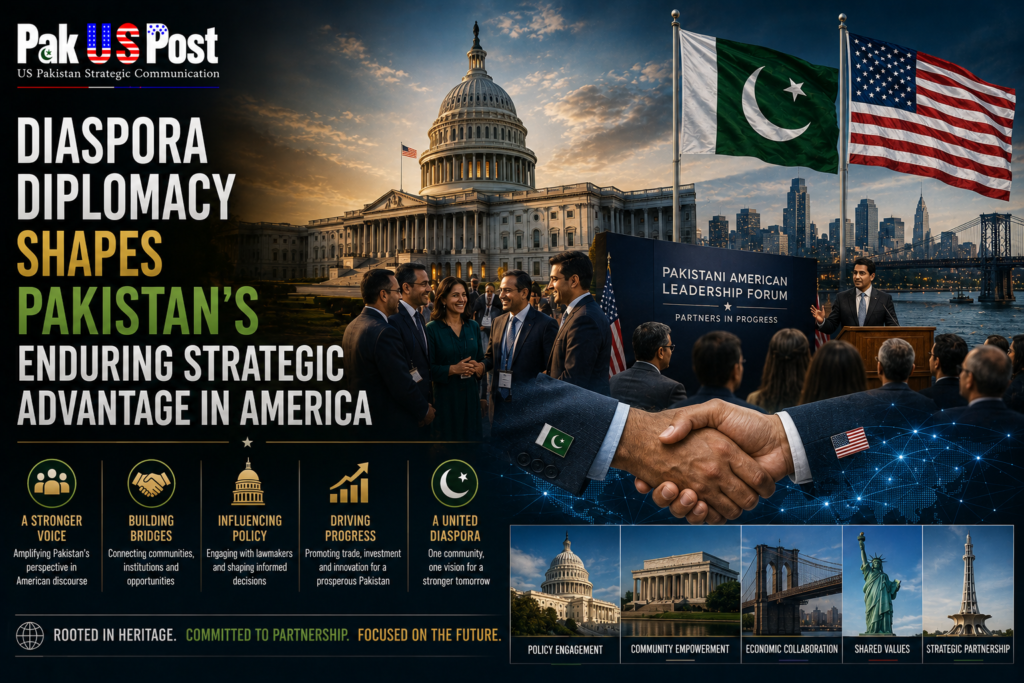
Diaspora Diplomacy Shapes Pakistan’s Enduring Strategic Advantage in America

Few countries possess an untapped strategic asset as extensive, professionally accomplished and geographically dispersed as Pakistan’s community in the United States. Yet despite decades of migration, educational advancement and entrepreneurial success, Pakistan has never transformed its American diaspora into a coordinated instrument of national influence. While successive governments have viewed overseas Pakistanis principally through the lenses of remittances, consular affairs and electoral participation, contemporary international competition increasingly demonstrates that diaspora communities represent something considerably more consequential. They influence legislative debates, shape research partnerships, facilitate technological transfer, attract investment, construct national narratives and sustain long term diplomatic relationships beyond the fluctuations of governments.
The evolution of American policymaking reinforces this reality. Washington no longer formulates foreign policy exclusively within executive departments. Congressional committees, state governments, universities, technology corporations, think tanks, philanthropic foundations, venture capital ecosystems and civic organisations collectively shape strategic perceptions. Influence therefore depends less upon episodic diplomatic engagement than upon continuous participation across interconnected policy networks. Countries that cultivate sophisticated diaspora engagement increasingly secure enduring access to these networks. Those that neglect them gradually lose narrative space, investment opportunities and intellectual visibility.
Pakistan enters this environment with significant latent advantages. Pakistani Americans have achieved considerable representation across medicine, engineering, finance, information technology, academia, entrepreneurship and public administration. Their educational attainment consistently exceeds national averages while professional integration has expanded across multiple generations. Their contribution to American innovation, healthcare delivery, scientific research and technological entrepreneurship is widely recognised within professional communities. Yet these individual successes rarely aggregate into coherent strategic influence benefiting Pakistan’s national interests.
The principal obstacle is not demographic size but institutional organisation. Pakistan’s engagement with its diaspora remains fragmented among ministries, overseas missions, provincial initiatives and ad hoc political outreach. Relationships frequently depend upon personalities rather than durable institutional mechanisms. Policy continuity disappears with administrative transitions, while strategic communication often focuses upon ceremonial interaction instead of sustained knowledge partnerships. Consequently, highly accomplished professionals remain connected emotionally to Pakistan while remaining structurally detached from policymaking processes capable of translating expertise into national capability.
Other nations provide instructive comparisons. Several countries have gradually institutionalised diaspora engagement through permanent advisory councils, innovation platforms, academic exchange mechanisms, investment facilitation offices and legislative liaison programmes. Rather than treating expatriate communities merely as cultural ambassadors, they integrate overseas expertise into economic planning, technological development and diplomatic outreach. Their governments recognise that influence emerges through consistent participation within American institutions instead of episodic lobbying during bilateral tensions.
The United States itself provides an enabling environment for organised civic participation. Professional associations, university partnerships, policy institutes, municipal administrations and congressional offices routinely interact with diaspora organisations representing diverse national communities. Influence develops through sustained credibility, technical competence and issue based collaboration rather than emotional nationalism. Pakistani American organisations therefore possess considerable opportunities to shape informed discussions regarding education, innovation, healthcare cooperation, trade, climate resilience, emerging technologies and regional stability. However, fragmented organisational structures frequently dilute collective effectiveness.
Public diplomacy illustrates this challenge. International perceptions increasingly emerge through distributed information ecosystems rather than official government statements. Researchers, journalists, university scholars, entrepreneurs and civil society leaders collectively construct narratives shaping foreign policy discourse. Pakistani American professionals occupy many of these influential environments, yet institutional coordination supporting evidence based public engagement remains limited. Individual excellence consequently produces isolated success stories rather than reinforcing a coherent national narrative.
This deficiency becomes increasingly consequential as geopolitical competition expands beyond traditional security domains. Artificial intelligence, quantum computing, biotechnology, cybersecurity, advanced manufacturing and semiconductor development increasingly influence strategic partnerships. Universities, research laboratories and technology companies now occupy positions once reserved primarily for diplomatic institutions. Pakistani researchers and entrepreneurs already contribute within these sectors across American institutions. Nevertheless, structured mechanisms facilitating reciprocal knowledge exchange with Pakistani universities, laboratories and industries remain insufficiently developed.
Academic collaboration represents one of the most promising avenues for strategic engagement. Pakistani scholars occupying faculty positions across American universities contribute to globally significant research spanning medicine, engineering, economics, environmental sciences and computational technologies. Yet systematic programmes enabling joint laboratories, doctoral supervision, research commercialisation and faculty mobility remain comparatively limited. Knowledge generated by diaspora academics often circulates globally without becoming integrated into Pakistan’s innovation ecosystem.
Technology entrepreneurship presents comparable opportunities. Pakistani Americans increasingly establish successful enterprises across Silicon Valley, Austin, Boston, New York and other innovation clusters. Their familiarity with venture financing, product commercialisation and international markets positions them uniquely to bridge American technological ecosystems with Pakistan’s expanding entrepreneurial landscape. However, regulatory uncertainty, bureaucratic complexity, inconsistent intellectual property enforcement and investment procedures frequently discourage sustained engagement beyond philanthropic initiatives.
Investment flows similarly reveal unrealised potential. Remittances have long constituted an important component of Pakistan’s external finances, yet productive investment remains substantially below potential. Diaspora investors frequently identify regulatory ambiguity, inconsistent dispute resolution, taxation concerns and administrative delays as impediments to long term commitments. Modern diaspora policy therefore requires moving beyond remittance dependence toward investment ecosystems supporting venture capital, industrial partnerships, technology transfer and infrastructure financing.
Public policy dialogue constitutes another underdeveloped dimension. American legislative processes increasingly depend upon expert testimony, research publications, professional consultations and sustained stakeholder engagement. Pakistani American academics, economists, legal scholars and security specialists possess substantial expertise relevant to congressional deliberations concerning South Asia, technology governance, education, healthcare and economic cooperation. Yet institutional platforms connecting these experts with Pakistan’s diplomatic missions remain sporadic and insufficiently coordinated.
This limitation also affects strategic communications during periods of bilateral tension. International narratives often crystallise rapidly following regional crises, security incidents or political developments. Governments alone cannot effectively shape complex information environments. Credible voices emerging from universities, professional associations and independent research institutions frequently exercise greater influence than official statements. Organised diaspora engagement therefore enhances resilience by diversifying authoritative channels through which evidence based perspectives enter American discourse.
Generational transformation introduces additional complexity. Younger Pakistani Americans frequently possess stronger professional identities than traditional ethnic organisational affiliations. Their engagement increasingly revolves around entrepreneurship, climate innovation, healthcare technology, civic leadership and academic excellence rather than conventional political mobilisation. Diaspora policy must therefore evolve beyond community events toward issue based networks reflecting contemporary professional aspirations. Governments that fail to recognise this transition risk gradually losing engagement with emerging generations possessing considerable strategic influence.
Digital transformation further alters diaspora diplomacy. Professional collaboration no longer depends upon physical proximity. Virtual research platforms, digital innovation networks, online investment forums and remote educational partnerships enable continuous engagement across continents. Pakistan’s digital governance initiatives therefore require integration with overseas expertise capable of supporting cybersecurity, artificial intelligence, financial technologies, digital healthcare and educational modernisation. Such engagement demands sophisticated institutional architecture rather than occasional conferences.
Pakistan’s diplomatic missions require corresponding adaptation. Embassies and consulates traditionally emphasise political reporting, consular services and bilateral representation. Contemporary diplomacy increasingly necessitates specialised officers facilitating technology partnerships, academic collaboration, venture investment and innovation diplomacy. Diplomatic success increasingly depends upon convening ecosystems rather than merely conducting negotiations. Missions serving large diaspora populations should therefore function as strategic platforms connecting researchers, investors, policymakers and entrepreneurs.
Parliamentary engagement also deserves greater attention. Congressional relationships develop through sustained interaction extending beyond executive diplomacy. Pakistani American professionals frequently possess local relationships with elected representatives across multiple states. Coordinated legislative outreach, policy briefings and constituency engagement could significantly improve mutual understanding regarding economic cooperation, educational exchanges and technological partnerships. Such efforts require bipartisan consistency, factual credibility and long term commitment rather than reactive lobbying.
Think tanks constitute another essential arena. American strategic discourse frequently originates within research institutions producing policy analyses informing executive agencies and Congress. Pakistani scholars, visiting fellows and diaspora researchers already contribute individually to several respected institutions. However, Pakistan lacks systematic programmes supporting sustained research collaboration, joint publications, policy dialogues and scholarly exchanges capable of strengthening intellectual engagement over extended periods.
Media ecosystems further reinforce the importance of organised expertise. Journalists increasingly rely upon academic specialists, policy researchers and independent analysts for interpretation of international developments. Well organised diaspora networks therefore strengthen informational accuracy by providing informed perspectives grounded in professional credibility. Reactive media engagement during crises cannot substitute for sustained intellectual presence cultivated through years of consistent scholarship and public communication.
The entrepreneurial dimension extends beyond investment alone. Diaspora professionals possess practical understanding of regulatory standards, export compliance, intellectual property management, advanced manufacturing and global supply chains. Their experience could substantially accelerate Pakistan’s industrial competitiveness if systematically incorporated into national development strategies. Structured mentorship programmes linking overseas entrepreneurs with domestic startups would generate practical knowledge transfer exceeding conventional development assistance.
Provincial governments similarly require greater integration within diaspora strategy. Economic opportunities frequently emerge at subnational levels through universities, industrial zones, technology parks and municipal partnerships. Direct engagement between overseas professionals and provincial development authorities could stimulate innovation clusters tailored to regional comparative advantages. Such decentralised cooperation enhances resilience while reducing administrative bottlenecks associated with excessively centralised policymaking.
Institutional trust nevertheless remains indispensable. Diaspora communities engage more confidently where governance demonstrates transparency, regulatory predictability and professional competence. Frequent policy reversals, inconsistent implementation and bureaucratic discretion discourage long term participation irrespective of patriotic sentiment. National capability therefore depends as much upon domestic institutional reform as overseas outreach. Effective diaspora diplomacy begins with credible governance at home.
Security considerations also require careful calibration. Contemporary strategic competition increasingly encompasses cyber resilience, technological security, supply chain integrity and protection of critical knowledge infrastructure. Diaspora engagement must therefore incorporate appropriate safeguards protecting sensitive technologies while encouraging legitimate scientific collaboration. Transparent regulatory frameworks provide greater confidence than restrictive ambiguity. Security institutions consequently benefit from clear protocols balancing openness with national resilience.
Educational mobility remains another strategic priority. Thousands of Pakistani students continue pursuing higher education within American universities each year. These students represent future researchers, entrepreneurs, policymakers and institutional leaders. Structured alumni engagement beginning during their educational experience would gradually expand national networks across academia, industry and public service. Countries maintaining sophisticated alumni diplomacy frequently cultivate enduring strategic relationships extending across generations.
Women’s leadership deserves particular emphasis within diaspora strategy. Pakistani American women increasingly occupy influential positions across medicine, science, education, law, public administration and corporate leadership. Their contributions remain underrepresented within official engagement frameworks despite possessing exceptional potential for strengthening educational partnerships, healthcare cooperation and scientific collaboration. Inclusive institutional design therefore expands national capability while reflecting contemporary professional realities.
The financial architecture supporting diaspora engagement also requires modernisation. Dedicated innovation funds, co investment platforms, research commercialisation grants and diaspora venture networks would encourage productive partnerships beyond philanthropic contributions. Public resources should function primarily as catalytic instruments leveraging substantially larger private investment through transparent governance and professional management.
Strategic communication requires equally significant reform. Pakistan frequently communicates internationally through defensive narratives responding to external criticism rather than proactively highlighting scientific achievement, entrepreneurial innovation, educational excellence and technological collaboration. Diaspora professionals provide authentic credibility for constructive storytelling because their accomplishments emerge independently within highly competitive American institutions. Institutional support should therefore facilitate rather than direct such engagement.
An integrated national diaspora strategy would necessarily transcend electoral cycles. Long term influence cannot depend upon changing political priorities or administrative preferences. Parliament should therefore consider establishing a permanent bipartisan framework defining strategic objectives, institutional responsibilities, performance indicators and accountability mechanisms governing overseas engagement. Independent advisory bodies incorporating diaspora expertise could provide continuity across successive governments while maintaining professional credibility.
Data governance equally deserves attention. Pakistan possesses limited comprehensive information regarding diaspora expertise, sectoral distribution, research capabilities and entrepreneurial networks. Modern digital registries, maintained voluntarily with appropriate privacy protections, would significantly improve policy planning. Understanding available expertise constitutes the foundation for targeted engagement rather than indiscriminate outreach.
Ultimately, diaspora diplomacy should not be viewed as an extension of public relations but as an element of national strategic capability. International influence increasingly derives from distributed networks connecting governments with universities, industries, research institutions, civic organisations and technological ecosystems. Pakistani Americans already participate extensively within these environments. The central policy challenge lies not in creating influence from nothing but in connecting existing excellence with coherent national objectives through credible institutions.
Pakistan therefore confronts an important strategic choice. It may continue approaching its overseas community primarily through remittances, ceremonial engagement and episodic political mobilisation, thereby leaving substantial national capability unrealised. Alternatively, it may construct an enduring architecture integrating diaspora expertise into innovation policy, technological development, academic collaboration, legislative outreach, investment facilitation and strategic communication. The latter approach requires administrative discipline, institutional continuity and governance reform, yet its dividends extend far beyond bilateral relations. In an era where knowledge, credibility and networks increasingly determine geopolitical relevance, organised diaspora engagement represents not merely an instrument of diplomacy but a durable foundation of national competitiveness.
A Public Service Message