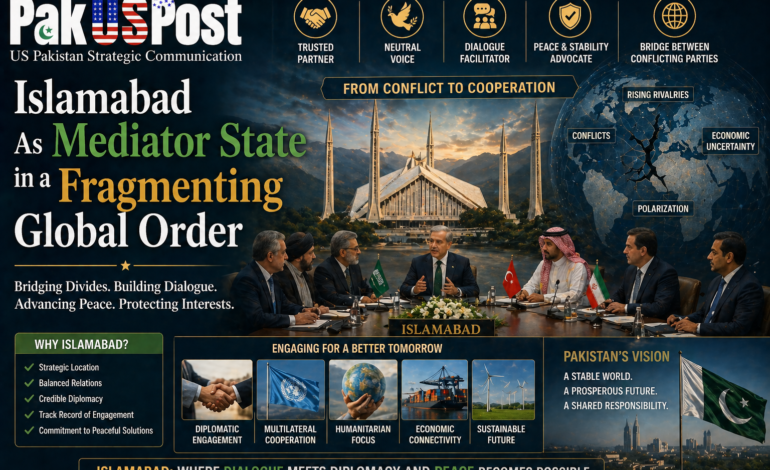
Islamabad As Mediator State in a Fragmenting Global Order

The idea of Pakistan as a mediator state appears, at first glance, counterintuitive in a global system that has historically associated the country with security volatility, regional rivalry, and episodic diplomatic dependence. Yet the structural conditions of contemporary international politics are quietly reshaping the space for middle powers that can operate across competing blocs without full alignment. In this evolving landscape, mediation is no longer a symbolic diplomatic gesture but an emerging form of geopolitical utility, where states derive relevance not from dominance but from access, trust asymmetry, and communication channels across divided systems.
The international order is undergoing a phase of fragmentation that is neither fully bipolar nor genuinely multipolar. Instead, it is characterised by overlapping spheres of influence, where the United States and China compete in technological, financial, and military domains, while regional powers such as Saudi Arabia, Türkiye, Iran, and India assert autonomous strategic agendas. Within this configuration, conflict theatres from Ukraine to Gaza, from the Red Sea to the South China Sea, are increasingly interconnected through energy flows, supply chain disruptions, and digital information warfare. The result is a system in which escalation risks are distributed, but de escalation mechanisms are increasingly weak.
In such an environment, the demand for mediating actors has increased, but the supply of credible intermediaries has not expanded proportionately. Traditional mediators such as Switzerland or Norway operate within normative frameworks but lack geopolitical access to high intensity conflict zones involving major powers. Conversely, states with access often lack neutrality or trust across competing blocs. This creates a structural gap in the international system, where mediation is both necessary and under supplied.
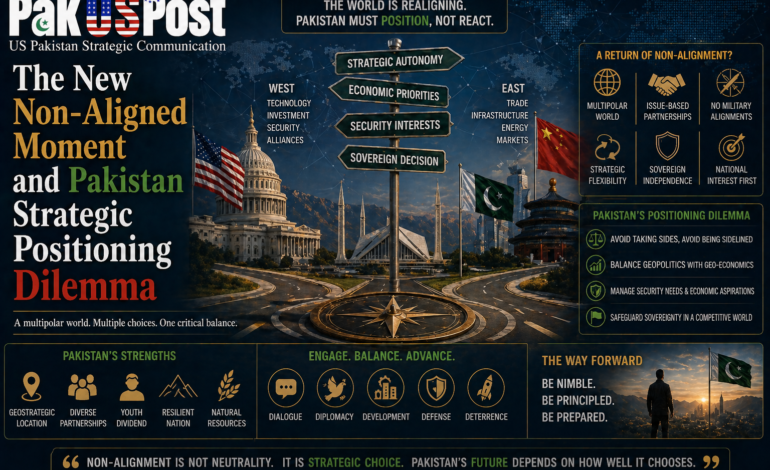
Pakistan occupies a complex position within this gap. Geographically, it sits at the intersection of South Asia, Central Asia, the Middle East, and Western China. Politically, it maintains relationships with rival power centres, including the United States and China, Gulf monarchies and Iran, Türkiye and Western institutions. Strategically, it is embedded in security architectures ranging from counterterrorism cooperation to nuclear deterrence stability. This dense web of relationships creates both constraint and opportunity. Constraint, because competing expectations limit policy freedom. Opportunity, because few states maintain simultaneous access to such diverse geopolitical networks.
However, mediation is not simply a function of geographic positioning or diplomatic connectivity. It is fundamentally a question of credibility. The ability to act as an intermediary depends on perceptions of neutrality, institutional stability, communication discipline, and diplomatic predictability. Here lies Pakistan’s central challenge. Its historical identity as a frontline state in the Cold War and post 9/11 security architecture has embedded a perception of reactive diplomacy, often shaped by crisis response rather than agenda setting.
Yet this perception is not static. The evolution of Pakistan’s diplomatic engagements over the past decade reveals gradual diversification. Engagement with China through long term infrastructural frameworks, recalibrated relations with Gulf states through economic diplomacy, selective re engagement with the United States through climate and economic channels, and cautious opening towards regional connectivity initiatives all suggest an incremental shift towards multi vector diplomacy. The question is whether this shift can be consolidated into a coherent mediatory identity.
In contemporary global discourse, mediation is increasingly linked to issue based diplomacy rather than comprehensive neutrality. States do not need to be universally neutral; they need to be trusted within specific domains. Türkiye’s role in Ukraine grain negotiations, Qatar’s involvement in Afghanistan dialogue channels, and Oman’s quiet facilitation of Iran United States communication illustrate this emerging model of functional mediation. These examples suggest that mediation is becoming sectoral, episodic, and interest driven rather than institutional and permanent.
Within this framework, Pakistan’s potential mediatory role is most plausible in three interconnected domains. The first is US China indirect communication, where formal diplomatic engagement is limited but informal signalling and crisis de escalation remain essential. Pakistan’s simultaneous engagement with both powers provides a narrow but significant channel for interpretive diplomacy, particularly in regional security contexts. However, this requires extreme calibration to avoid perceptions of alignment bias.
The second domain is Islamic world conflict mediation, particularly between Gulf states and Iran, or within intra regional disputes involving political Islam, energy competition, and security alignments. Pakistan’s historical ties across both Sunni majority Gulf states and Shia majority Iran provide a unique but delicate positioning. Yet this also exposes Islamabad to reputational risk if mediation is perceived as partial or externally influenced.
The third domain lies in South and Central Asian connectivity disputes, where infrastructure corridors, energy pipelines, and trade routes intersect with competing strategic interests. Here, Pakistan’s geography is not merely symbolic but operational. Connectivity initiatives involving China, Central Asia, and potentially the Middle East position Pakistan as a potential logistical and diplomatic bridge. However, internal economic instability and policy inconsistency limit its ability to fully capitalise on this role.
Media narratives play a decisive role in shaping perceptions of mediatory credibility. International media often frames Pakistan through a dual lens of strategic indispensability and systemic instability. This contradiction produces an ambiguous global image. On one hand, Pakistan is seen as too important to ignore due to its nuclear status and regional connectivity. On the other, it is perceived as too volatile to serve as a neutral platform for sustained mediation.
Western policy discourse tends to evaluate mediatory states through institutional benchmarks such as governance stability, financial predictability, and diplomatic consistency. Within this framework, Pakistan is often categorised as a state in transition rather than a stable intermediary. Chinese media narratives, by contrast, emphasise strategic partnership and regional connectivity, portraying Pakistan as a reliable corridor state rather than a neutral mediator. Gulf media often highlight trust based bilateralism, while Turkish narratives emphasise ideological solidarity within broader Muslim world diplomacy. These divergent perceptions create an uneven global reputational landscape.
Digital media further complicates this environment. Rapid information cycles, geopolitical commentary ecosystems, and social media amplification produce fluctuating narratives about Pakistan’s international role. A single diplomatic engagement may be interpreted simultaneously as strategic alignment, hedging behaviour, or crisis management, depending on the observer’s analytical lens. This narrative volatility undermines the consistency required for sustained mediatory credibility.
Institutionally, effective mediation requires more than diplomatic intent. It demands specialised bureaucratic capacity, strategic communication infrastructure, and long term policy continuity. Countries that successfully operate as mediators typically invest in niche diplomatic expertise, confidential communication channels, and long horizon trust building. Pakistan’s institutional architecture, while experienced in crisis diplomacy, has limited capacity in sustained facilitative negotiation roles that extend across multiple geopolitical cycles.
Economic stability is another critical determinant. Mediator states often function as financial safe spaces or logistical hubs that provide predictability in uncertain environments. Pakistan’s recurring balance of payments challenges, fiscal volatility, and external dependency reduce its attractiveness as a stable mediation platform. Without macroeconomic stabilisation, diplomatic mediation risks being perceived as symbolic rather than structural.
Despite these constraints, the global system is entering a phase where demand for mediation is structurally increasing. As major power competition intensifies and multilateral institutions weaken, the number of unresolved or partially frozen conflicts is expanding. From cyber conflict regulation to maritime disputes and proxy war de escalation, the need for intermediary channels is becoming systemic rather than episodic. This creates an opening for states that can position themselves as functional intermediaries rather than traditional neutral arbiters.
For Pakistan, the strategic question is whether it can transition from crisis driven diplomacy to anticipatory mediation. Crisis diplomacy involves reactive engagement once instability emerges. Anticipatory mediation involves building communication channels before crises escalate. This requires trust accumulation, institutional continuity, and narrative consistency over time.
Another dimension involves digital diplomacy. The future of mediation is increasingly mediated through digital platforms, encrypted communication channels, and hybrid diplomatic networks involving state and non state actors. Pakistan’s engagement in this domain remains limited but could become increasingly relevant as cyber diplomacy becomes a central feature of international conflict management.
At the structural level, mediation is also linked to legitimacy. States that are perceived as excessively aligned with one bloc struggle to gain trust from opposing actors. Pakistan’s historical balancing between China and the United States, and between Gulf states and Iran, places it in a complex legitimacy environment. Managing this requires not neutrality in absolute terms, but calibrated ambiguity that preserves access without compromising credibility.
Ultimately, the possibility of Islamabad emerging as a mediator state depends on whether it can resolve the tension between strategic dependence and diplomatic autonomy. Mediation is not a declared status but an earned function. It emerges when other actors perceive value in entrusting communication, facilitation, or de escalation roles to a third party.
The international system is not yet ready to assign Pakistan a formal mediatory identity, but it is increasingly structured in ways that make such a role potentially necessary. The gap between structural demand and institutional readiness defines Pakistan’s diplomatic challenge. Whether this gap becomes an opportunity or a limitation will depend on sustained policy coherence, economic stabilisation, and narrative discipline over time.
In a fragmenting global order, mediation is no longer the privilege of the neutral. It is the function of the connected, the trusted, and the consistently legible. Pakistan’s future in this domain will depend on whether it can transform connectivity into credibility, and credibility into sustained diplomatic utility.
A Public Service Message