Kashmir Dispute In A Distracted World Global Attention Decline

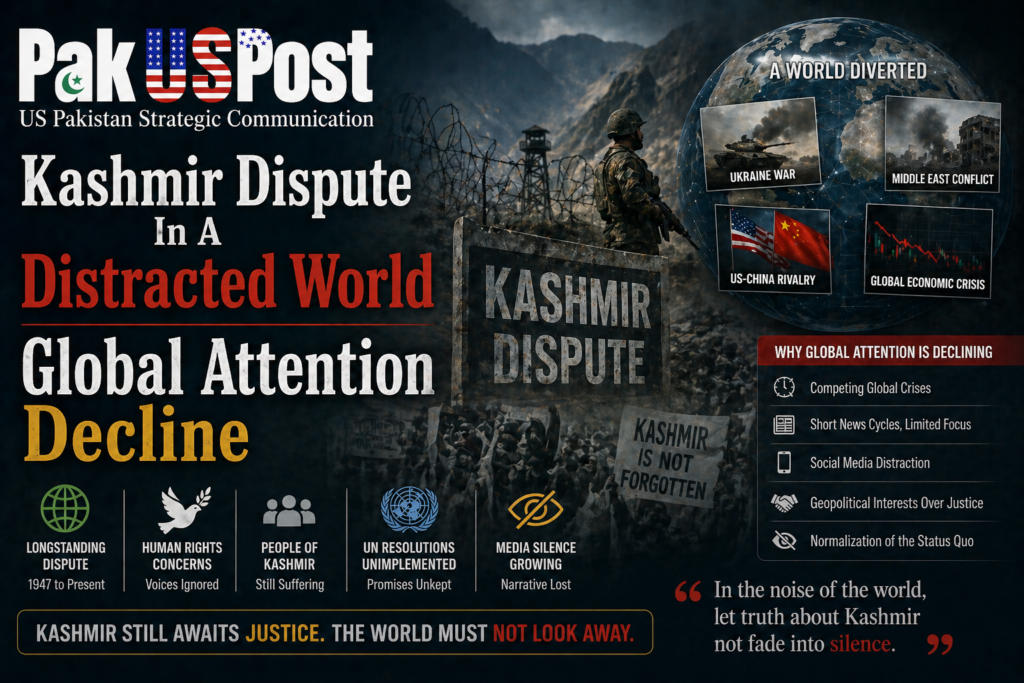
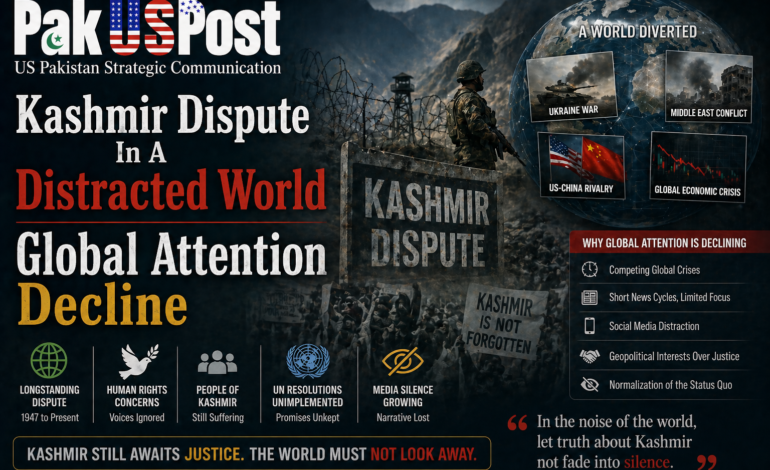
The Kashmir dispute occupies a paradoxical position in contemporary international politics. It remains one of the most militarised territorial conflicts in the world, yet it increasingly struggles to secure sustained attention within a global system overwhelmed by simultaneous crises, from Ukraine and Gaza to the South China Sea and climate induced displacement. The question is no longer whether Kashmir is unresolved, but whether it is becoming structurally deprioritised within an attention economy that rewards immediacy, visual intensity, and strategic spillover over long running territorial disputes that appear frozen in diplomatic time.
The international system today operates less like a hierarchy of issues and more like a competitive attention marketplace. Conflicts rise and fall not only on the basis of strategic importance but also through media saturation, geopolitical spillover, and narrative adaptability. In such an environment, Kashmir suffers from what may be described as chronic visibility without sustained urgency. It appears episodically in global discourse, often triggered by escalations along the Line of Control or human rights reports, but fails to maintain continuity in diplomatic agendas dominated by more recent and globally networked crises.
For Pakistan, this poses a strategic dilemma that is simultaneously diplomatic, narrative, and epistemic. The traditional approach to Kashmir has relied heavily on internationalising the dispute through periodic diplomatic campaigns, multilateral forums, and references to United Nations resolutions. However, the efficacy of this approach has diminished in a world where institutional memory is weak, attention cycles are short, and geopolitical crises compete for cognitive bandwidth within global media systems. The challenge is not simply one of advocacy but of narrative engineering within a fragmented global information order.
The transformation of global media ecosystems has significantly altered the way territorial disputes are perceived. In earlier eras, conflicts like Kashmir could be sustained within long term editorial frameworks in Western newspapers, policy journals, and diplomatic correspondence. Today, digital platforms, algorithmic news distribution, and social media virality determine which conflicts remain visible. Issues that generate immediate visual content or dramatic escalation tend to dominate, while structurally entrenched disputes without constant kinetic escalation are gradually marginalised.
This does not mean Kashmir has disappeared from global consciousness. Rather, it has been reframed within competing narratives that dilute its singularity. In some Western policy circles, it is increasingly embedded within broader South Asian stability discussions, often overshadowed by Indo Pacific strategic calculations. In Indian strategic communication, it is framed as an internal matter of integration and security normalisation following constitutional changes in 2019. In Pakistani discourse, it remains central to national identity narratives and regional diplomacy. However, these competing frames rarely intersect within a unified global agenda.
The result is narrative fragmentation. Kashmir exists simultaneously as a human rights issue, a bilateral territorial dispute, a counterterrorism theatre, and a regional security concern, depending on the observer’s institutional and geopolitical lens. This multiplicity of frames weakens its ability to generate sustained international policy pressure, even when episodic attention spikes occur. The absence of a dominant global narrative architecture means that Kashmir is continuously reinterpreted rather than consistently understood.
Within this fragmented environment, Pakistan faces a strategic question of framing rather than simply advocacy. The traditional vocabulary of territorial dispute and UN mediated resolution has limited resonance in a global order increasingly shaped by thematic governance issues such as climate security, water scarcity, digital surveillance, and demographic transition. The challenge is whether Kashmir can be reframed not only as a political dispute but as a multidimensional crisis intersecting with global governance concerns.
One emerging dimension is water security. The Indus basin system, of which Kashmir is a critical hydrological component, is increasingly under pressure from climate variability, glacial melt, and upstream infrastructural interventions. In a world where water is becoming a strategic commodity, Kashmir’s rivers and glaciers acquire significance beyond territorial sovereignty. This creates an opportunity for reframing the dispute within climate security discourse, linking regional stability to transboundary resource management and environmental sustainability.
Another dimension is human rights and surveillance governance. The post 2019 administrative restructuring of Jammu and Kashmir has generated sustained debate in international human rights forums regarding mobility restrictions, communication controls, and demographic changes. However, these discussions often remain episodic and legally abstract, lacking integration into broader global conversations about digital governance, surveillance technologies, and population management in contested regions. The challenge for Pakistan is to situate Kashmir within this expanding global discourse on technological governance and civil liberties.
A third dimension is geopolitical reorientation. The rise of Indo Pacific strategic frameworks has shifted global attention towards maritime competition, particularly between the United States and China. Within this broader architecture, South Asia is often treated as a secondary theatre, and Kashmir as a legacy dispute rather than an active flashpoint. This reclassification reduces its strategic salience in Western policy planning, even as regional military dynamics remain significant. The question is whether Pakistan can reinsert Kashmir into Indo Pacific discourse by highlighting its potential escalation pathways and nuclear proximity risks.
Media narratives play a crucial role in shaping this perceptual hierarchy. Western media tends to approach Kashmir through episodic coverage, often triggered by security incidents or diplomatic exchanges. The framing is frequently cautious, balancing human rights concerns with geopolitical sensitivities related to India’s growing strategic importance. Indian media, particularly in the digital ecosystem, overwhelmingly frames Kashmir as a post conflict normalisation zone, emphasising development projects and security stabilisation. Pakistani media, meanwhile, maintains a consistent focus on internationalisation and human rights advocacy, but often within a reactive rather than agenda setting framework.
Social media platforms further complicate this environment. Algorithmic prioritisation tends to amplify conflict zones with high visual intensity or viral potential. Kashmir, despite periodic visibility, struggles to maintain sustained digital momentum compared to conflicts that produce continuous graphic content or global diaspora engagement. This creates a paradox where attention is abundant but unstable, and visibility does not translate into policy influence.
Within this context, the international system appears not to have resolved Kashmir but to have deprioritised it within a crowded geopolitical agenda. This deprioritisation is not necessarily permanent, but it reflects structural shifts in global attention economics. The rise of multipolar crises, from Ukraine to Gaza, has compressed diplomatic bandwidth, forcing states and institutions to prioritise conflicts with immediate global spillover effects. Kashmir, despite its nuclear proximity and historical significance, is often categorised as a contained regional dispute.
For Pakistan, this creates a strategic urgency to rethink the epistemology of advocacy. The challenge is not merely to keep Kashmir visible but to transform its narrative architecture. This involves moving from episodic diplomatic interventions to sustained thematic integration across global policy domains. Rather than relying solely on traditional forums, Pakistan must engage climate institutions, digital governance platforms, human rights networks, and water security regimes to embed Kashmir within multiple overlapping global conversations.
This does not imply dilution of the core political dispute. Rather, it suggests narrative expansion. In an interconnected global order, issues gain traction not only through political claims but through their ability to intersect with multiple governance domains. Kashmir’s strategic relevance can thus be amplified by linking it to broader concerns about climate instability, technological surveillance, nuclear risk management, and regional connectivity.
At the same time, Pakistan must confront internal limitations in narrative coherence and institutional capacity. Effective international framing requires sustained diplomatic engagement, policy research infrastructure, and media strategy coordination. Without these elements, narrative efforts risk remaining fragmented and reactive. The international system rewards consistency and thematic persistence, not episodic assertion.
Another critical dimension is legal framing. International law remains a foundational reference point for Kashmir, particularly United Nations resolutions and historical agreements. However, the effectiveness of legal argumentation depends on its integration into contemporary global legal debates, including self determination, humanitarian law, and occupation governance frameworks. Revitalising the legal discourse requires not only repetition of established positions but reinterpretation within evolving international jurisprudence.
The role of middle powers and emerging coalitions also deserves attention. As global governance becomes more diffuse, regional actors and middle powers increasingly shape issue prioritisation. Countries in Africa, Latin America, and Southeast Asia may not directly engage with Kashmir but are influenced by broader principles of sovereignty, territorial integrity, and human rights. Building coalitional awareness within these constituencies could help diversify diplomatic support beyond traditional alignments.
Ultimately, the question is not whether Kashmir remains unresolved, but whether it can remain visible and relevant within a world that is structurally predisposed to distraction. The international system has not closed the file on Kashmir, but it has placed it in a lower tier of urgency. Reversing this trend requires strategic patience, narrative innovation, and multi domain engagement.
For Pakistan, Kashmir cannot be treated as a static diplomatic file awaiting periodic activation. It must be understood as a dynamic narrative ecosystem that requires continuous engagement across legal, environmental, technological, and geopolitical domains. Only through such an integrated approach can it regain sustained traction in a distracted world where attention itself has become the most contested resource in international politics.
A Public Service Message