
State Capacity Crisis Limits Pakistan Policy Execution Power Today

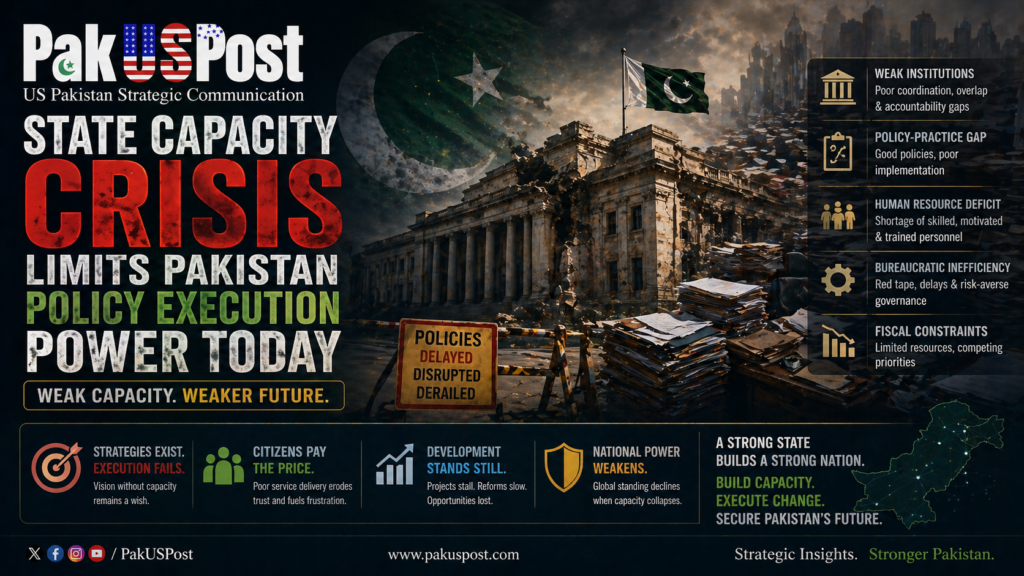
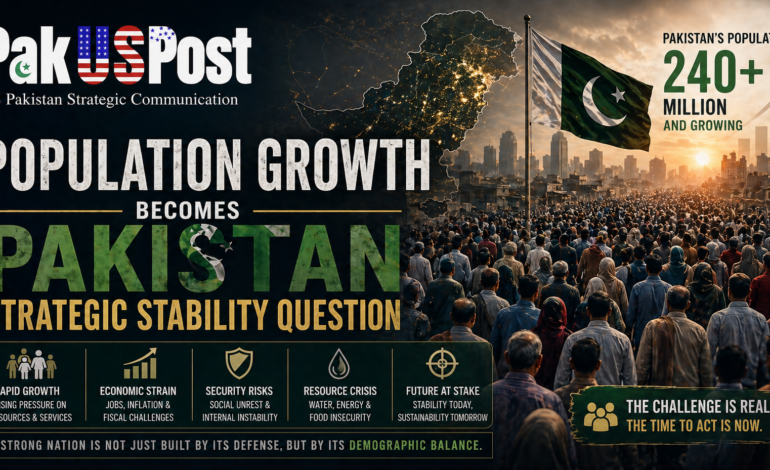
Pakistan’s governance challenge is increasingly defined not by the absence of policy ideas, but by a persistent and widening gap between policy ambition and administrative execution. Across sectors ranging from energy reform and climate adaptation to water governance, population planning, and industrial strategy, the state repeatedly articulates frameworks that are intellectually aligned with global development discourse, yet struggles to translate them into sustained, measurable outcomes. This disjuncture has gradually evolved into what can be described as a structural state capacity crisis, where institutional delivery systems lag significantly behind policy formulation processes. In the emerging Pakistan–United States post-policy environment, this gap is also being reinterpreted through the lens of implementation credibility, where external partners increasingly assess not only policy intent but execution probability before committing financial, technical, or strategic support.
At the heart of this crisis lies a fragmented administrative architecture. Pakistan’s governance system operates through a complex layering of federal ministries, provincial departments, autonomous bodies, and regulatory agencies, often with overlapping mandates and unclear lines of accountability. While this structure allows for policy proliferation, it simultaneously diffuses responsibility, making coordinated implementation difficult. Large-scale national strategies frequently require cross-institutional collaboration, yet institutional silos persist, resulting in delays, duplication of effort, and weak policy coherence. The consequence is a governance environment where policy documents are frequently comprehensive, but implementation pathways remain underdeveloped.
This structural imbalance is further compounded by fiscal constraints. Pakistan’s public financial management system is characterised by limited fiscal space, rigid expenditure structures, and dependence on external financing. Development budgets are often subject to mid-year revisions, reallocation pressures, and revenue shortfalls, which disrupt project continuity. Even well-designed infrastructure or reform initiatives face implementation bottlenecks when funding flows are inconsistent or delayed. In such an environment, policy ambition tends to outpace financial sustainability, creating a cycle of partial implementation and stalled projects.
The media environment reflects and reinforces this execution gap. Public discourse often oscillates between announcement-driven optimism and crisis-driven criticism. Policy announcements are frequently framed as transformative milestones, particularly in televised and digital media narratives. However, when implementation lags or outcomes fall short, discourse shifts rapidly toward institutional failure narratives. This cyclical pattern contributes to a credibility deficit, where successive policy initiatives are received with increasing scepticism by both domestic audiences and international observers. Over time, this erodes the perceived reliability of the state as an executing actor.
In recent years, the Pakistan–US post-engagement framework has added a new dimension to this issue. International partners increasingly evaluate governance systems through performance-based metrics, particularly in areas such as climate resilience, disaster management, and economic reform implementation. Development assistance is progressively tied to measurable outcomes, transparency mechanisms, and institutional reform benchmarks. This shift reflects a broader global trend in which donor confidence is influenced not only by policy alignment but by execution history. In this context, Pakistan’s implementation gap becomes a strategic variable affecting external investment flows and cooperation depth.
Sectoral analysis reveals that the state capacity crisis is not uniform but varies across policy domains. In some areas, such as military coordination or crisis response mechanisms, Pakistan demonstrates relatively high execution capacity due to centralised command structures and established institutional protocols. However, in civilian governance sectors such as education reform, urban planning, and environmental regulation, implementation capacity is significantly weaker. These disparities reflect differences in institutional design, resource allocation, and bureaucratic incentives.
Energy policy offers a particularly illustrative case. Over the past two decades, Pakistan has developed multiple energy sector reforms aimed at improving generation capacity, reducing circular debt, and diversifying energy sources. While generation capacity has increased in certain phases, systemic issues such as distribution losses, tariff misalignment, and governance inefficiencies persist. Policy frameworks have often been technically sound, yet implementation has been inconsistent due to regulatory fragmentation and institutional resistance. This pattern is repeated in water management, where policy sophistication is not matched by infrastructural execution or enforcement capacity.
At the bureaucratic level, human resource constraints play a significant role in shaping execution outcomes. Civil service structures often face challenges related to skill gaps, capacity limitations, and limited exposure to modern governance tools such as data analytics, digital monitoring systems, and performance-based management frameworks. While reform efforts have been introduced periodically, they have not fundamentally altered incentive structures within the bureaucracy. Promotion systems remain largely tenure-based rather than performance-driven, reducing institutional motivation for efficiency-oriented execution.
Another dimension of the state capacity crisis is coordination failure across tiers of government. The devolution process, while intended to strengthen provincial autonomy and local governance, has in some cases created new coordination challenges. Responsibilities for service delivery are distributed across federal, provincial, and local levels without fully integrated planning mechanisms. This leads to gaps in implementation, particularly in areas requiring vertical coordination such as health infrastructure, education quality control, and urban development planning.
In the digital age, expectations of governance performance have also increased. Citizens now interact with state systems through digital platforms, social media, and real-time information flows, creating heightened awareness of policy delays and implementation failures. This transparency intensifies pressure on institutions but does not necessarily translate into improved execution capacity. Instead, it often amplifies perceptions of inefficiency, particularly when digital visibility of policy announcements is not matched by visible outcomes on the ground.
Within the broader geopolitical context, state capacity is increasingly recognised as a component of strategic credibility. In the Pakistan–US post-policy environment, governance performance influences not only development cooperation but also security and economic engagement. International stakeholders increasingly view execution capacity as an indicator of systemic reliability. This includes the ability to manage climate risks, implement structural reforms, and maintain macroeconomic stability under external shocks. Weak implementation capacity therefore carries implications beyond domestic governance, affecting Pakistan’s positioning in global policy networks.
The central paradox is that Pakistan is not deficient in policy formulation capacity. In fact, policy frameworks are often sophisticated, reflecting engagement with global best practices and technical expertise. The limitation lies in translation capacity, the ability to convert policy design into sustained operational outcomes. This translation gap is shaped by institutional fragmentation, fiscal constraints, bureaucratic incentives, and coordination failures, all of which interact to produce a persistent implementation deficit.
Addressing this challenge requires structural reforms rather than incremental adjustments. Strengthening state capacity involves reconfiguring institutional incentives, improving inter-agency coordination, enhancing fiscal predictability, and investing in bureaucratic skill development. It also requires the integration of digital governance systems capable of tracking project implementation in real time, thereby reducing delays and improving accountability. Without such reforms, policy ambition will continue to exceed execution capacity, reinforcing a cycle of announcement without delivery.
In conclusion, Pakistan’s state capacity crisis is not a temporary governance inefficiency but a structural constraint that shapes the country’s development trajectory and strategic credibility. It reflects a systemic imbalance between policy imagination and administrative realism, between institutional design and operational capability. In the evolving Pakistan–United States post-strategic environment, this gap has acquired external significance, influencing investment decisions, cooperation frameworks, and policy engagement levels. The future effectiveness of Pakistan’s governance system will depend on whether it can bridge this gap and transform policy ambition into consistent execution before credibility erosion becomes irreversible.
A Public Service Message