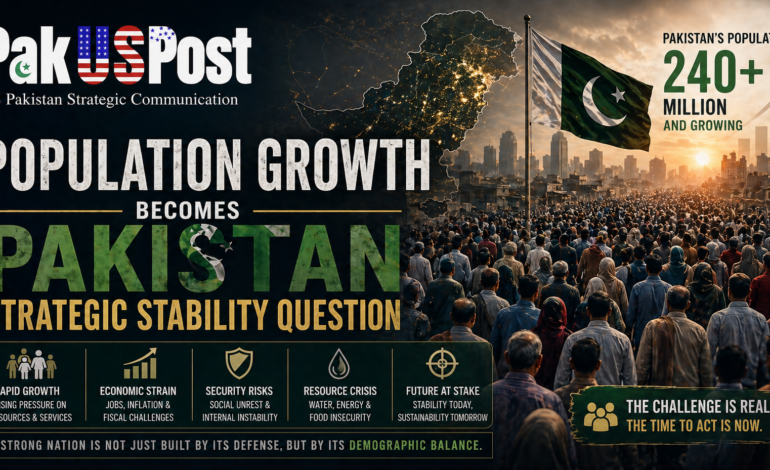
Population Growth Becomes Pakistan Strategic Stability Question


Pakistan’s demographic trajectory has long been described in optimistic policy language as a “youth dividend”, a phrase that implies latent economic dynamism waiting to be unlocked through education, employment, and institutional reform. Yet beneath this narrative of potential lies a far more complex and increasingly urgent strategic reality. Population growth in Pakistan is no longer simply a development concern; it has become a central question of state capacity, economic absorption, social stability, and geopolitical positioning in an interconnected global labour and migration system. In the emerging Pakistan–United States post-policy landscape, demographic trends are also being reinterpreted through the lenses of migration governance, remittance dependency, and human capital flows, placing Pakistan’s population structure within broader transnational economic calculations.
At the core of the issue is a widening structural gap between population expansion and economic system capacity. Pakistan’s labour market is expanding at a pace that consistently outstrips formal job creation. Each year, millions of young people enter working age, yet the economy’s ability to absorb them into productive employment remains constrained by slow industrial diversification, limited export expansion, and persistent reliance on low productivity sectors. Agriculture continues to employ a large share of the population, but it is increasingly unable to sustain livelihoods due to fragmentation of landholdings, water stress, and climate variability. The services sector, while growing, remains heavily informal, absorbing labour without necessarily generating productivity gains.
This imbalance produces a demographic paradox. On paper, Pakistan possesses one of the youngest populations in the world, a characteristic often associated with future economic dynamism. In practice, however, this youth bulge is increasingly characterised by underemployment, skill mismatch, and structural exclusion from high productivity sectors. Educational attainment has expanded significantly over the past two decades, yet the translation of credentials into meaningful employment remains weak. Universities produce graduates faster than the economy generates skilled positions, creating a phenomenon of credential inflation where degrees no longer guarantee economic mobility.
Media discourse around this demographic reality reflects a deep narrative divide. On one side, state-aligned and development-oriented narratives emphasise digital transformation, entrepreneurship ecosystems, and youth innovation as pathways to harness demographic potential. This framing positions Pakistan’s young population as a strategic asset capable of integrating into global digital economies, particularly in freelancing, IT services, and remote work platforms. On the other side, independent economic commentary increasingly highlights structural unemployment, labour market saturation, and the risk of social frustration among educated but underutilised youth cohorts. These competing narratives reflect not only analytical disagreement but also a broader uncertainty about the state’s capacity to convert demographic scale into economic strength.
The issue becomes more complex when viewed through a geopolitical lens. In the Pakistan–US post-strategic context, demographic dynamics are increasingly linked to migration systems and labour mobility frameworks. Pakistan functions as both a labour-exporting economy and a remittance-dependent system, where overseas employment acts as a structural safety valve for domestic labour market pressures. Remittances constitute a significant share of foreign exchange inflows, stabilising external accounts but also masking underlying weaknesses in domestic job creation. This creates a paradoxical dependency: population pressure is partially relieved through external migration, yet this very mechanism reduces urgency for deep structural reform in domestic employment systems.
At the same time, global migration regimes are becoming more selective and regulated, particularly in high-income economies where political pressures around immigration have intensified. This constrains Pakistan’s ability to externalise its demographic surplus indefinitely. Gulf economies, traditionally major destinations for Pakistani labour, are also undergoing structural transitions toward automation and national workforce prioritisation. As a result, the external absorption capacity for Pakistan’s labour surplus is no longer guaranteed, introducing a new layer of strategic uncertainty into demographic planning.
Internally, population growth interacts directly with urbanisation patterns. Cities such as Karachi, Lahore, Faisalabad, and Rawalpindi are expanding rapidly, but often in unplanned or semi-formal ways. Urban infrastructure struggles to keep pace with population influx, resulting in pressure on housing markets, transport systems, water supply, and public services. Informal settlements continue to expand on the peripheries of major cities, creating spatial inequalities that mirror economic disparities. Urban labour markets, meanwhile, are increasingly characterised by informal employment, daily wage labour, and precarious service sector jobs.
Rural areas face a different but related challenge. High fertility rates combined with limited economic diversification create conditions of persistent rural dependency. Climate stress, particularly in agriculture-dependent regions, accelerates migration toward urban centres, further intensifying urban demographic pressure. This rural–urban migration cycle is not fully absorbed by industrial employment, leading instead to expansion of informal economies.
The state’s response to population growth has historically oscillated between policy articulation and implementation constraints. Population planning policies have been introduced at various points, often emphasising family planning, reproductive health, and awareness campaigns. However, the effectiveness of these interventions has been uneven, influenced by cultural dynamics, institutional capacity limitations, and inconsistent political prioritisation. In many regions, access to reproductive health services remains limited, particularly for women in rural and peri-urban areas. This creates structural barriers to achieving meaningful demographic transition.
From a governance perspective, the challenge lies not only in population size but in institutional readiness to manage demographic complexity. Education systems, health infrastructure, and labour market institutions are not fully aligned with the scale and speed of demographic change. Skill development programmes remain fragmented, often disconnected from market demand signals. Technical and vocational training institutions exist but frequently lack integration with industrial planning frameworks, resulting in persistent skill mismatches.
The media environment further complicates demographic discourse. Population growth is often framed in either alarmist or celebratory terms, with limited space for nuanced structural analysis. Sensational narratives around overpopulation risks coexist with optimistic narratives about youth-driven technological transformation, but both tend to simplify a deeply complex socio-economic reality. Increasingly, digital media platforms are becoming spaces where demographic frustration is expressed through discussions of unemployment, migration aspirations, and economic inequality, particularly among younger populations.
In strategic terms, Pakistan’s demographic trajectory has implications beyond domestic development. Population structure influences regional stability, labour market competitiveness, and migration flows, all of which are increasingly relevant in global policy discussions. In the Pakistan–US post-policy environment, demographic factors intersect with broader concerns around economic resilience, security cooperation, and migration management frameworks. The internationalisation of labour markets means that Pakistan’s population dynamics are now embedded within global economic systems rather than confined to national borders.
The central analytical tension is temporal. Population growth operates on long-term biological and social cycles, while economic reform operates on shorter political and institutional cycles. This mismatch creates a persistent lag between demographic pressure and policy response. Even when reforms are initiated, their impact is often delayed relative to the speed of population expansion, resulting in a structural gap that accumulates over time.
Addressing this challenge requires more than incremental policy adjustments. It demands a reconfiguration of economic strategy toward labour-intensive industrialisation, export diversification, and productivity enhancement. It also requires alignment between education systems and labour market needs, as well as expansion of urban planning frameworks capable of absorbing demographic inflows. Without such alignment, population growth risks becoming a destabilising factor rather than a developmental asset.
In conclusion, Pakistan’s population is neither inherently a dividend nor a burden; it is a structural variable whose impact depends entirely on institutional capacity, economic transformation, and governance effectiveness. At present, the imbalance between demographic expansion and economic absorption capacity is widening, creating pressures that are increasingly visible in labour markets, migration patterns, and urban systems. In the evolving Pakistan–US strategic context, demographic management is likely to become an integral component of broader discussions on economic cooperation and regional stability. Whether Pakistan’s population becomes a source of strength or instability will ultimately depend on whether the state can close the gap between demographic reality and institutional capability before structural pressures reach a critical threshold.
A Public Service Message