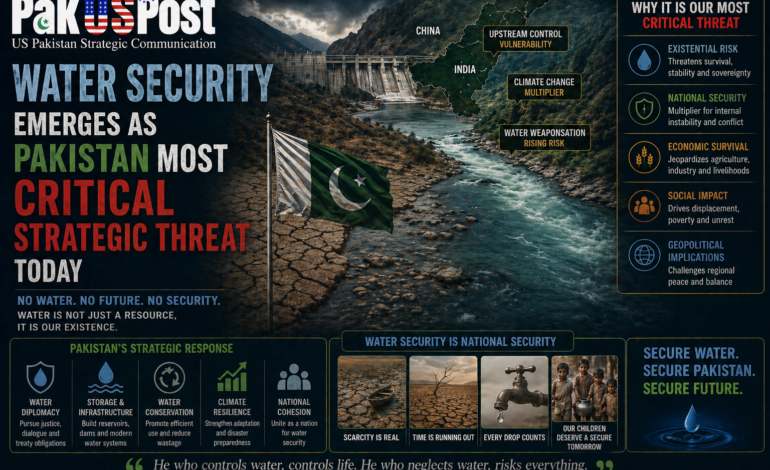
Water Security Emerges As Pakistan Most Critical Strategic Threat Today

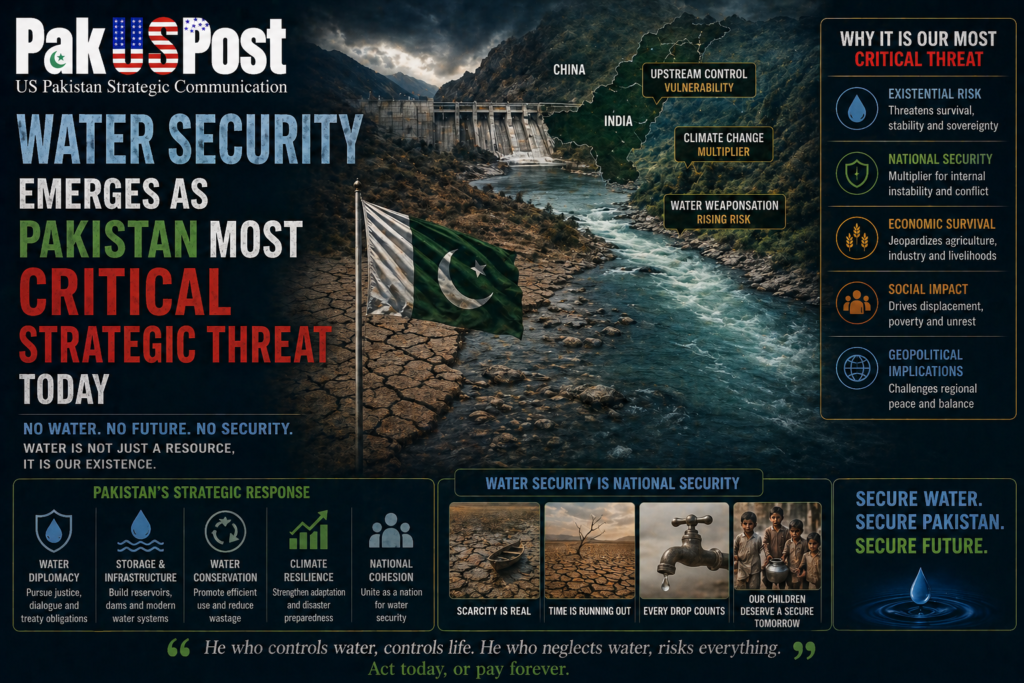
Water in Pakistan is no longer a background development concern confined to irrigation departments, engineering debates, or seasonal policy briefings. It has become a central axis of national security thinking, a structural variable in economic survival, and an increasingly visible fault line in both domestic governance discourse and regional geopolitics. What was once treated as a technical issue of canal efficiency and dam construction has evolved into a complex strategic condition shaped by climate acceleration, upstream hydropolitics, demographic pressure, and institutional fragmentation. In the emerging Pakistan–United States post-strategic dialogue space, water is also gradually being reframed as part of climate security cooperation, disaster risk financing, and agricultural resilience planning, placing it within a broader global governance architecture rather than a purely bilateral South Asian dispute.
The Indus Basin, which sustains more than two hundred million people in Pakistan, is increasingly under stress from multiple converging pressures. Glacial melt patterns in the Himalayas and Karakoram ranges are becoming less predictable, altering long-term river flow reliability. Seasonal monsoons, once relatively stable in timing and intensity, are now marked by volatility, oscillating between destructive flooding and prolonged drought cycles. These climatic disruptions are not abstract environmental phenomena; they directly affect wheat yields, cotton production, hydroelectric generation, and urban water supply systems. In a country where agriculture remains a significant share of employment and export earnings, water volatility translates almost immediately into macroeconomic vulnerability.
Yet the crisis cannot be reduced to climate alone. Pakistan’s water insecurity is deeply embedded in a long history of infrastructural underinvestment and governance inefficiency. The irrigation system, one of the largest contiguous networks in the world, is characterized by seepage losses, outdated canal regulation, and uneven distribution. Groundwater extraction has become a parallel survival mechanism, particularly in Punjab and Sindh, leading to a silent depletion of aquifers that is rarely captured in headline statistics but is increasingly visible in rural livelihood stress. In many districts, tube wells have replaced canals as the primary source of irrigation, shifting the burden of water access from public infrastructure to private extraction, with long-term ecological consequences.
At the geopolitical level, water in Pakistan is often interpreted through the lens of India–Pakistan relations and the Indus Waters Treaty framework. This 1960 agreement, brokered with international mediation, has historically been cited as a rare example of sustained water cooperation between adversarial states. However, its durability is now being tested by changing hydrological realities and evolving infrastructure development on the eastern rivers. In Pakistani media discourse, Indian upstream projects are frequently framed as potential instruments of strategic pressure, particularly during periods of heightened political tension. This narrative has gained traction in television talk shows, policy commentary, and digital media ecosystems, where water is increasingly portrayed not only as a shared resource but also as a lever of coercion.
At the same time, a parallel discourse is emerging within Pakistan that shifts attention inward, emphasizing domestic mismanagement, weak storage capacity, and fragmented water governance. The country’s per capita water storage capacity remains significantly lower than recommended thresholds for water-stressed economies, leaving it highly exposed to seasonal fluctuations. Large dam projects are often delayed due to political contestation, provincial disagreements, and financing constraints, reinforcing a cycle in which short-term crisis management substitutes for long-term structural planning. This internal critique, while less politically charged than external blame narratives, is gradually gaining visibility in academic and policy circles.
The media environment plays a crucial role in shaping these competing narratives. In mainstream Pakistani coverage, water crises are often presented through episodic frames, such as flood disasters, drought emergencies, or inter-provincial water disputes. These frames generate public attention but rarely translate into sustained policy discourse. In contrast, digital platforms and emerging policy think tanks are beginning to construct a more systemic understanding of water as a continuous risk variable rather than a periodic emergency. This shift reflects a broader transformation in information consumption patterns, where climate data, satellite imagery, and hydrological modelling are increasingly accessible to non-state actors, reshaping public understanding of environmental risk.
Within this evolving narrative landscape, water is also becoming entangled with questions of state legitimacy and institutional credibility. The repeated gap between policy announcements and implementation outcomes has created a perception that water governance suffers from chronic execution deficits. National water policies, irrigation reforms, and climate adaptation strategies are frequently articulated with considerable technical sophistication, yet their translation into measurable outcomes remains uneven. This disconnect between policy ambition and administrative capacity is not unique to the water sector but is particularly visible here due to the immediacy of water-related crises in public life.
The Pakistan–United States post-policy context adds another layer of strategic complexity. In recent years, US engagement with Pakistan has increasingly incorporated climate resilience, disaster preparedness, and agricultural sustainability into its development cooperation framework. Water, in this sense, is no longer viewed solely through a geopolitical South Asia lens but as part of a broader climate-security nexus. International financial institutions and donor agencies are increasingly linking water infrastructure investment to governance reforms, transparency mechanisms, and climate adaptation benchmarks. This introduces a new form of conditionality where hydrological resilience is tied to institutional performance.
However, external engagement alone cannot resolve the structural contradictions within Pakistan’s water economy. The fundamental challenge lies in aligning demographic pressure with ecological constraints. Pakistan’s population continues to grow at a rate that places sustained pressure on food systems, urban infrastructure, and rural water demand. The expansion of cities such as Lahore, Karachi, and Faisalabad has intensified urban water stress, where demand consistently outpaces supply infrastructure. Informal settlements often rely on tanker water systems, creating a parallel economy of water distribution that operates outside formal regulatory oversight.
Agriculture, which consumes the majority of available freshwater resources, remains largely dependent on traditional irrigation practices. Water-intensive crops such as sugarcane and rice continue to dominate in certain regions despite their relatively low efficiency in water-stressed conditions. This reflects not only market incentives but also entrenched political economy structures where crop selection is influenced by subsidy regimes, provincial priorities, and agrarian power relations. Attempts to introduce crop diversification or water pricing reforms have historically faced resistance from powerful stakeholder groups, limiting policy effectiveness.
Climate change intensifies all these structural vulnerabilities. Glacial retreat in northern Pakistan has introduced a paradoxical dynamic where short-term increases in meltwater are followed by long-term declines in river stability. This creates a temporary illusion of abundance that masks underlying depletion trends. At the same time, extreme weather events such as cloudbursts and flash floods are becoming more frequent, overwhelming drainage systems and causing significant infrastructural damage. The 2022 floods remain a reference point in policy discussions, illustrating how climate-induced water variability can escalate into a nationwide humanitarian and economic crisis.
In strategic terms, water insecurity is increasingly linked to broader questions of national resilience. It intersects with food security, energy production, and internal migration patterns. Hydroelectric generation, a key component of Pakistan’s energy mix, is directly dependent on river flows, making energy security partially contingent on hydrological stability. Similarly, rural–urban migration is often accelerated by water scarcity in agrarian regions, contributing to urban congestion and labour market pressures. These interconnected dynamics suggest that water cannot be treated as an isolated sectoral issue but must be integrated into a comprehensive national security framework.
The policy challenge, therefore, is not simply technical but institutional and strategic. It requires a shift from fragmented governance toward integrated water resource management that aligns federal and provincial responsibilities, modernizes irrigation infrastructure, and incorporates climate forecasting into planning processes. It also requires investment in data systems capable of providing real-time monitoring of water flows, usage patterns, and groundwater depletion. Without such systems, policy responses will remain reactive rather than anticipatory.
In the longer term, Pakistan’s water future will depend on its ability to reconcile three competing imperatives: ecological sustainability, economic development, and political stability. Each of these dimensions imposes constraints on the others. Expanding agricultural output without improving water efficiency will exacerbate scarcity. Strengthening regulatory enforcement without addressing rural livelihoods may generate political resistance. Investing in large-scale infrastructure without institutional reform risks perpetuating inefficiency.
In the evolving Pakistan–US strategic context, water may emerge as one of the few areas where long-term cooperation is both necessary and feasible. Climate adaptation funding, agricultural technology transfer, and disaster risk financing offer potential avenues for structured engagement. However, such cooperation will only be effective if it is matched by domestic institutional reform capable of absorbing and implementing external support.
Ultimately, water security in Pakistan is not a singular crisis but a cumulative condition shaped by intersecting failures of governance, planning, and adaptation. It reflects the broader challenge of managing a rapidly changing environmental landscape with institutions designed for a more stable era. As climate variability intensifies and population pressures increase, water will continue to move from the periphery of policy debate to the centre of strategic thinking. The question is no longer whether water is a national security issue, but whether Pakistan’s governance systems can evolve quickly enough to treat it as one before structural stress becomes irreversible.
A Public Service Message