

Evidence Driven Regulation Strengthens Future Institutional Decision Quality

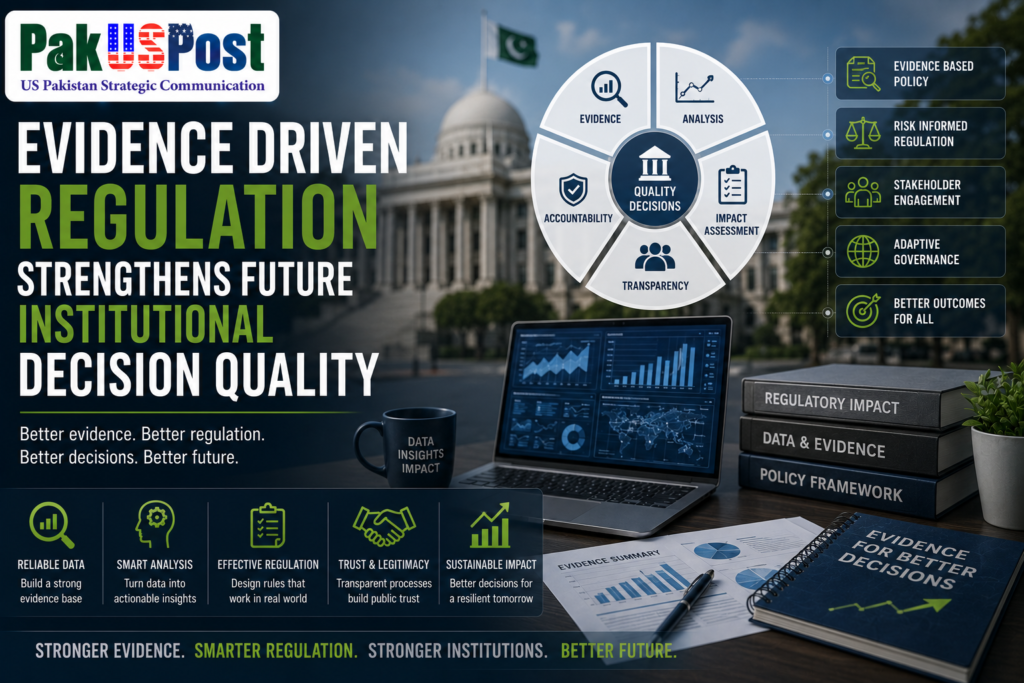
Evidence driven regulation has become one of the defining characteristics separating adaptive states from administratively constrained governments. Across advanced and emerging economies alike, public institutions increasingly recognise that regulatory authority alone is insufficient to produce effective governance. The quality of regulation depends upon the quality of evidence informing it, the integrity of institutions implementing it, and the capacity of governments to continuously evaluate outcomes rather than merely announce policies. The future of institutional decision quality therefore rests upon transforming governance from assumption based administration into evidence centred public management, where measurable outcomes, behavioural insights, administrative analytics, and continuous regulatory review shape state performance. For Pakistan, this transformation presents not merely an opportunity for administrative reform but an essential requirement for improving national competitiveness, strengthening institutional credibility, and enhancing strategic resilience in an increasingly complex international environment.
Modern governance has evolved beyond the traditional bureaucratic model in which ministries formulate regulations based primarily upon precedent, political judgement, or departmental preferences. Contemporary policymaking increasingly integrates behavioural science, policy experimentation, digital analytics, performance measurement, and regulatory impact assessment into routine administrative practice. Governments capable of collecting reliable data, interpreting institutional performance, and adjusting regulations according to empirical evidence consistently demonstrate greater policy stability, improved service delivery, stronger investor confidence, and enhanced public trust. Conversely, states relying upon fragmented information, inconsistent implementation, and politically reactive decision making frequently encounter regulatory uncertainty, implementation failures, and declining institutional legitimacy.
Evidence driven governance represents an institutional philosophy rather than a single technical instrument. It requires governments to establish systematic mechanisms through which policies are designed, tested, monitored, evaluated, and refined throughout their operational life cycle. Regulatory decisions become iterative rather than static, allowing institutions to adapt to changing economic conditions, technological developments, demographic shifts, and security challenges without undermining legal certainty or administrative continuity. Such adaptive governance increases state capacity because institutions continuously learn from implementation rather than treating regulation as a one time legislative exercise.
Behavioural science has emerged as one of the most influential contributors to regulatory innovation. Traditional regulatory models frequently assume that individuals and organisations respond rationally to legal incentives. Practical experience demonstrates otherwise. Human decision making reflects cognitive biases, institutional cultures, social expectations, informational limitations, and behavioural patterns that frequently diverge from theoretical assumptions. Governments incorporating behavioural insights into regulatory design therefore improve compliance while reducing enforcement costs. Small adjustments in administrative procedures, information presentation, digital interfaces, public communication, and incentive structures often produce substantial improvements in taxpayer compliance, environmental protection, public health, financial regulation, and social welfare administration.
For Pakistan, behavioural science offers considerable potential across taxation, energy conservation, healthcare utilisation, education participation, digital governance, environmental management, judicial administration, and public procurement. Administrative reforms informed by behavioural evidence can increase voluntary compliance while reducing expensive enforcement mechanisms. Such approaches strengthen institutional legitimacy because citizens experience regulation as transparent, predictable, and understandable rather than excessively coercive or administratively burdensome.
Policy experimentation represents another essential component of evidence driven governance. Rather than implementing nationwide reforms immediately, governments increasingly conduct pilot programmes within selected jurisdictions before expanding successful initiatives nationally. Controlled experimentation reduces implementation risk, identifies operational challenges, measures unintended consequences, and improves institutional learning before large scale resource commitments occur. Experimental governance allows policymakers to distinguish between theoretically attractive reforms and practically effective interventions through measurable evidence.
Countries demonstrating sustained governance innovation routinely employ regulatory sandboxes, demonstration projects, phased implementation schedules, and experimental administrative programmes across sectors ranging from financial technology and artificial intelligence to healthcare delivery and education reform. Such mechanisms encourage institutional learning while preserving regulatory stability. Pakistan possesses significant opportunities to institutionalise experimental governance within provincial administrations, special economic zones, municipal authorities, digital public services, agricultural modernisation programmes, and emerging technology regulation. Pilot based implementation could substantially reduce policy failures associated with nationwide reforms introduced without adequate operational testing.
Administrative analytics has become increasingly central to modern state capacity. Governments now generate enormous quantities of administrative data through taxation systems, customs authorities, healthcare networks, education institutions, judicial records, procurement platforms, and digital service delivery mechanisms. When properly integrated and analysed, these datasets provide valuable insights into institutional performance, regulatory effectiveness, service delivery efficiency, fiscal management, and emerging governance challenges. Administrative analytics transforms routine governmental operations into continuous sources of policy intelligence.
Pakistan has invested considerably in digital public administration over recent years, creating opportunities to integrate administrative databases into comprehensive governance intelligence systems. Interoperable digital platforms linking ministries, provincial governments, regulatory agencies, and statistical institutions could significantly improve evidence availability for strategic decision making. Data governance standards, cybersecurity protections, privacy safeguards, and institutional interoperability frameworks would become essential prerequisites for responsible administrative analytics while maintaining public confidence in digital governance.
Regulatory impact assessment has become a widely recognised international practice for improving legislative quality before regulations enter into force. Rather than evaluating regulations only after implementation, impact assessment requires policymakers to estimate anticipated economic, fiscal, administrative, environmental, social, technological, and institutional consequences before regulatory adoption. This systematic evaluation strengthens legislative quality by requiring transparent justification, measurable objectives, implementation planning, stakeholder consultation, and alternative policy analysis.
Institutionalising comprehensive regulatory impact assessment within Pakistan would strengthen legislative discipline while improving policy coherence across ministries. Major regulatory initiatives affecting investment, industrial development, financial markets, technological innovation, healthcare, environmental protection, education, labour markets, and digital governance could undergo structured evaluation before implementation. Such procedures would reduce regulatory inconsistencies, minimise unintended economic consequences, and improve coordination among competing administrative priorities.
Regulatory review complements impact assessment by evaluating existing regulations after implementation. Many governments accumulate overlapping rules over decades, creating administrative complexity that discourages investment, increases compliance costs, and reduces institutional efficiency. Periodic regulatory reviews identify obsolete legislation, conflicting administrative procedures, duplicative reporting requirements, and ineffective compliance mechanisms. Simplifying regulatory frameworks improves economic competitiveness while strengthening government credibility.
Pakistan’s regulatory architecture reflects decades of legislative accumulation across federal and provincial jurisdictions. Systematic review mechanisms could modernise administrative frameworks without weakening regulatory objectives. Sunset clauses, periodic evaluation requirements, independent review commissions, and digital regulatory inventories could support continuous institutional modernisation while preserving legal certainty for businesses and citizens alike.
Performance measurement has likewise become indispensable for strengthening institutional accountability. Governments increasingly establish measurable performance indicators allowing policymakers, oversight institutions, legislatures, and citizens to evaluate administrative effectiveness objectively. Performance measurement shifts governance discussions from procedural compliance towards measurable public outcomes. Ministries become accountable not merely for budget expenditure or regulatory issuance but for demonstrable improvements in service delivery, institutional efficiency, economic performance, and public welfare.
Effective performance measurement requires carefully designed indicators aligned with institutional mandates rather than excessive quantitative reporting. Poorly designed metrics encourage bureaucratic compliance without improving governance quality. Successful systems combine quantitative indicators with qualitative assessment, independent evaluation, stakeholder feedback, and strategic policy review. Pakistan’s civil administration could benefit substantially from integrated performance frameworks connecting ministerial planning, budget allocation, implementation monitoring, and independent evaluation into coherent governance cycles.
Evidence driven governance also strengthens national resilience by improving crisis management capabilities. During pandemics, natural disasters, financial instability, cybersecurity incidents, food insecurity, and climate emergencies, governments possessing integrated administrative intelligence, reliable statistical systems, and rapid analytical capacity consistently respond more effectively than institutions dependent upon fragmented reporting structures. Evidence based crisis management reduces uncertainty, accelerates resource allocation, strengthens interagency coordination, and improves strategic communication with citizens.
Institutional decision quality increasingly depends upon multidisciplinary expertise extending beyond traditional civil service structures. Universities, policy institutes, professional associations, technology firms, statistical agencies, and international research networks now contribute significantly to public sector innovation. Governments capable of integrating external expertise while preserving democratic accountability strengthen institutional adaptability without undermining administrative independence.
Pakistan possesses substantial opportunities to deepen technical cooperation with the United States across governance innovation, public administration, behavioural science, regulatory analysis, administrative analytics, digital government, higher education collaboration, and institutional research. Such cooperation should emphasise knowledge transfer, professional development, institutional partnerships, and analytical capacity building rather than dependency. Sustainable cooperation strengthens domestic capabilities while preserving national policy ownership.
United States institutions have accumulated extensive experience in evidence based policymaking through regulatory impact assessment, performance management systems, behavioural science applications, administrative data analysis, and public policy evaluation. Academic institutions, public administration schools, independent policy organisations, and specialised research centres have developed methodologies that can inform governance innovation internationally while remaining adaptable to local constitutional, cultural, and administrative contexts.
Academic exchange programmes represent one of the most productive mechanisms for strengthening institutional decision quality over the long term. Collaborative research involving Pakistani and United States universities can support methodological innovation in regulatory economics, administrative law, behavioural public policy, public finance, digital governance, artificial intelligence regulation, environmental policy, healthcare administration, and institutional performance evaluation. Joint research initiatives encourage professional networks while developing locally relevant policy knowledge rather than importing institutional models without adaptation.
Professional training partnerships between civil service academies, regulatory authorities, universities, and governance institutes similarly strengthen administrative competence. Mid career executive education focusing upon regulatory analysis, evidence evaluation, policy experimentation, programme evaluation, administrative analytics, and strategic governance can gradually transform institutional cultures towards continuous learning and analytical professionalism. Capacity building should prioritise sustainable domestic expertise capable of independently advancing governance reforms.
Digital transformation provides additional opportunities for evidence driven administration. Artificial intelligence supported analytics, interoperable administrative databases, predictive modelling, secure digital identities, electronic procurement systems, and integrated public service platforms generate valuable operational intelligence supporting informed policy decisions. Nevertheless, technological innovation must remain subordinate to constitutional principles, legal safeguards, transparency standards, and democratic accountability. Technology enhances governance only when institutional design, ethical oversight, and administrative competence evolve simultaneously.
Institutional fragmentation remains among Pakistan’s most persistent governance challenges. Overlapping mandates, inconsistent regulatory interpretation, limited interagency coordination, and discontinuous policy implementation reduce overall state effectiveness despite considerable institutional expertise. Evidence driven governance can strengthen coordination by establishing common analytical frameworks, shared performance indicators, interoperable information systems, and standardised evaluation methodologies across ministries and regulatory agencies.
Long term policy continuity requires institutional arrangements capable of preserving strategic priorities beyond electoral cycles or administrative transitions. Many successful jurisdictions establish independent evaluation offices, regulatory oversight councils, national statistical authorities, fiscal monitoring institutions, and professional civil service systems that maintain analytical consistency regardless of political change. Such institutions support democratic governance by separating objective evidence generation from legitimate political decision making.
Pakistan could consider establishing a National Evidence and Regulatory Excellence Council bringing together representatives from federal ministries, provincial governments, academia, statistical agencies, regulatory authorities, judicial experts, and private sector specialists. Such a body could develop common standards for regulatory impact assessment, performance evaluation, behavioural policy applications, administrative analytics, and evidence quality assurance while respecting constitutional responsibilities of individual institutions.
Strengthening parliamentary oversight also contributes significantly to evidence based governance. Legislative committees equipped with independent analytical support, policy research capacity, and technical expertise can evaluate regulatory proposals more effectively while improving executive accountability. Parliamentary scrutiny informed by objective evidence strengthens democratic legitimacy without unnecessarily delaying administrative decision making.
Independent evaluation institutions should likewise become integral components of governance architecture. External programme evaluations conducted according to transparent methodological standards provide valuable feedback regarding policy effectiveness while encouraging institutional learning. Evaluation should be regarded as an instrument for continuous improvement rather than administrative criticism. Governments demonstrating strong evaluation cultures typically adapt more rapidly to changing strategic environments because evidence rather than institutional inertia guides reform.
Regulatory consistency remains particularly important for economic development. Investors, entrepreneurs, financial institutions, and international partners require predictable regulatory environments supporting long term planning. Frequent policy reversals, inconsistent implementation, contradictory administrative guidance, and fragmented enforcement discourage productive investment while increasing economic uncertainty. Evidence based regulatory review strengthens consistency by identifying implementation challenges before they generate systemic institutional risks.
Administrative accountability similarly depends upon transparent decision making supported by documented evidence. Regulatory agencies should publish impact assessments, implementation evaluations, performance reports, consultation outcomes, and review findings whenever appropriate, allowing stakeholders to understand policy rationale while strengthening institutional credibility. Transparency encourages analytical discipline because decision makers recognise that evidence supporting regulations will undergo public and professional scrutiny.
Future governance innovation will increasingly integrate behavioural economics, computational social science, artificial intelligence, systems analysis, predictive analytics, and interdisciplinary policy research into routine public administration. Pakistan possesses significant human capital capable of contributing to these emerging governance disciplines through universities, civil service institutions, research organisations, technology enterprises, and professional associations. Strategic investment in analytical capability therefore represents investment in national institutional resilience.
Ultimately, evidence driven regulation is not simply an administrative reform agenda but a strategic state building project. It recognises that national competitiveness, democratic legitimacy, economic resilience, security preparedness, and public confidence increasingly depend upon institutions capable of learning continuously, adapting responsibly, and governing intelligently. The objective is not technocracy replacing democratic judgement but evidence strengthening political decision making through rigorous analysis, transparent evaluation, and measurable accountability.
Pakistan’s pathway towards stronger institutional decision quality therefore lies in systematically embedding behavioural science, policy experimentation, administrative analytics, regulatory impact assessment, continuous review mechanisms, and performance measurement throughout the machinery of government. Technical cooperation with United States institutions, expanded academic exchange, professional capacity development, and collaborative governance innovation can accelerate this transition while preserving domestic ownership of reform priorities. By institutionalising evidence as the foundation of regulatory practice, Pakistan can strengthen regulatory consistency, enhance administrative accountability, improve long term policy continuity, and build a governance architecture capable of meeting the strategic, economic, technological, and societal challenges of the coming decades with greater confidence, resilience, and institutional effectiveness.
A Public Service Message