
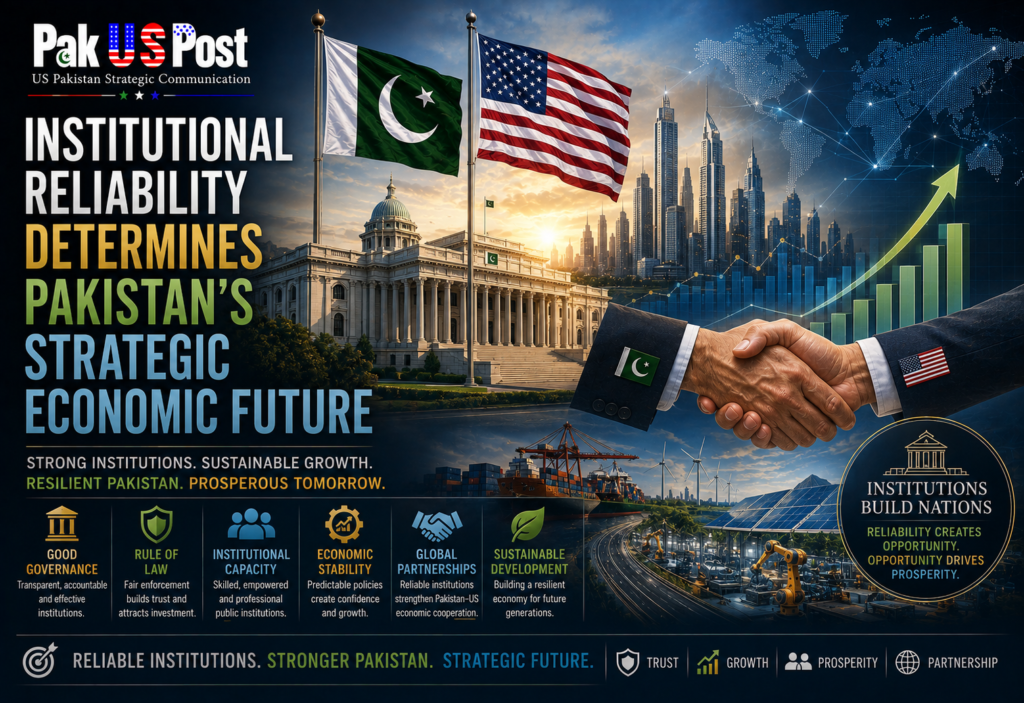
Institutional Reliability Determines Pakistan’s Strategic Economic Future

The international investment environment is undergoing a structural transformation. Capital is no longer governed merely by market size, resource abundance or fiscal concessions. Investors increasingly allocate resources according to a more exacting criterion, namely whether states possess institutions capable of delivering continuity, credibility and administrative certainty over extended periods. The age of transactional investment diplomacy is gradually giving way to an era in which regulatory confidence constitutes strategic capital in its own right.
For Pakistan, this shift carries consequences extending far beyond economics. The country occupies a significant geopolitical position, possesses demographic advantages and remains connected to multiple commercial corridors linking South Asia, Central Asia, the Gulf and western markets. Yet geography alone no longer determines investment outcomes. States now compete through governance performance. Institutional reliability has become an essential determinant of national competitiveness.
This reality holds particular relevance within the evolving Pakistan United States relationship. Bilateral engagement is increasingly moving beyond traditional security concerns towards technology partnerships, digital commerce, critical minerals, clean energy, advanced manufacturing, health innovation and strategic supply chain cooperation. These sectors require long investment horizons, sophisticated legal protections and confidence that policy commitments will survive changes in political leadership.
International investors, particularly those operating from highly regulated economies such as the United States, no longer assess opportunities through commercial indicators alone. They measure institutional behaviour. They examine whether contracts are enforceable, whether regulations remain stable, whether administrative decisions are predictable and whether judicial systems can resolve disputes efficiently. Investment decisions increasingly resemble governance assessments.
This evolution reflects broader changes in the global economy. Supply chains are fragmenting under geopolitical pressures. Corporations seek resilience rather than simple cost advantages. Technological industries require extensive capital commitments that may remain operational for decades. Such investments cannot function in environments characterised by administrative unpredictability or abrupt policy shifts.
Pakistan possesses significant economic potential but faces a recurring challenge in converting strategic opportunities into enduring outcomes. The difficulty does not primarily stem from an absence of policy initiatives. Pakistan has produced numerous investment frameworks, industrial policies and reform agendas over successive decades. The persistent issue lies in implementation continuity.
Investors frequently encounter institutional complexity arising from overlapping jurisdictions, inconsistent interpretations and procedural uncertainty. Federal authorities may adopt a particular policy direction while provincial agencies apply divergent operational standards. Regulatory bodies occasionally issue competing requirements. Administrative transfers disrupt institutional memory, while changing political priorities affect implementation speed.
These conditions create hidden transaction costs. Capital becomes more expensive. Commercial planning becomes difficult. Long term projects encounter delays unrelated to market conditions. Consequently, investors begin pricing institutional uncertainty into financial calculations, reducing competitiveness despite attractive commercial fundamentals.
This challenge is not unique to Pakistan. Numerous countries have confronted similar constraints and achieved substantial improvements through deliberate institutional reforms. Their experiences demonstrate that investment confidence emerges not from promotional campaigns but from repeated evidence of administrative reliability.
Singapore offers one of the most striking examples. The city state lacked extensive natural resources yet developed a reputation for legal certainty, efficient regulation and contract enforcement. Investors gradually viewed Singapore not merely as a market but as an institutional ecosystem where risks remained measurable and predictable. Regulatory consistency became an economic asset equivalent to physical infrastructure.
The experience of Vietnam similarly illustrates how sustained policy continuity can transform investor perceptions. Economic reforms succeeded because investors recognised long term governmental commitment towards industrialisation, export orientation and administrative predictability. Confidence accumulated gradually through practical implementation rather than rhetorical commitments.
The United Arab Emirates presents another important model. Economic diversification required more than financial incentives. Specialised legal jurisdictions, internationally recognised arbitration mechanisms and streamlined regulatory systems created an environment where investors could anticipate outcomes with greater certainty.
Rwanda demonstrates that institutional transformation is possible even under constrained circumstances. Administrative digitisation, procedural simplification and disciplined implementation substantially improved governance perceptions. The lesson is clear. Institutional quality does not depend solely upon national wealth. It depends upon organisational discipline, continuity and reform coherence.
Pakistan’s future economic trajectory increasingly depends upon embracing this principle. The next phase of national competitiveness will be determined less by incentives and more by institutional performance. Regulatory certainty should therefore be regarded as strategic infrastructure.
One of the most pressing areas requiring attention is administrative continuity. Frequent transfers within public institutions often interrupt policy execution. Each transition risks delaying projects, weakening accountability and reducing institutional memory. Investors require confidence that agreements concluded with one administrative team will remain valid under subsequent leadership.
A stronger professional civil service architecture could address this challenge. Specialised cadres dealing with investment, technology regulation, infrastructure and commercial governance should receive long term assignments, technical training and performance based evaluation systems. Institutional knowledge must become a permanent state asset rather than an individual possession.
Judicial efficiency represents another decisive variable. Commercial disputes are inevitable in every economy. Investors do not expect perfect conditions. They expect reliable mechanisms for dispute resolution. Delayed litigation increases uncertainty and raises costs. Efficient commercial courts, expanded arbitration frameworks and technology enabled judicial processes could significantly improve investor confidence.
Alternative dispute resolution deserves greater emphasis within Pakistan’s governance framework. Commercial mediation, sector specific arbitration and fast track investment tribunals can reduce procedural burdens while ensuring timely outcomes. These mechanisms are particularly important for technology intensive sectors where delays carry substantial financial consequences.
Digital governance offers perhaps the most immediate opportunity for institutional strengthening. Administrative complexity frequently arises from fragmented procedures requiring interaction with multiple agencies. Digital integration can reduce uncertainty by standardising processes and enhancing transparency.
Pakistan has already made progress in taxation, customs modernisation and digital payments. Yet institutional platforms remain fragmented. Investors continue navigating separate approval systems with varying requirements. A unified national investment portal integrating licensing, taxation, environmental approvals, customs procedures and compliance obligations would significantly improve administrative efficiency.
Transparency in regulatory decision making is equally important. Investors seek predictability more than preferential treatment. Public consultation before major regulations, publication of implementation guidelines and accessible dispute mechanisms reduce uncertainty. States increasingly compete through openness rather than discretion.
Policy continuity across political transitions requires particular attention. Democratic systems naturally produce changes in leadership and priorities. Yet strategic sectors require durable consensus extending beyond electoral cycles. Infrastructure, technology partnerships, energy cooperation and industrial investments often span decades. Investors therefore assess whether national priorities remain protected from abrupt political shifts.
Pakistan could benefit from institutionalising bipartisan economic compacts identifying sectors of enduring national importance. Such arrangements would preserve democratic competition while ensuring continuity in critical areas including digital infrastructure, industrial development, advanced manufacturing and technological cooperation.
National security institutions also possess an important role in this process. Economic resilience increasingly forms part of strategic stability. Technological capacity, industrial diversification and investment attractiveness contribute directly to national strength. Consequently, economic governance and security planning are becoming more interconnected.
Civil military coordination in strategic sectors should therefore focus upon institutional facilitation rather than administrative intervention. Transparent coordination mechanisms improve implementation while preserving investor confidence. Predictability remains essential. Investors accept security considerations when frameworks are clear, lawful and consistently applied.
The Pakistan United States economic relationship offers valuable opportunities in this regard. American investors and institutions possess extensive experience in commercial law, regulatory impact assessments, competition policy and dispute resolution mechanisms. Bilateral cooperation can support capacity building in these areas without compromising national sovereignty.
Emerging sectors particularly require sophisticated governance structures. Artificial intelligence, cybersecurity, biotechnology, semiconductor manufacturing and critical minerals involve complex regulatory questions concerning intellectual property, data governance, environmental standards and national security considerations. Institutional ambiguity in these sectors may deter precisely the investment needed for future growth.
Pakistan’s expanding technology ecosystem offers significant promise. Young entrepreneurs, digital services and innovation driven enterprises increasingly attract international interest. Yet sustaining this momentum requires stronger frameworks for intellectual property protection, venture capital regulation and digital commerce governance.
Global investment trends increasingly reward countries capable of demonstrating resilience through institutions rather than rhetoric. Sovereign wealth funds, pension funds and multinational corporations assess governance quality alongside economic indicators. Institutional reliability affects borrowing costs, credit ratings and perceptions of long term stability.
This creates an important strategic insight. Governance reform is not merely an administrative exercise. It is a national competitiveness strategy. It influences investment, technology transfer, industrial growth and international partnerships.
The future of Pakistan United States economic engagement will depend increasingly upon this institutional dimension. Investors are not searching solely for incentives. They seek confidence. They seek evidence that commitments endure, regulations remain coherent and institutions function predictably.
States possessing credible institutions enjoy a powerful advantage in the twenty first century economy. Their policies attract capital because investors trust implementation. Their markets expand because commercial risks remain manageable. Their strategic partnerships deepen because reliability becomes a form of national influence.
Pakistan stands at a moment where institutional strengthening can produce transformative effects. The country already possesses geography, demographics and opportunity. The next stage requires converting these assets into sustained economic outcomes through legal certainty, administrative professionalism and regulatory consistency.
Institutional reliability has therefore become more than a governance aspiration. It has become an instrument of strategic statecraft. Nations that master this discipline will shape future investment flows, technological partnerships and economic alliances. Those that fail to do so may continue offering incentives while watching opportunity migrate elsewhere.
For Pakistan, the central challenge is no longer identifying potential. The challenge is constructing institutions capable of converting potential into permanence. In the emerging global economy, credibility itself has become a strategic resource, and states able to preserve it will define the contours of future prosperity.
A Public Service Message