
From Reactive to Proactive Diplomacy: Strategic Recommendations for Pakistan in Managing US Relations and Regional Stability

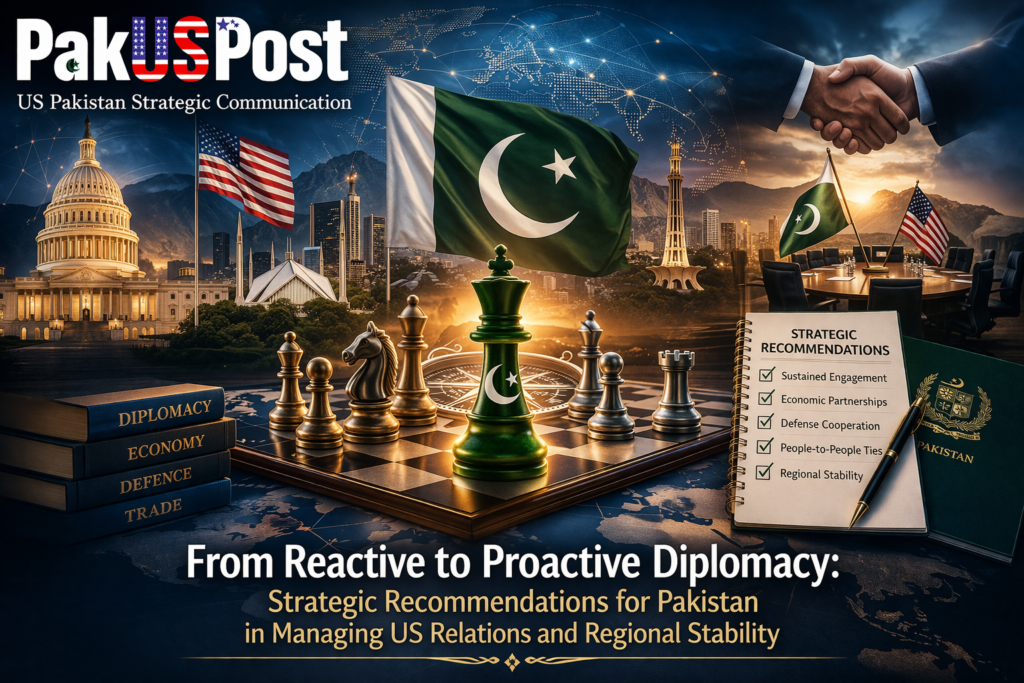
In an era defined by rapid geopolitical realignments, Pakistan’s foreign policy faces a pivotal inflection point. For decades, Islamabad’s approach to international affairs especially its engagement with the United States and neighboring regional actors has been shaped by reactive responses to external pressures rather than forward‑leaning strategic initiatives that define its own interests. The prevalence of security‑centric diplomacy, driven by immediate contingencies and tactical imperatives, has often circumscribed Pakistan’s policy agency, limiting its capacity to shape outcomes that influence regional stability, economic integration, and global partnerships in sustainable ways. As global power dynamics evolve marked by the intensification of US–China rivalry, escalating regional conflicts, and the expansion of economic diplomacy frameworks there is an urgent need for Pakistan to transition from a reactive posture to proactive strategic orientation in managing its diplomatic engagements, particularly with Washington and key regional actors.
The limitations of traditional security‑centric diplomacy have become increasingly evident in recent years. While security cooperation remains an integral component of statecraft, Pakistan’s reliance on this modality has at times entrenched a narrow view of national interests that prioritizes immediate defense imperatives over long‑term strategic planning and multidimensional partnerships. This approach, rooted in historical exigencies of conflict and strategic competition, has consistently placed Pakistan in the position of responding to crises often externally defined rather than initiating policy frameworks that reflect a comprehensive vision for economic growth, social development, and geopolitical influence. The reactive posture has also constrained Pakistan’s ability to reconcile internal policy coherence with the complex expectations of external partners, particularly in engagements with the United States that span military cooperation, counterterrorism cooperation, and economic linkages.
The first step toward proactive diplomacy is acknowledging that national security in the twenty‑first century extends well beyond conventional defense concerns. Broader constructs of security and the instruments to manage them now encompass economic resilience, energy security, technological competitiveness, environmental stability, and social cohesion. Pakistan’s foreign policy must therefore embrace a holistic security paradigm that integrates these dimensions into its external engagements. Such an orientation would enable Islamabad to craft policy initiatives that not only address the immediate concerns of deterrence or crisis management but also foster long‑term partnerships that contribute to structural national resilience. This shift would also reframe Pakistan’s diplomatic discourse, enabling it to engage global actors from a position of substantive strategic interest rather than solely tactical necessity.
The emergence of economic and diplomatic levers such as peace facilitation in regional disputes and cooperation in global supply chains offers Pakistan significant avenues for proactive engagement. Pakistan’s recent attempts to serve as a diplomatic interlocutor in the escalating US–Iran tensions illustrate the potential for Islamabad to act as a constructive agent of stability in its extended neighborhood. While challenges and structural constraints remain, the very act of facilitating dialogue between conflicting parties signals a departure from traditional reactive postures toward initiatives that contribute to conflict resolution and regional stability. In a world fractured by polarizing geopolitical rivalries, constructive diplomacy that creates avenues for negotiation and de‑escalation enhances Pakistan’s international standing and signals its readiness to contribute meaningfully to solutions rather than merely respond to problems.
Similarly, Pakistan’s participation in the United States‑led Critical Minerals Supply Initiative underscores the strategic utility of engaging in economic diplomacy that transcends traditional security paradigms. By aligning itself with global efforts to secure resilient supply chains for minerals crucial to emerging technologies, Pakistan positions itself at the intersection of economic modernization, technological progress, and international cooperation. This engagement offers Islamabad an opportunity to articulate a strategic vision that integrates economic development with diplomatic outreach—thereby converting economic participation into leverage for broader policy influence. Such proactive engagement must be nurtured through sustained interministerial coordination, robust regulatory frameworks, and investments in institutional capacity that enable Pakistan to meet global standards and deliver on partnership commitments.
Central to Pakistan’s transition toward proactive diplomacy are internal institutional reforms that enhance coherence, accountability, and strategic foresight in foreign policy execution. Foreign policy should not reside solely within the Ministry of Foreign Affairs but must be a cross‑government priority embedded within a comprehensive national strategy. This requires the establishment of formal mechanisms for interagency coordination that bring together foreign affairs, finance, defense, commerce, technology, and development portfolios to ensure an integrated approach to external engagements. Strategic planning units, foresight committees, and policy evaluation frameworks can provide the analytical backbone required to anticipate global trends, assess policy impacts, and align diplomatic initiatives with national priorities. Additionally, investments in capacity building through training, recruitment of specialized talent, and exposure to global analytical paradigms will strengthen Pakistan’s ability to formulate and implement nuanced foreign policy strategies.
Another essential dimension of proactive diplomacy is the alignment of the national narrative with a clear strategic vision. Pakistan’s diplomatic posture must be underpinned by a coherent narrative that clearly articulates its priorities, values, and contributions to global and regional stability. This narrative should emphasize Pakistan’s commitment to peace, economic cooperation, technological collaboration, and respect for sovereign equality among nations. A clearly defined narrative enhances diplomatic clarity and enables Pakistan to assert its interests confidently in international forums, bilateral negotiations, and global partnerships. It also provides a platform for strategic communication that counters misperceptions and strengthens Pakistan’s ability to influence global discourse on issues of importance.
Risk contingency planning constitutes another indispensable aspect of proactive diplomacy. In a world of cascading crises—ranging from armed conflicts to economic disruptions and environmental shocks—Pakistan must develop robust frameworks for anticipating and managing risks. Strategic risk assessment units should be tasked with scenario modelling, early warning mechanisms, and contingency planning that empower policymakers to respond to emerging threats with agility and foresight. Such planning ensures that Pakistan’s diplomatic and strategic responses are informed by data, evidence, and long‑term projections rather than short‑term reactive impulses. Furthermore, risk planning must extend to economic vulnerabilities, including disruptions in global trade, energy supply fluctuations, and technological supply chain shocks.
Strategic communication frameworks are equally vital to Pakistan’s proactive diplomatic agenda. Effective communication of policy intent, national priorities, and diplomatic achievements enhances Pakistan’s visibility and credibility in the international community. This requires a concerted effort to engage global media, international institutions, and public diplomacy platforms to project Pakistan’s narrative in ways that resonate with diverse audiences. Strategic communication also involves transparent articulation of policy rationales, responsiveness to international concerns, and engagement in multilateral dialogues that amplify Pakistan’s voice on issues such as regional stability, economic cooperation, and technological collaboration. Enhanced communication frameworks can mitigate misunderstanding, build trust, and establish Pakistan as a constructive partner in addressing global challenges.
A proactive diplomatic posture also necessitates a recalibration of Pakistan’s engagement with major powers particularly the United States without compromising national sovereignty or strategic autonomy. While security cooperation and defense partnerships remain significant dimensions of the Pakistan–US relationship, Islamabad must work toward expanding the relationship into areas of mutual interest such as economic development, technological collaboration, education exchange, and cultural cooperation. Diversifying the basis of engagement will reduce dependency on narrow security narratives and create more resilient bilateral ties that can withstand geopolitical shifts. Pakistan must also articulate clear expectations, benchmarks, and reciprocal commitments that underscore mutual respect and shared benefits in the relationship with Washington.
Simultaneously, Pakistan must diversify its diplomatic engagements beyond traditional partners. Engagement with regional actors—such as Gulf Cooperation Council states, Central Asian Republics, Southeast Asian economies, and African nations—can enhance Pakistan’s strategic reach and economic opportunities. Regional cooperation frameworks that prioritize connectivity, trade facilitation, energy security, and collective peace initiatives offer Pakistan avenues to contribute constructively to regional architecture. Such engagements must be pursued with strategic clarity, well‑defined objectives, and effective implementation mechanisms that reinforce Pakistan’s role as a credible and cooperative partner.
The private sector also has a critical role in shaping Pakistan’s proactive diplomatic agenda. Economic diplomacy must extend beyond government channels to include business communities, industry associations, and investment platforms that can attract foreign capital, foster technology transfer, and create jobs. Strengthening public‑private partnerships and aligning foreign policy with economic strategy will enhance Pakistan’s appeal as an investment destination and integrate diplomatic efforts with domestic economic outcomes. Additionally, Pakistan must prioritize policies that improve its ease of doing business, enhance regulatory transparency, and protect investor rights—thereby reinforcing the credibility of its economic diplomacy.
Education, culture, and people‑to‑people exchange constitute additional levers for proactive diplomacy. Soft power initiatives that promote Pakistan’s cultural heritage, academic partnerships, and exchange programs contribute to building long‑term relationships that extend beyond transactional interests. These initiatives enhance mutual understanding, foster goodwill, and create constituencies of influence in key partner countries. Investing in cultural diplomacy and educational collaboration expands Pakistan’s diplomatic footprint and reinforces its identity as a nation committed to constructive global engagement.
From a policy‑maker perspective, the transition toward proactive diplomacy requires a comprehensive national strategy rooted in long‑term vision, institutional coherence, and strategic implementation capacity. This strategy should articulate clear priorities, define measurable outcomes, and allocate resources to priority areas that align external engagement with national objectives. Pakistan must invest in strategic infrastructure—both physical and institutional—that enables it to execute diplomatic initiatives effectively, monitor outcomes, and adjust strategies based on evolving global and regional dynamics.
In conclusion, Pakistan’s proactive diplomacy represents not merely a shift in tactics but an evolution in strategic thought that reimagines the role of foreign policy as an instrument of national transformation. By transcending reactive responses to external events and embracing a forward‑looking orientation that integrates security, economic, and diplomatic imperatives, Pakistan can redefine its place in the global order. The emergence of economic diplomacy, peace facilitation, institutional reforms, strategic communication, and narrative alignment offers Pakistan the tools to shape its external environment rather than being shaped by it. Through strategic foresight, institutional resilience, and coherent execution, Pakistan can enhance its credibility as a constructive regional partner, strengthen its relationship with the United States, and contribute meaningfully to regional stability and global cooperation. Indeed, the path toward proactive diplomacy is both a national imperative and a strategic opportunity that promises to unlock enduring gains for Pakistan’s security, prosperity, and sovereign agency in the decades ahead.
A Public Service Message