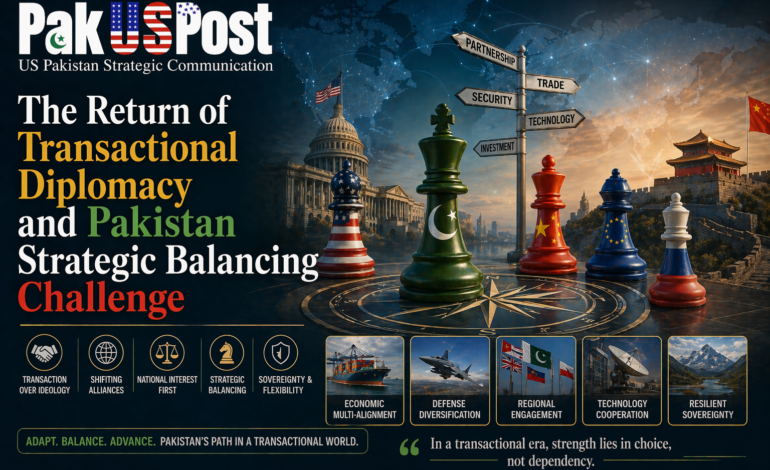
The Return of Transactional Diplomacy and Pakistan Strategic Balancing Challenge

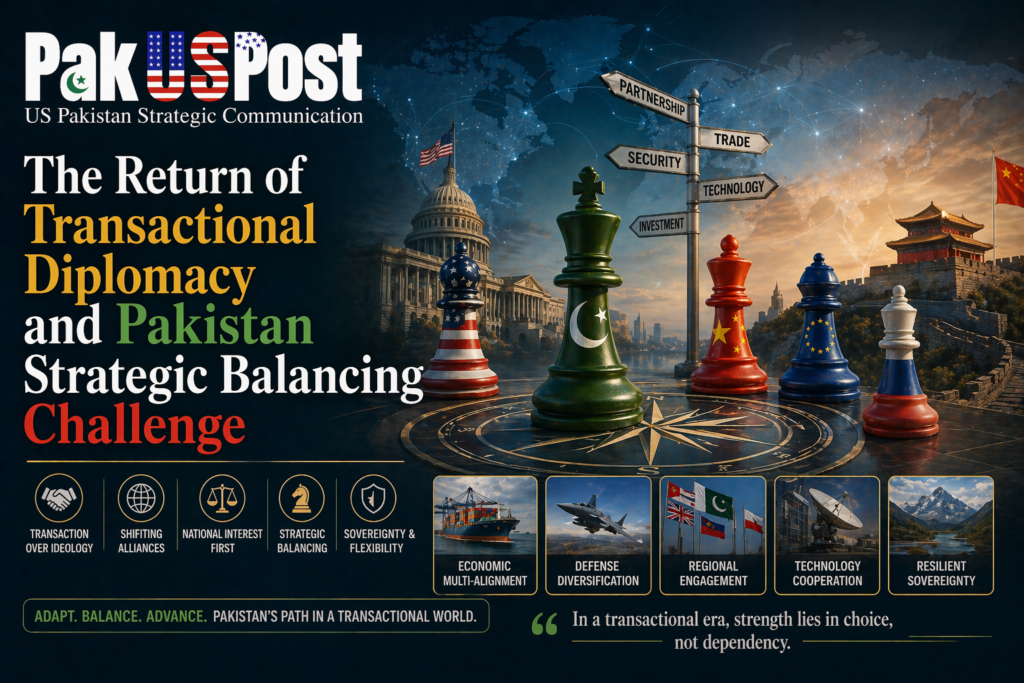
The international system is no longer animated by the grand ideological architectures that once defined alliances, enmities, and long-term strategic fidelity. Instead, it is increasingly governed by a transactional logic in which power is negotiated in real time, commitments are conditional, and diplomatic value is measured through immediate returns rather than historical alignment. In this emerging environment, Pakistan finds itself not at the margins of global politics but at the intersection of several competing strategic economies, each demanding attention, accommodation, and calibrated responsiveness. The United States, China, Saudi Arabia, Türkiye, and Iran no longer represent fixed poles of alignment but shifting centres of opportunity and constraint, each embedded in overlapping domains of security, capital, energy, and narrative influence.
The return of transactional diplomacy is not merely a stylistic shift in international relations. It reflects deeper structural transformations in global capitalism, the fragmentation of multilateral institutions, and the erosion of ideological coherence in foreign policy making. Where once alliances were justified through shared political values or civilizational narratives, they are now increasingly structured around infrastructure financing, supply chain dependencies, defence procurement cycles, and technology access regimes. This recalibration has profound implications for mid tier states such as Pakistan, which historically relied on external alignments for economic stabilisation and security balancing.
For Pakistan, the United States remains a critical but increasingly conditional partner. The relationship is no longer defined by the binary of ally or adversary but by episodic convergence around security cooperation, financial stabilisation, and crisis management. Washington’s strategic gaze is now overwhelmingly directed towards the Indo Pacific, where competition with China shapes trade policy, defence posture, and technological decoupling. Within this architecture, Pakistan is simultaneously relevant and peripheral, a state whose geography intersects with American concerns but whose strategic utility is no longer automatic. Engagement is thus transactional, mediated through aid conditionality, IMF linked fiscal oversight, and selective security cooperation.
China, by contrast, represents a different form of transactional engagement, one embedded in long duration infrastructural investment and strategic patience. The China Pakistan Economic Corridor has reconfigured Pakistan’s infrastructural geography, but it has also embedded Islamabad within a debt dependent and politically asymmetrical relationship. Beijing’s transactionalism is less immediate but more structurally binding, rooted in resource security, regional connectivity, and strategic depth in South Asia. Unlike Washington, China does not demand ideological alignment, but it does expect political reliability, particularly in matters relating to regional security and global diplomatic positioning.
Saudi Arabia introduces yet another dimension of transactional diplomacy, one that blends financial liquidity with labour market interdependence and religious legitimacy. Pakistan’s relationship with Riyadh has historically oscillated between economic lifeline and strategic solidarity. In the current phase, it is increasingly defined by investment expectations, energy security negotiations, and labour export dynamics. Saudi Arabia’s own transformation under Vision 2030 has reconfigured its external engagements into investment centric partnerships, where political support is often exchanged for capital flows and economic participation.
Türkiye represents a different modality of influence, operating through soft power projection, media narratives, defence industrial cooperation, and symbolic solidarity within broader Islamic identity frameworks. Its transactionalism is less financial and more reputational, relying on cultural resonance and selective strategic alignment. Pakistan’s engagement with Ankara is therefore embedded in defence procurement, media collaboration, and diplomatic coordination in multilateral Islamic forums, yet it remains constrained by economic asymmetry and limited structural interdependence.
Iran occupies the most complex position within Pakistan’s diplomatic matrix. It is simultaneously a neighbour, a civilizational counterpart, and a sanctioned state operating under severe economic and political constraints. The transactional dimension of this relationship is shaped by border security management, energy potential, sectarian sensitivities, and regional alignment pressures. Pakistan’s engagement with Tehran is frequently mediated through external pressures and internal security considerations, particularly in the context of Gulf dynamics and Western sanctions regimes. The relationship is thus transactional in a constrained environment, where opportunities are continuously filtered through geopolitical risk calculations.
Within this multi vector environment, Pakistan’s foreign policy is increasingly defined by simultaneity rather than sequence. It must engage all actors at once, often in contradictory contexts, without the luxury of linear alignment. This produces a form of diplomatic congestion where every relationship is both an opportunity and a liability. The traditional doctrine of strategic alignment is therefore replaced by a more fluid model of strategic balancing, in which Pakistan seeks to maximise autonomy while minimising dependency across all axes of engagement.
However, transactional diplomacy is not merely a structural condition imposed from outside. It is also actively constructed through media narratives, policy discourse, and digital diplomacy ecosystems. International media frequently frames Pakistan through the dual lens of crisis management and strategic utility. It is either a state perpetually on the edge of economic instability or a geopolitical corridor essential to regional connectivity. These narratives are not neutral descriptions but instruments of perception engineering that shape investor confidence, diplomatic engagement, and policy prioritisation.
Within South Asian media environments, particularly in digitally saturated platforms, Pakistan’s external relations are often interpreted through competitive national narratives that amplify either strategic dependency or sovereign resilience. Chinese media tends to emphasise infrastructural partnership and strategic convergence, while Western outlets frequently highlight governance challenges and financial vulnerability. Gulf based narratives focus on labour export and religious affinity, whereas Turkish media constructs a discourse of civilizational solidarity. These overlapping narratives create a fragmented epistemic environment in which Pakistan’s global position is constantly being reinterpreted.
In such a context, the central strategic question is not whether Pakistan can avoid transactional diplomacy, but whether it can convert transactionalism into strategic optionality. This requires a fundamental rethinking of foreign policy not as a set of bilateral relationships but as a portfolio of calibrated engagements, each designed to maximise leverage under specific conditions. It also requires institutional coherence, economic resilience, and narrative consistency, without which transactional engagements risk degenerating into reactive dependency.
The United States Pakistan dynamic illustrates this tension most clearly. Periods of convergence, often driven by security crises or regional instability, are followed by phases of disengagement, during which strategic mistrust accumulates. This cyclical pattern reflects the absence of a stable structural framework, replaced instead by episodic transactionalism. The challenge for Pakistan is to stabilise this relationship within a broader framework of economic and technological cooperation that extends beyond security contingencies.
With China, the challenge is different but equally complex. While the strategic relationship is deepening, it is also becoming more asymmetrical. Debt exposure, trade imbalances, and project concentration risk create structural dependencies that limit policy autonomy. Managing this relationship requires not only diplomatic engagement but also domestic economic reform that enhances absorptive capacity and reduces over reliance on single source financing.
In the Gulf context, particularly with Saudi Arabia, transactional diplomacy is entering a new phase defined by investment conditionality and labour market restructuring. Pakistan’s remittance economy remains deeply tied to Gulf employment markets, but future sustainability will depend on diversification of skill sets and expansion of high value labour exports. Without such adjustment, transactional dependence may translate into long term structural vulnerability.
Türkiye and Iran, while smaller in economic scale, play disproportionate roles in Pakistan’s strategic imagination. They represent alternative narratives of regional identity and geopolitical autonomy. However, these relationships too are constrained by economic limitations and external pressure regimes, reinforcing the broader pattern in which ideological affinity is insufficient to overcome structural asymmetry.
The broader international system is also undergoing a transformation that reinforces transactional logic. The fragmentation of global trade regimes, the weaponisation of financial systems, and the rise of sanctions based diplomacy have all contributed to a world in which access is conditional and engagement is negotiated rather than assumed. Middle powers are increasingly forced to navigate this environment without the protective umbrella of stable blocs, relying instead on adaptive diplomacy and selective alignment.
For Pakistan, this represents both a constraint and an opportunity. The constraint lies in limited economic resilience and institutional capacity. The opportunity lies in geographic centrality and diplomatic relevance across multiple strategic theatres. The challenge is to convert this positional advantage into sustained strategic leverage rather than episodic relevance.
Ultimately, the return of transactional diplomacy does not signal the end of strategy but its transformation. Strategy is no longer about fixed alliances but about managing fluid relationships under conditions of uncertainty. For Pakistan, this means embracing complexity rather than resisting it, and recognising that in a fragmented world, survival depends not on choosing sides but on continuously renegotiating them.
A Public Service Message