
AI MERGER GOVERNANCE AND DIGITAL SOVEREIGNTY IN GLOBAL ORDER

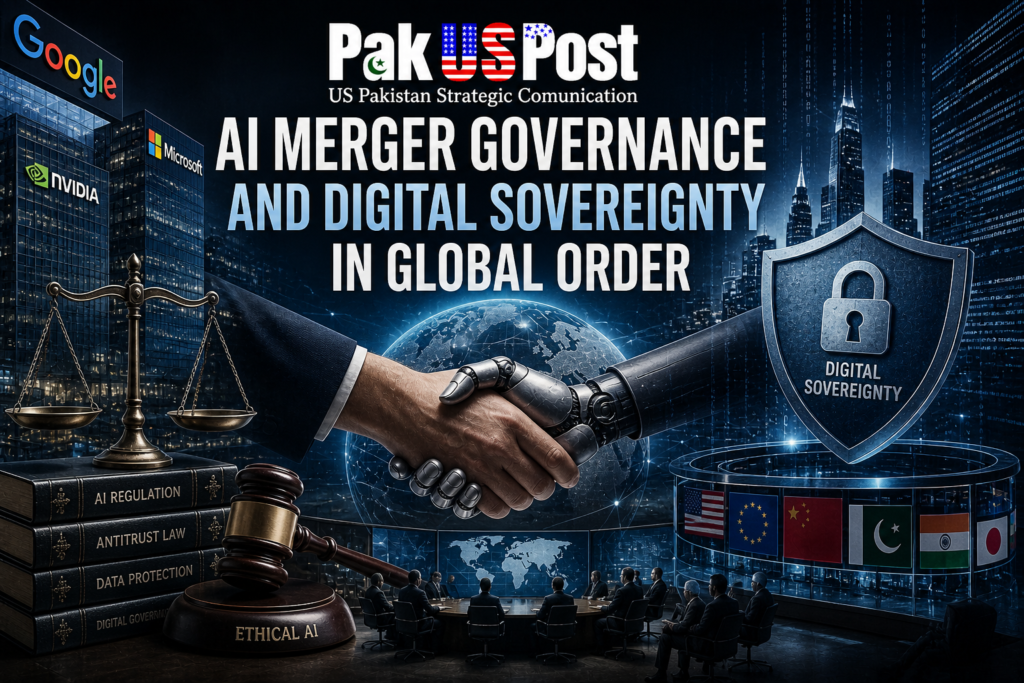
The accelerating consolidation of artificial intelligence industries across borders is quietly redrawing the architecture of global power. What once appeared as a technological competition among firms has now evolved into a structural struggle over sovereignty, information control, and cognitive infrastructure. Cross-border mergers, strategic acquisitions, and compute-driven alliances in artificial intelligence are no longer routine commercial transactions; they are geopolitical acts with long-term consequences for the distribution of knowledge, economic advantage, and strategic autonomy. The central policy question emerging from this transformation is whether the global system can regulate AI consolidation in a way that preserves open innovation while preventing the emergence of irreversible technological monopolies.
At the heart of this issue lies a fundamental asymmetry in the global digital economy. A small cluster of states and corporations now control the majority of advanced AI research, semiconductor supply chains, cloud infrastructure, and large-scale training data ecosystems. These components form an interdependent stack that determines not only technological capability but also informational authority. As AI systems increasingly mediate communication, governance, finance, and security decisions, control over these systems becomes equivalent to control over epistemic infrastructure itself. This shifts AI mergers from economic events into instruments of structural power reconfiguration.
The policy gap is stark. Existing international trade and competition frameworks were designed for industrial and post-industrial economies where mergers could be evaluated primarily through market concentration, pricing effects, and consumer welfare. AI consolidation, however, operates on entirely different parameters. It is driven by data accumulation, computational scale, model architecture exclusivity, and access to proprietary training environments. Traditional antitrust tools are therefore insufficient to assess systemic risks arising from AI mergers that may not immediately raise consumer prices but can permanently alter informational ecosystems.
In the absence of global coordination, AI governance is fragmenting into competing regulatory blocs. The United States continues to prioritize innovation speed and private-sector leadership, allowing large firms to scale rapidly under relatively flexible regulatory oversight. The European Union has moved toward rights-based regulation emphasizing transparency, accountability, and data protection, often constraining large-scale experimentation. China integrates AI development into state-led industrial policy, where national security and technological sovereignty are primary objectives. These divergent models are not merely regulatory preferences; they represent competing visions of the future digital order.
For developing economies, particularly those outside these core blocs, this fragmentation produces structural dependency. Countries such as Pakistan increasingly rely on imported AI systems for governance tools, financial modeling, security analytics, and even linguistic processing. This creates a condition where cognitive infrastructure is externally designed, externally maintained, and externally updated. The result is a form of digital dependency that extends beyond hardware or software into the domain of decision-making frameworks themselves. Over time, this may limit policy autonomy, constrain cultural representation in digital systems, and reduce capacity for indigenous technological innovation.
The absence of a global regime governing AI mergers and acquisitions thus raises a deeper question: whether technological sovereignty can exist in a system where foundational models are concentrated within a handful of transnational entities. Without intervention, the trajectory points toward a hierarchical global intelligence order in which a small number of AI ecosystems define the parameters of knowledge production, economic optimization, and even governance logic for the rest of the world.
The impact dimension of this shift is not limited to economic inequality. It extends into political and epistemic domains. AI systems increasingly determine what information is visible, how it is ranked, and how it is interpreted. When such systems are consolidated through mergers that reduce diversity of model architectures and training data sources, the risk of homogenized global cognition increases. This raises concerns about algorithmic monocultures, where a limited set of design philosophies shape global discourse, potentially marginalizing alternative epistemologies and cultural frameworks.
From a Pakistan–US Post perspective, this dynamic introduces a strategic paradox. On one hand, Pakistan benefits from access to advanced AI systems developed in global markets, enabling efficiency gains in governance, education, and economic planning. On the other hand, this reliance creates structural vulnerability, as policy-relevant decisions become increasingly mediated through externally governed algorithmic systems. The asymmetry is not simply technological but epistemic, affecting how problems are defined, prioritized, and solved.
The economic implications are equally significant. AI consolidation influences global labor markets, outsourcing flows, and productivity hierarchies. As AI systems become more centralized, the competitive advantage shifts toward states and corporations that control foundational models. This may intensify global inequality not through traditional capital accumulation alone, but through differential access to cognitive infrastructure. Countries without participation in AI governance frameworks risk becoming passive consumers of productivity systems rather than active contributors to their design.
The policy challenge, therefore, is not merely to regulate mergers at a transactional level but to design a global governance architecture capable of addressing systemic concentration risks. One possible approach is the establishment of an international AI competition and merger oversight body under multilateral auspices, tasked specifically with evaluating cross-border AI acquisitions based on criteria beyond market concentration, including data sovereignty impact, model diversity preservation, and geopolitical risk diffusion.
However, regulatory ambition must be balanced against innovation dynamics. Excessively restrictive frameworks could fragment the global AI ecosystem further, slowing diffusion of beneficial technologies. The challenge is to construct a governance model that prevents monopolistic consolidation without inhibiting collaborative innovation networks that have historically driven technological progress.
A complementary policy direction involves strengthening national AI capacity in developing economies through targeted investment in compute infrastructure, open-source model development, and regional data governance frameworks. For Pakistan, this implies not only adoption of AI technologies but active participation in their design and governance, potentially through partnerships that emphasize co-development rather than dependency.
The long-term impact of AI merger governance will ultimately depend on whether the international system recognizes artificial intelligence not merely as a sector of the economy but as foundational infrastructure of global cognition. If left unregulated, consolidation trends may produce a world in which informational sovereignty is as unevenly distributed as financial capital, with profound implications for global stability.
The emerging reality is clear: AI mergers are no longer corporate decisions confined to boardrooms. They are geopolitical events shaping the architecture of global intelligence. The absence of coordinated governance risks embedding asymmetries that will define the next phase of global order, not through military dominance or financial control alone, but through control over the systems that construct reality itself.
A Public Service Message