Western Unity Fractures Under Competing Global Crisis Pressures

BY SHAFQAT ALI QURESHI
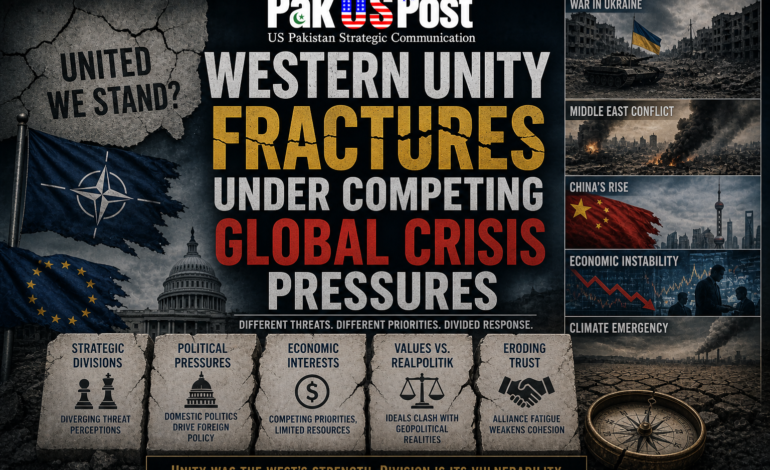
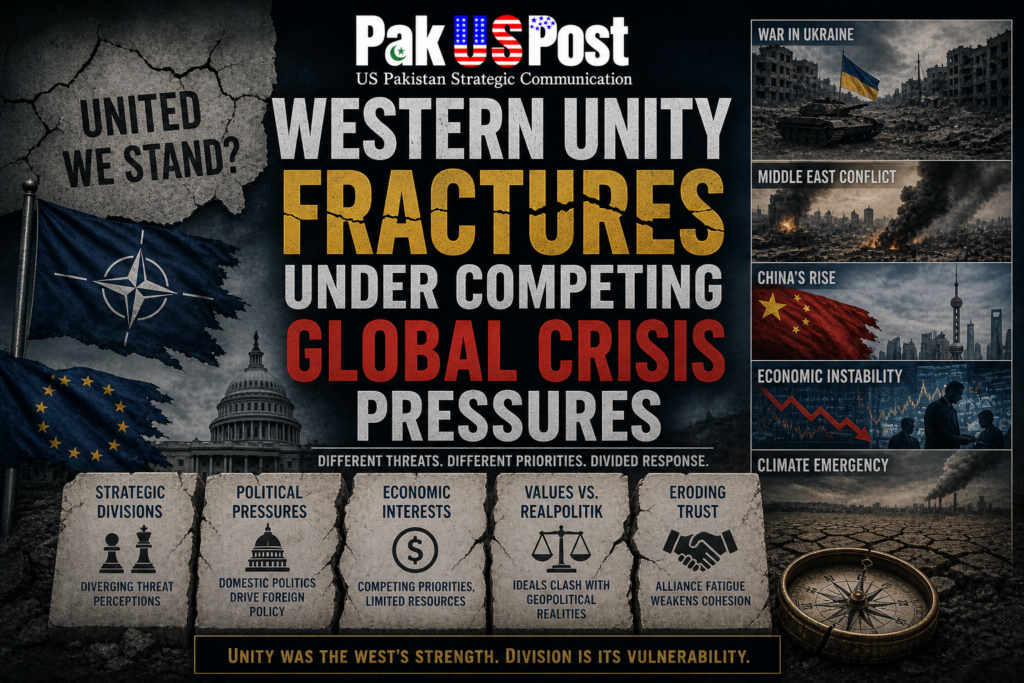
The idea of Western unity has long functioned as both strategic doctrine and political narrative, projecting coherence among transatlantic democracies even when internal disagreements were substantial. Yet the convergence of multiple global crises, including the war in Ukraine, the Gaza conflict, and intensifying strategic competition with China, has exposed a more fragmented reality beneath this long assumed alignment. What once appeared as a consolidated liberal international order now increasingly resembles a conditional coalition of interests, where alignment is episodic, issue specific, and heavily shaped by domestic political constraints rather than shared ideological certainty.
At the center of this fragmentation lies a fundamental shift in the nature of global leadership itself. During the post Cold War period, Western unity was anchored in relatively stable assumptions about collective security, economic globalization, and normative convergence around liberal democracy. Today, each of these pillars is under strain. Security threats are no longer uniform but regionally differentiated. Economic globalization has been partially replaced by strategic decoupling and supply chain nationalism. Normative consensus has fractured under the weight of internal political polarization within Western states themselves. The result is not outright disintegration, but a gradual erosion of coherence.
The war in Ukraine initially appeared to reinforce Western unity, producing unprecedented coordination among the United States, NATO allies, and the European Union in terms of sanctions, military aid, and diplomatic isolation of Russia. However, as the conflict has prolonged, divergences have become more visible. Questions around burden sharing, fiscal sustainability, energy security, and end state objectives have created subtle but persistent fault lines. European states closer to the conflict zone often prioritize de escalation and negotiated settlement frameworks, while others emphasize deterrence and long term strategic containment. The United States, meanwhile, oscillates between sustained engagement and growing domestic fatigue, shaped by shifting political cycles.
The Gaza conflict has further complicated this landscape by exposing normative asymmetries within Western discourse itself. While Western governments broadly maintain strategic alignment, public opinion and political elites diverge sharply on issues of humanitarian law, proportionality, and accountability. This has generated internal tensions within allied states, where foreign policy positions increasingly face domestic contestation in ways that constrain diplomatic flexibility. The result is a fragmented moral geography, where similar events are interpreted through competing ethical frameworks, weakening the perception of a unified Western stance.
China represents a different but equally destabilizing axis of divergence. Unlike Ukraine and Gaza, which are crisis driven conflicts, China is a structural challenge embedded in trade, technology, and long term geopolitical competition. Yet even here, Western unity is far from uniform. The United States increasingly frames China as a systemic rival requiring containment in strategic sectors such as semiconductors, artificial intelligence, and critical minerals. Europe, by contrast, often adopts a dual approach, describing China simultaneously as a partner, competitor, and rival. This conceptual ambiguity reflects economic interdependence and internal divisions within European economies regarding de risking versus decoupling strategies.
These divergences are not merely policy disagreements. They reflect deeper transformations in the domestic political economies of Western states. Rising populism, economic inequality, migration pressures, and political polarization have all contributed to more inward looking policy orientations. Foreign policy, once the domain of relatively stable elite consensus, is increasingly subject to electoral volatility and media driven contestation. This domesticization of foreign policy has significantly reduced the capacity for long term strategic alignment across Western capitals.
Media systems play a critical role in amplifying these fractures. In the contemporary information environment, global crises are not only events but narratives competing for attention, legitimacy, and emotional resonance. Ukraine is often framed as a civilizational struggle for sovereignty and democratic survival. Gaza is framed through humanitarian catastrophe and legal accountability lenses. China is framed through technological competition and systemic rivalry. These narrative frames do not always intersect coherently, and they often pull policy discourse in different directions, further complicating unified responses.
For countries outside the Western bloc, including Pakistan, these fractures are not merely external observations but strategic variables. Platforms such as Pakistan US Post increasingly analyze how shifting Western alignments affect trade, security partnerships, and diplomatic maneuverability. For Pakistan, Western fragmentation creates both opportunity and uncertainty. On one hand, competing priorities among Western states can open diplomatic space for diversified engagement with multiple power centers. On the other hand, inconsistency in Western policy coordination can generate volatility in global financial systems, aid frameworks, and security architectures that Pakistan remains partially dependent upon.
From a United States perspective, the erosion of seamless Western unity presents a strategic dilemma. Washington continues to rely on alliance structures such as NATO and partnerships with European and Indo Pacific allies to project global influence. However, sustaining these networks requires constant negotiation over burden sharing and strategic priorities. Domestic political divisions in the US further complicate this task, as foreign policy consensus becomes increasingly sensitive to electoral cycles and ideological polarization. This reduces predictability and introduces cyclical uncertainty into long term alliance planning.
Europe’s position is particularly complex. Caught between geographic proximity to the Ukraine conflict, economic interdependence with China, and security reliance on the United States, European states are increasingly forced into multidimensional balancing acts. The result is not strategic autonomy in the classical sense, but strategic ambiguity. European policy tends to oscillate between calls for independence and practical dependence on transatlantic security guarantees, producing an uneven and sometimes contradictory external posture.
The broader implication is that Western unity, rather than collapsing, is being reconfigured. It is shifting from a coherent ideological bloc into a flexible network of conditional alignments. Cooperation persists, but it is increasingly transactional, issue specific, and temporally limited. This transformation does not necessarily signal decline, but it does indicate the end of automatic cohesion. Alignment must now be actively constructed rather than assumed.
This has significant consequences for global governance. Institutions designed in an era of Western coherence now operate in a more fragmented environment. Multilateral responses to crises become slower, more negotiated, and more dependent on ad hoc coalitions. Global south states, including Pakistan, are required to navigate this complexity with greater diplomatic agility. Engagement strategies can no longer assume stable Western consensus but must instead account for internal divergences among Western actors themselves.
At a deeper level, the fragmentation of Western unity reflects a broader transition in the global order from hierarchy to heterogeneity. The post Cold War moment was characterized by relative ideological convergence and Western institutional dominance. The current phase is defined by overlapping crises, competing narratives, and plural centers of power interpretation. In such an environment, unity is no longer a structural given but a strategic achievement that must be continuously negotiated.
The critical question is whether this fragmentation will stabilize into a new equilibrium of managed pluralism or continue to drift toward deeper incoherence. Much depends on how Western states reconcile domestic political pressures with external strategic commitments. It also depends on whether shared interests in stability, economic resilience, and security cooperation can outweigh increasingly divergent interpretations of global crises.
For policymakers, including those engaged in transnational policy discourse through platforms like Pakistan US Post, the lesson is clear. Western unity should no longer be treated as a fixed variable in global analysis. It is now a dynamic and contingent condition, shaped by intersecting crises, domestic politics, and narrative competition. Understanding this shift is essential for anticipating future patterns of global alignment, where coherence will be episodic, and fragmentation will be the default condition rather than the exception.
A Public Service Message