Reframing Pakistan United States Relations Toward Sustainable Economic Interdependence Future

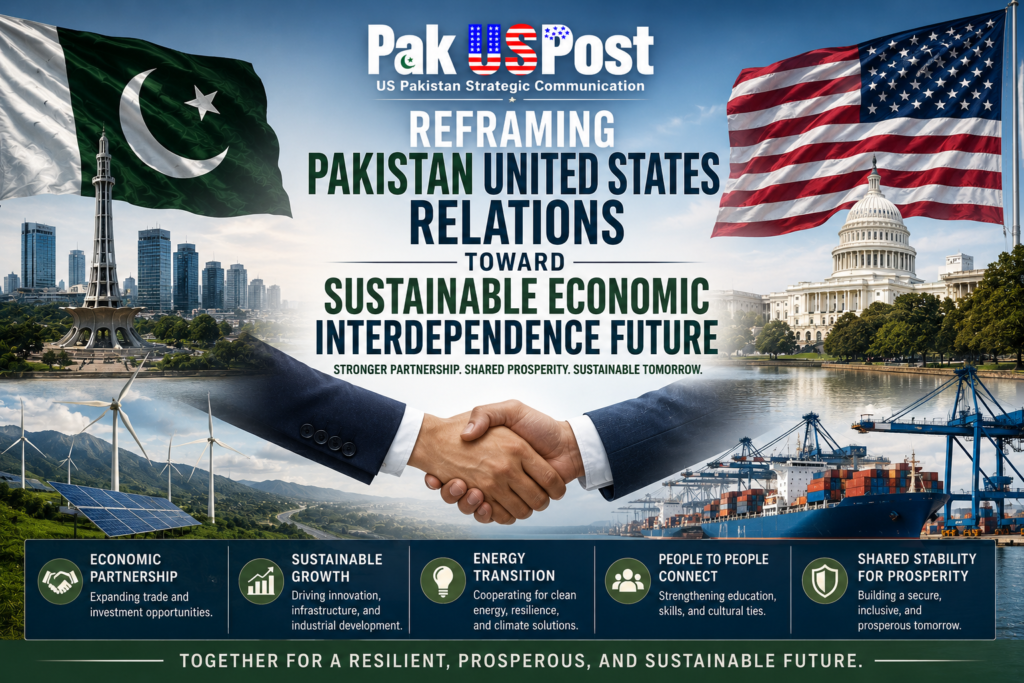
The trajectory of Pakistan United States relations has long been defined by a narrow and often episodic security calculus, wherein geopolitical urgency repeatedly overshadowed structural economic design. From Cold War alignments to post 9/11 counterterrorism cooperation, the relationship has oscillated between strategic embrace and transactional disengagement, producing a diplomatic pattern characterized more by contingency than continuity. This historical asymmetry has left Pakistan structurally dependent on external financial inflows, constrained in export diversification, and persistently vulnerable to external shocks in both political and economic domains. At the same time, the United States has largely engaged Pakistan through a lens of security utility rather than economic partnership, resulting in a relational architecture that has failed to mature into a stable developmental axis.
In the contemporary global order, this inherited framework is increasingly misaligned with emerging realities. The world economy is undergoing a profound reconfiguration driven by supply chain fragmentation, geoeconomic competition, technological decoupling, and the rise of regional production networks. In such an environment, bilateral relationships are no longer defined primarily by military cooperation or crisis diplomacy but by the depth of economic interdependence, regulatory alignment, and innovation connectivity. Within this shifting landscape, the Pakistan United States relationship appears structurally underutilized, lacking the institutional density required to transform political engagement into sustainable economic integration.
The imperative, therefore, is not incremental adjustment but paradigmatic reorientation. A transition from security centric diplomacy to economic interdependence requires a fundamental rethinking of both policy architecture and strategic imagination. This involves dismantling the residual logic of aid dependency and replacing it with investment driven engagement, trade expansion, and human capital mobility frameworks. The central challenge is not merely technical but epistemic, as it requires both states to reconceptualize the other not as a situational ally in security theatres but as a long term economic stakeholder.
For Pakistan, this shift demands a structural recalibration of its external economic orientation. Historically, Pakistan’s export base has remained narrowly concentrated in low value textile production, while its import profile has been heavily skewed toward energy, capital goods, and intermediate inputs. This imbalance has perpetuated chronic current account vulnerability and constrained fiscal autonomy. A reimagined economic partnership with the United States could serve as a catalytic force in diversifying Pakistan’s export portfolio, particularly in digital services, agribusiness innovation, pharmaceutical manufacturing, and climate resilient technologies. However, such diversification cannot emerge spontaneously; it requires deliberate policy engineering, regulatory reform, and institutional modernization.
One of the most critical dimensions of this transformation lies in the reconceptualization of trade itself. Traditional trade frameworks between the two countries have remained limited in scope and elasticity, often constrained by tariff asymmetries, compliance bottlenecks, and non tariff barriers. A forward looking economic agenda would require the establishment of structured trade facilitation mechanisms that go beyond conventional preferential access. This includes digital customs integration, mutual recognition agreements for regulatory standards, and sector specific investment corridors that link US technological capital with Pakistani production ecosystems. In particular, the expansion of digital trade could serve as a transformative vector, enabling Pakistan’s youth driven workforce to integrate into global service economies without the physical constraints of traditional export logistics.
Equally significant is the role of investment diplomacy in redefining bilateral engagement. The United States remains one of the largest sources of global capital and technological innovation, yet Pakistan has not been effectively positioned within its broader investment geography. This disconnect is partly attributable to perceptional risk, regulatory unpredictability, and institutional opacity within Pakistan’s domestic economic environment. Addressing these constraints requires not only macroeconomic stabilization but also micro-level governance reform. Transparent procurement systems, consistent taxation frameworks, and predictable legal enforcement mechanisms are essential prerequisites for attracting sustained foreign direct investment.
Moreover, the evolution of Pakistan United States economic relations must be contextualized within the broader architecture of global supply chain realignment. As multinational corporations diversify production away from concentrated hubs, new opportunities are emerging for mid tier economies to integrate into distributed manufacturing networks. Pakistan, with its demographic advantage and strategic geographic positioning, could potentially serve as a supplementary node in these reconfigured supply chains. However, realizing this potential depends on infrastructural modernization, energy reliability, and logistical efficiency, all of which require long term capital infusion and policy continuity.
Human capital represents another critical axis of transformation. The United States and Pakistan share an asymmetrical yet potentially complementary demographic relationship. While Pakistan possesses a large and youthful labor force, the United States continues to face structural shortages in specific skill intensive sectors, particularly in technology, healthcare, and engineering. A reimagined bilateral framework could institutionalize structured labor mobility programs, academic exchange expansion, and remote work integration platforms. Such mechanisms would not only generate remittance inflows but also facilitate skill transfer, innovation diffusion, and transnational knowledge ecosystems.
However, economic interdependence cannot be sustained without institutional trust. One of the enduring limitations of Pakistan United States relations has been the cyclical erosion of trust during periods of geopolitical divergence. This volatility has repeatedly undermined long term planning and discouraged deep structural commitments from both sides. To overcome this constraint, the relationship must be insulated from episodic political disruptions through the creation of institutional buffers such as bilateral economic councils, independent trade arbitration mechanisms, and multi year strategic economic roadmaps. These structures would provide continuity beyond electoral cycles and geopolitical fluctuations.
At a broader level, the reorientation toward economic interdependence also carries significant implications for Pakistan’s global positioning. A more economically integrated relationship with the United States would enhance Pakistan’s credibility within international financial institutions, improve sovereign risk assessments, and potentially expand access to climate finance and development capital. It would also enable Pakistan to diversify its external partnerships beyond traditional security alliances, thereby reducing strategic overdependence on any single geopolitical axis.
For the United States, reengagement with Pakistan through an economic lens offers its own strategic dividends. In a global environment marked by intensifying competition for influence across Asia, Africa, and the Middle East, Pakistan represents a geographically pivotal state connecting multiple economic corridors. Its proximity to emerging Eurasian trade routes, combined with its demographic scale, positions it as a latent economic bridge between regional markets. A stable and economically integrated Pakistan would therefore contribute to broader regional stability, supply chain resilience, and energy transit security.
Yet, the transition toward economic interdependence is neither linear nor guaranteed. It is constrained by structural impediments, including domestic political volatility, institutional fragmentation, and external geopolitical pressures. Furthermore, global economic fragmentation may incentivize selective rather than comprehensive engagement, thereby limiting the depth of bilateral integration. Overcoming these challenges requires sustained political commitment, technocratic capacity building, and strategic patience.
Ultimately, the future of Pakistan United States relations will be determined not by rhetorical commitments but by the extent to which both states are willing to reconfigure their mutual expectations. If the relationship continues to be anchored in security episodicity, it will remain vulnerable to disruption and stagnation. However, if it is reconstituted around economic interdependence, institutional trust, and long term developmental alignment, it has the potential to evolve into a more stable and mutually beneficial partnership.
Such a transformation would not merely alter bilateral dynamics but would also reshape Pakistan’s internal socioeconomic trajectory. Expanded economic integration could generate employment diversification, stimulate urban industrial growth, and accelerate technological adoption. More importantly, it could enable Pakistan to transition from a reactive economic posture to a proactive developmental strategy, thereby redefining its role within the global economic system. The challenge, therefore, is not simply to manage relations but to fundamentally reimagine them. In an era where economic connectivity increasingly defines geopolitical relevance, the logic of security centric engagement appears increasingly anachronistic. The future of Pakistan United States relations will depend on whether both countries can transcend historical inertia and construct a framework grounded in economic interdependence, institutional stability, and shared developmental aspiration.
A Public Service Message