
Pakistani American Influence Needs Institutional Public Diplomacy Architecture

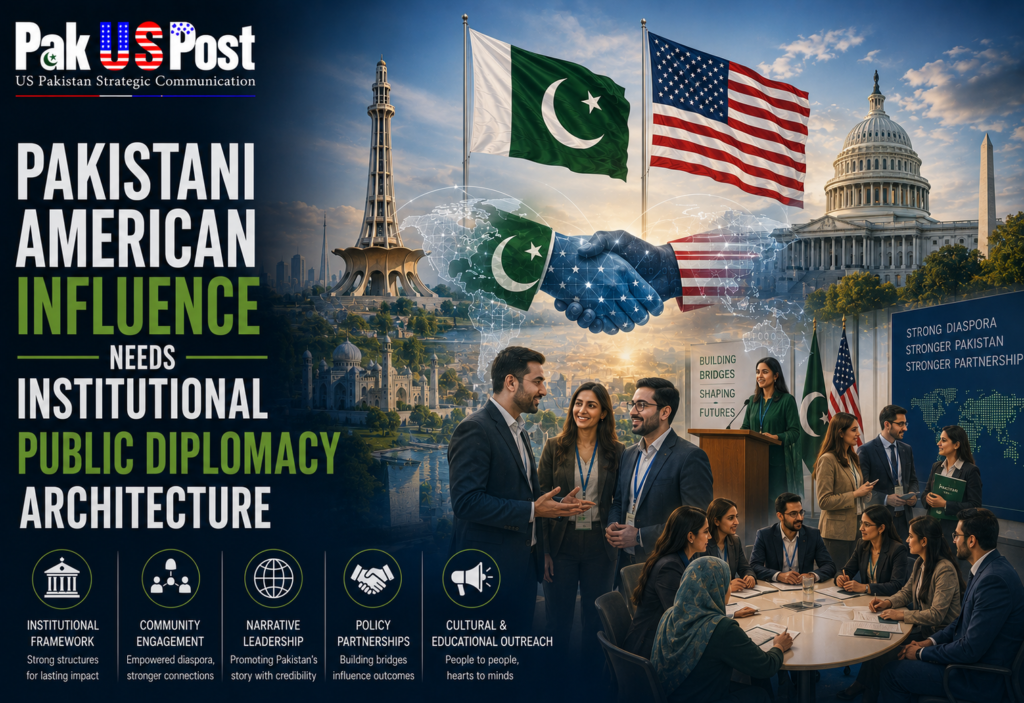
Pak US Post must treat the Pakistani American community in the United States not as a sentimental constituency of bilateral relations, nor as an electoral instrument to be activated during diplomatic crises, but as a dispersed institutional asset whose intellectual, commercial, philanthropic and civic capital can materially affect the quality of Pakistan United States engagement. The community already occupies influential positions across medicine, higher education, technology, finance, entrepreneurship, law, public administration, media, research and local government, yet its collective policy utility remains substantially below its potential because influence is often exercised through disconnected individuals rather than durable institutions. The central policy question is therefore not whether Pakistani Americans possess access to Washington, universities or corporate America. They demonstrably do. The question is whether Pakistan can develop an ethical architecture capable of converting dispersed social capital into credible public diplomacy without manufacturing a lobbying apparatus, compromising community autonomy or allowing bilateral advocacy to become captive to partisan politics.
Washington responds more readily to organised knowledge than to communal sentiment. Congressional offices receive a continuous stream of correspondence, policy memoranda, constituent interventions, campaign related engagement and invitations to community events. Universities encounter diaspora perspectives through faculty appointments, student associations, research partnerships, endowed programmes and public lectures. Businesses interact through chambers of commerce, professional associations, investment networks and technology ecosystems. Philanthropic organisations establish another channel through which perceptions of Pakistan are formed, particularly when development, education, healthcare and disaster response are presented through measurable outcomes rather than national slogans. Digital platforms add a further layer, allowing a relatively small number of highly active voices to create the appearance of a much broader consensus. The strategic challenge for Islamabad is to understand these channels as separate but interconnected nodes of influence, rather than assuming that community visibility automatically translates into diplomatic effectiveness.
The distinction between diaspora diplomacy and diaspora politics is consequential. Diaspora politics seeks leverage over political outcomes, whereas public diplomacy seeks credibility in the formation of public understanding. The former can become transactional, partisan and personality dependent. The latter requires continuity, evidence and institutional restraint. Pakistan should therefore resist the temptation to construct a centralised overseas influence mechanism that attempts to dictate what Pakistani Americans should say. Such an arrangement would be counterproductive in the American political environment, where independent civic identity is itself a source of credibility. The appropriate objective is to create conditions under which qualified members of the diaspora can contribute independently to informed debate, while Pakistani institutions provide reliable information, research access, economic data and policy documentation.
This distinction is particularly important in congressional engagement. Pakistani American professionals can become valuable interlocutors with congressional offices, but their effectiveness will depend on the quality and transparency of the evidence they provide. A sustainable congressional outreach mechanism should maintain a nonpartisan policy registry identifying legislative developments relevant to Pakistan, including trade preferences, development assistance, counterterrorism cooperation, technology controls, immigration, education, climate resilience and regional security. Policy briefs supplied to congressional offices should distinguish verified facts from advocacy positions and should disclose institutional sponsorship. Where diaspora organisations receive financial or logistical support from Pakistani entities, that relationship should be stated clearly. Credibility is not weakened by disclosure. It is weakened when undisclosed relationships are subsequently exposed by opponents.
Pakistan also needs a more sophisticated understanding of congressional geography. Pakistani American influence is not concentrated exclusively in Washington. Community networks operate through districts and states where elected representatives respond to constituent concerns, local economic interests and civic organisations. A professional engagement framework should therefore develop district level stakeholder maps identifying Pakistani American businesses, physicians, academics, researchers, entrepreneurs, community organisations, universities and philanthropic institutions. These maps should not be used as political targeting instruments. Their purpose should be institutional coordination, enabling Pakistani diplomatic missions and relevant ministries to understand where expertise exists and where bilateral initiatives could generate measurable value.
The embassy and consulates should consequently maintain professional diaspora engagement cells with clearly defined functions, trained personnel and transparent operating procedures. Their mandate should include expert mapping, research coordination, investment facilitation, academic linkages, crisis communication and structured consultation. They should not become partisan political offices. Diplomatic personnel should avoid endorsing candidates, intervening in intra community disputes or encouraging political mobilisation on behalf of any Pakistani government. The institutional test should be simple: if an engagement activity would appear inappropriate when disclosed publicly to an American congressional committee, it should not be conducted through an official diplomatic channel.
Universities offer an especially underused avenue. Pakistani American academics are positioned to influence how Pakistan is interpreted within political science, international relations, development studies, public health, economics, engineering, media studies and area studies. Yet academic engagement can easily become ceremonial. Pakistan should move towards competitive research partnerships rather than honorary associations. A Pakistan United States Diaspora Research Fund could support joint projects conducted by American and Pakistani universities on subjects such as water security, agricultural productivity, public health, climate adaptation, artificial intelligence governance, digital finance, urbanisation, migration, counterterrorism and regional commerce. Selection should be based on peer reviewed criteria, institutional independence and research quality rather than proximity to government.
Such a fund would also address an important credibility problem. American universities are generally more receptive to research collaboration when funding arrangements, data ownership and publication rights are explicit. Pakistani institutions should therefore adopt standard agreements specifying financial disclosure, data provenance, intellectual property, publication independence and conflict of interest procedures. Research commissioned for diplomatic purposes should never be presented as independent scholarship. Conversely, independent research should not be pressured to produce favourable conclusions. Pakistan gains greater strategic value from uncomfortable evidence that improves policy than from flattering studies that fail external scrutiny.
The professional diaspora can also become a bridge between economic diplomacy and technological development. Pakistani American entrepreneurs occupy sectors where Pakistan seeks greater integration, including software, healthcare technology, financial services, logistics, advanced manufacturing and professional services. The government should create a verified diaspora expertise platform linking professionals with Pakistani ministries, universities, provincial investment authorities and private firms. Participation should be voluntary, professionally credentialed and governed by data protection standards. Instead of collecting merely names and contact details, the platform should classify expertise by sector, investment capacity, research interests, mentoring availability and institutional affiliations. This would allow a technology entrepreneur in California, a physician in Texas or a researcher in Massachusetts to be connected with an appropriate Pakistani institution without forcing them into a generic community engagement programme.
The economic dimension deserves particular attention because commercial relationships can provide a less politically volatile foundation for bilateral engagement. Pakistani American businesses can help American investors interpret regulatory conditions, identify credible local partners and assess market risks. Yet diaspora networks should not become informal substitutes for due diligence. Any investment facilitation mechanism should operate alongside formal regulatory procedures, anti corruption safeguards, beneficial ownership verification and commercially independent risk assessment. The diaspora can reduce informational asymmetry, but it should not be permitted to eliminate institutional scrutiny.
Philanthropy presents another strategic opportunity. Pakistani American donors have contributed to hospitals, schools, disaster relief, scholarships and community development. A more systematic philanthropic architecture could encourage co financing between American foundations, diaspora donors and Pakistani institutions for projects with transparent impact metrics. Areas such as maternal health, vocational education, climate adaptation, water efficiency and digital literacy could generate stronger reputational dividends than publicity oriented charitable campaigns. Pakistan should publish annual impact reports showing funds committed, beneficiaries reached, independent evaluations and administrative costs. Measurable philanthropy is more persuasive in Washington than symbolic generosity.
Digital discourse constitutes a more complicated arena. Pakistani American communities are exceptionally exposed to competing narratives about Pakistan, the United States, civil military relations, terrorism, democratic governance, economic performance and regional security. Social platforms reward emotional intensity, rapid reaction and identity affirmation. A single video, selectively edited interview or unverified allegation can therefore acquire disproportionate political significance. Pakistan should not respond by attempting to control diaspora discourse. Such an approach would be technologically unrealistic and diplomatically damaging. Instead, it should build a rapid factual information infrastructure capable of supplying journalists, researchers, community organisations and public officials with primary documents, verified statistics, official transcripts and contextual explanations.
The institutional principle should be information availability rather than narrative enforcement. A public diplomacy portal could provide downloadable datasets, diplomatic statements, trade statistics, development indicators, legal documents and historical timelines in formats accessible to researchers and media organisations. Corrections should be evidence based and issued without inflammatory language. Where Pakistani policy has produced legitimate controversy, the response should acknowledge the issue and explain the institutional position rather than attempt reputational suppression. American audiences are more likely to trust an institution capable of admitting uncertainty than one that treats every criticism as hostile propaganda.
A serious diaspora framework must also anticipate capture. Community organisations do not constitute a homogeneous political bloc. They contain ideological differences, generational divisions, professional hierarchies, regional identities and competing interpretations of Pakistan United States relations. Any official programme that privileges one organisation as the representative voice of Pakistani Americans will eventually distort the ecosystem. Engagement should therefore be pluralistic, rotating and criteria based. Access to diplomatic consultations should depend upon professional relevance, institutional legitimacy, demonstrated expertise and transparency rather than personal proximity to officials.
The same principle applies to funding. Government support for diaspora engagement should be governed by written rules requiring disclosure of financial relationships, independent auditing and publication of programme objectives. Organisations receiving Pakistani public funds should not be permitted to conceal that relationship while presenting themselves as entirely independent advocacy bodies. Similarly, diaspora organisations should retain the right to disagree with Pakistani policy. Independence is not an obstacle to public diplomacy. It is one of its principal sources of legitimacy.
For strategic planners, the deeper lesson is that diaspora influence should be regarded as an ecosystem rather than an instrument. The community can strengthen Pakistan United States relations when it connects knowledge, commerce, research, philanthropy and civic participation. It can weaken them when institutions attempt to instrumentalise identity, personalise influence or convert diplomatic engagement into partisan mobilisation. The difference lies in governance.
A Pakistan United States Diaspora Council could provide an institutional coordination layer without becoming a political command structure. Its membership should include representatives from academia, business, medicine, technology, philanthropy, professional associations, research institutions and civil society, selected through transparent criteria and periodic rotation. Government officials should participate as observers and facilitators rather than controlling the agenda. The council should publish an annual assessment covering congressional engagement, research partnerships, investment referrals, philanthropic projects, professional exchanges and public diplomacy initiatives. It should also maintain a conflict of interest register and disclose funding relationships.
For the security establishment, this architecture offers a further advantage. It creates a distinction between legitimate diaspora engagement and covert or opaque influence activity. Pakistan’s strategic institutions require reliable channels through which they can understand American political and social perceptions without conflating community advocacy with intelligence collection or political manipulation. Any security related engagement must remain within applicable Pakistani and American law, with clear institutional mandates and documented authorisation. The objective should be situational awareness and professional consultation, not the construction of clandestine influence networks. Strategic maturity requires understanding that reputational credibility itself is a national security asset.
For policymakers in Islamabad, the practical benchmark should therefore shift from counting community events to measuring institutional outcomes. Relevant indicators could include the number of independently produced research collaborations, congressional briefings based on disclosed evidence, investment projects facilitated through formal channels, university partnerships, philanthropic programmes independently evaluated, professional exchanges and verified policy references in American institutions. A quarterly diaspora diplomacy dashboard could allow the Foreign Ministry, Board of Investment, Ministry of Commerce, Higher Education Commission and relevant provincial authorities to identify where engagement is producing tangible bilateral value.
The objective is not to make Pakistani Americans speak with one voice. That would be neither possible nor desirable. The objective is to ensure that the many voices already present in American society can connect with Pakistan through credible institutions, reliable information and professional networks. A mature bilateral relationship cannot depend indefinitely on episodic diplomatic visits or personality based access. It requires social infrastructure capable of surviving changes in government, congressional composition and political mood.
Pak US Post should therefore frame Pakistani American engagement as a component of national diplomatic capacity, not as an auxiliary lobbying exercise. The most valuable diaspora advocate is not necessarily the loudest activist or the person with the closest access to a politician. It may be the scientist whose research withstands peer review, the physician who builds a durable health partnership, the entrepreneur who brings an American company into a Pakistani market, the professor who introduces Pakistani evidence into a university curriculum, or the civic leader who can explain Pakistan without reducing it to a security narrative. Institutionalising these relationships would give Pakistan something more durable than political access. It would provide a distributed network of credibility across American society, capable of absorbing diplomatic shocks, correcting misinformation, expanding economic opportunity and generating policy knowledge. That is the form of diaspora influence most compatible with democratic accountability, American political norms and Pakistan’s long term strategic interests.
A Public Service Message