Public Health Messaging Compliance and Behavioral Governance in Digital Age

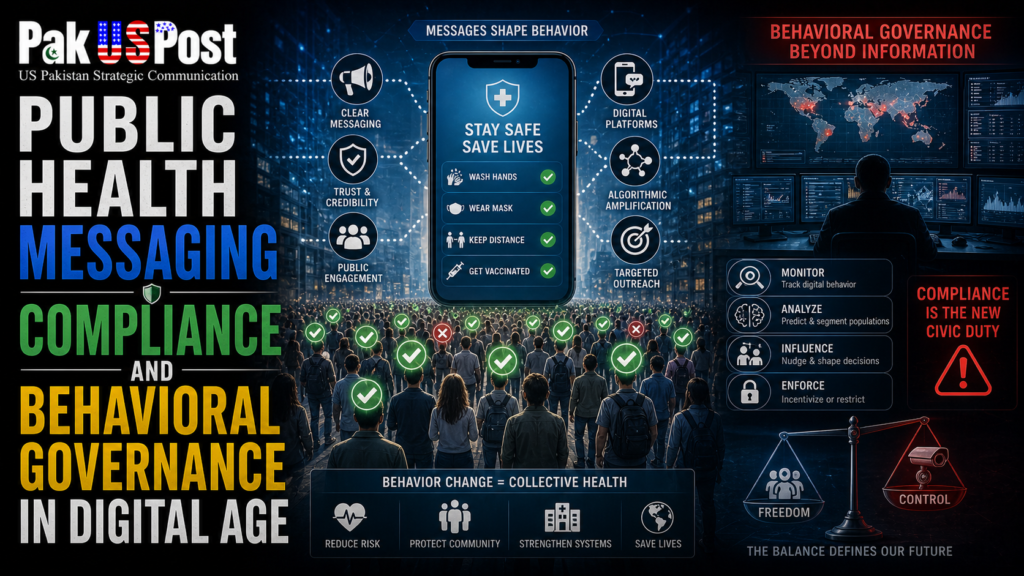
Public health communication has evolved from a peripheral administrative function into a central mechanism of governance in contemporary states, particularly as societies become increasingly shaped by digital information ecosystems, algorithmically mediated attention structures, and rapidly shifting behavioral norms. The contemporary challenge is no longer limited to designing effective health policies or ensuring institutional capacity for implementation. Instead, the deeper challenge lies in constructing communicative architectures capable of producing sustained behavioral compliance in environments where information is fragmented, trust is unevenly distributed, and authority is continuously contested.
At the heart of this transformation is a fundamental paradox. States are more capable than ever of collecting health data, modeling disease patterns, and designing targeted interventions, yet they are simultaneously less able to guarantee uniform behavioral adherence to public health directives. The expansion of digital platforms has multiplied the number of voices competing in the public sphere, many of which operate outside traditional regulatory frameworks. As a result, public health messaging now functions within a contested communicative environment where scientific authority must compete with misinformation, commercial influence, cultural resistance, and algorithmically amplified counter narratives.
This tension becomes particularly visible in regulatory domains such as tobacco control, vaccination campaigns, dietary regulation, and lifestyle modification policies. In each of these domains, compliance is not simply a matter of awareness but of persuasion, trust, identity alignment, and perceived autonomy. The effectiveness of public health messaging therefore depends less on the volume of information disseminated and more on the framing strategies through which that information is embedded within broader social meaning systems.
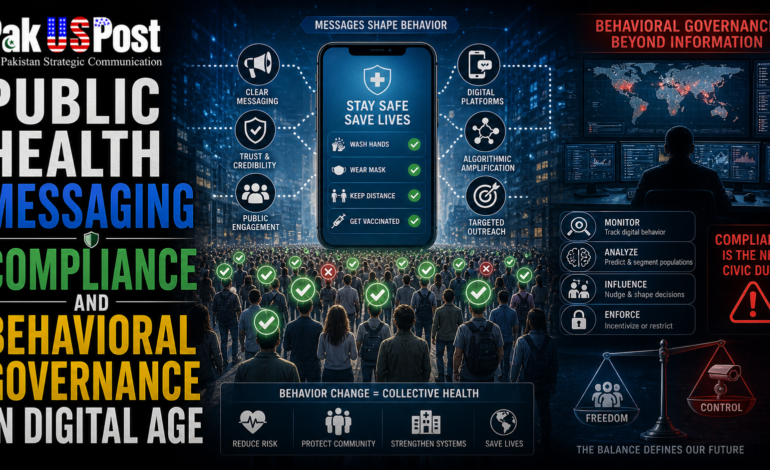
Behavioral governance in this context refers to the capacity of the state and associated institutions to shape population behavior not through coercion alone but through structured communication, incentive design, and normative influence. Unlike traditional regulatory approaches that rely on enforcement mechanisms, behavioral governance operates through psychological and cultural pathways that influence how individuals interpret risk, responsibility, and collective obligation. In digital societies, these pathways are increasingly shaped by platform algorithms that prioritize engagement over accuracy, emotional intensity over informational clarity, and virality over institutional credibility.
The result is a fragmented informational landscape in which public health messages are continuously reinterpreted, contested, and reframed. A single policy announcement can generate multiple competing narratives, each amplified within different digital communities. In such an environment, the success of public health communication depends on its ability to maintain coherence across diverse interpretive ecosystems while resisting distortion through selective amplification.
From a comparative policy perspective, states that have achieved relatively high levels of compliance in public health initiatives tend to share certain communicative characteristics. First, they integrate emotional framing with scientific messaging, recognizing that behavioral change is driven not only by cognitive understanding but also by affective resonance. Second, they embed public health narratives within culturally familiar symbols and moral frameworks, thereby increasing perceived legitimacy. Third, they maintain consistency across institutional voices, reducing ambiguity and fragmentation in public perception.
However, even in such cases, compliance is rarely uniform. Psychological reactance, a well documented behavioral phenomenon, often emerges when individuals perceive health regulations as infringing upon personal autonomy. This is particularly evident in contexts where public health measures are communicated through prohibitive or punitive language. Messages framed as restrictions or obligations can inadvertently trigger resistance, even among populations that cognitively understand the rationale behind the policy.
In contrast, framing strategies that emphasize collective benefit, long term economic stability, and intergenerational health outcomes tend to generate higher levels of voluntary compliance. This is because such framing aligns individual behavior with broader social narratives, reducing the perceived tension between personal freedom and collective responsibility. However, even these approaches are not universally effective, particularly in environments characterized by deep political polarization or institutional distrust.
The rise of digital media has significantly complicated these dynamics. Unlike traditional broadcast systems, digital platforms operate through decentralized content distribution mechanisms governed by algorithmic curation. This means that public health messages are no longer received in a uniform manner but are filtered through personalized information environments shaped by user behavior, platform design, and engagement optimization logic. As a result, two individuals exposed to the same public health campaign may interpret it in entirely different ways depending on their digital context.
Moreover, digital platforms have enabled the rapid circulation of counter narratives that directly challenge official health messaging. These counter narratives are not necessarily grounded in scientific evidence but often derive their influence from emotional appeal, identity alignment, or distrust of institutional authority. In many cases, they are amplified by commercial interests, political actors, or ideological communities that benefit from undermining consensus around public health issues. This creates a complex informational battlefield in which scientific communication must compete with highly adaptive and emotionally resonant alternative narratives.
In the context of Pakistan, these dynamics are particularly significant. The country faces a dual challenge of managing traditional public health constraints such as resource limitations, infrastructure gaps, and uneven healthcare access, while simultaneously navigating a rapidly expanding digital information ecosystem. Public health messaging in such an environment must operate across multiple layers of complexity, including linguistic diversity, varying levels of digital literacy, and deeply embedded cultural norms.
The relationship between Pakistan and the United States in the domain of public health communication offers an important comparative lens. The United States, with its advanced public health institutions and extensive experience in behavioral health campaigns, has developed sophisticated communication strategies that integrate behavioral science, data analytics, and media engagement. However, it also faces significant challenges related to misinformation, political polarization, and institutional distrust, particularly in the context of digital platforms.
Pakistan, by contrast, operates in a more constrained informational environment but also retains certain advantages in terms of cultural coherence and centralized messaging potential. The challenge lies in adapting global best practices to local contexts without importing the structural vulnerabilities of highly fragmented media ecosystems. This requires not only technical capacity but also institutional coordination and narrative discipline.
One of the most critical areas of public health communication in both contexts is tobacco control. Tobacco consumption remains a major public health challenge globally, and policy responses increasingly rely on a combination of regulatory measures and behavioral messaging. However, the effectiveness of such policies depends heavily on how they are communicated to the public. Messages that emphasize moral condemnation or individual blame often prove less effective than those that highlight structural determinants, economic costs, and familial health impacts.
In addition, the rise of alternative nicotine delivery systems, including vaping products, has introduced new complexities into public health messaging. These products are often marketed through sophisticated digital campaigns that emphasize harm reduction narratives while minimizing long term health uncertainties. Public health institutions must therefore navigate a communicative environment in which scientific uncertainty is strategically exploited by commercial actors to shape consumer perception.
The governance challenge extends beyond tobacco control to broader questions of lifestyle regulation, including diet, physical activity, and preventive healthcare behaviors. In each of these domains, compliance is influenced by deeply embedded cultural practices, socioeconomic constraints, and informational accessibility. Public health messaging that fails to account for these factors risks being perceived as externally imposed or culturally misaligned, thereby reducing its effectiveness.
In digital environments, the credibility of public health institutions is also closely tied to their ability to maintain transparency and consistency. Inconsistencies in messaging, delayed responses to emerging health threats, or perceived alignment with political agendas can significantly undermine trust. Once trust is eroded, even scientifically robust messaging may fail to achieve behavioral impact, as audiences increasingly filter information through preexisting skepticism.
This highlights a central paradox of behavioral governance in the digital age. The more information becomes available, the more difficult it becomes to ensure that information translates into consistent behavior. Information abundance does not automatically produce behavioral alignment; in many cases, it produces interpretive fragmentation. Individuals are exposed to multiple, often contradictory narratives, each claiming authority and legitimacy, making it increasingly difficult for any single message to achieve dominance.
To address this challenge, public health communication must evolve beyond linear information dissemination models toward more adaptive, network based strategies. This includes leveraging trusted community intermediaries, integrating culturally resonant storytelling techniques, and engaging with digital platforms in ways that account for algorithmic amplification dynamics. It also requires a shift from reactive messaging to anticipatory communication, where potential misinformation pathways are identified and addressed before they become dominant narratives.
From a policy perspective, particularly in Pakistan–US cooperation frameworks, there is significant scope for collaborative development of digital public health communication strategies. This includes joint research on behavioral compliance mechanisms, shared development of misinformation mitigation tools, and capacity building in digital health literacy. However, such cooperation must be sensitive to differences in institutional structures, cultural contexts, and informational ecosystems.
Ultimately, the future of public health messaging will depend on the ability of institutions to operate within complex communicative environments without losing epistemic authority. This requires not only technical innovation but also a renewed understanding of trust as a central governance resource. Trust is not merely an outcome of effective communication; it is a precondition for it. Without trust, even the most scientifically accurate messages fail to produce behavioral change.
In conclusion, public health messaging in the digital age is no longer a subsidiary function of governance but a central arena in which state capacity, institutional legitimacy, and behavioral outcomes are negotiated. The challenge is not simply to inform populations but to construct communicative ecosystems capable of sustaining long term behavioral transformation in the face of fragmentation, skepticism, and algorithmic disruption. For countries like Pakistan, and for partnerships such as those with the United States, the task ahead is to build resilient, adaptive, and culturally grounded public health communication systems that can navigate the complexities of the digital information order while maintaining clarity, trust, and effectiveness.
A Public Service Message