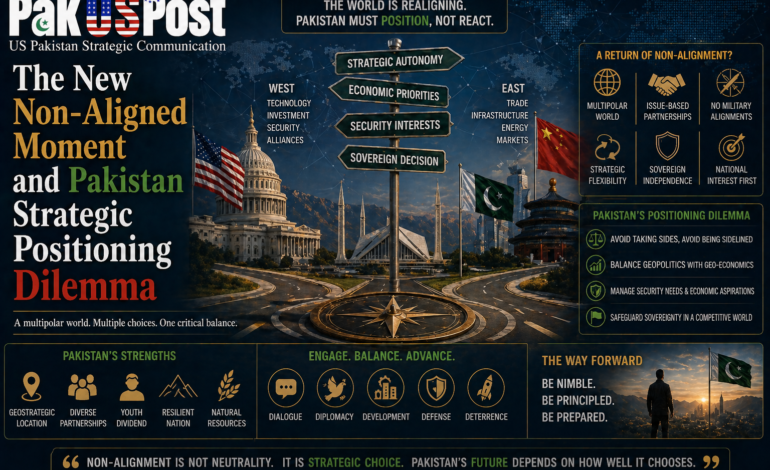
The New Non-Aligned Moment and Pakistan Strategic Positioning Dilemma

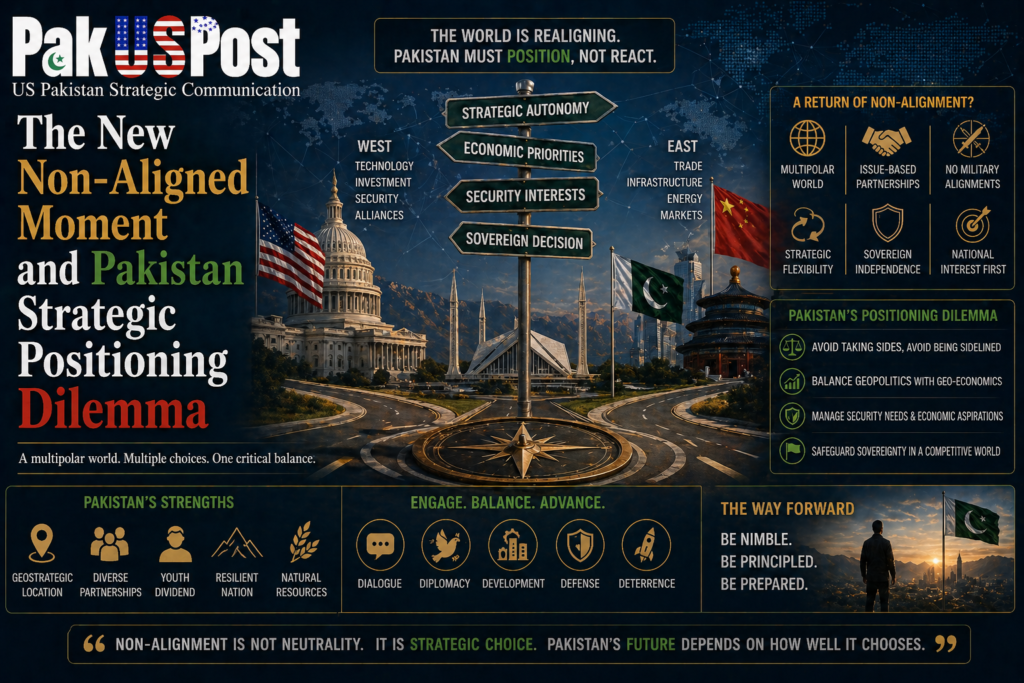
The contemporary international system is witnessing the gradual emergence of what may be described as a new nonaligned moment, although it bears little resemblance to the Cold War era Non Aligned Movement that was anchored in ideological coherence and post-colonial solidarity. The present configuration is instead shaped by strategic fluidity, economic interdependence, technological competition, and fragmented governance structures. In this environment, states are increasingly resisting rigid bloc alignment, not out of ideological conviction, but out of pragmatic necessity in a world where economic survival, technological access, and security stability depend on multi directional engagement.
This new phase is not characterised by neutrality in the classical sense. Rather, it is defined by selective alignment, issue based cooperation, and transactional flexibility. Middle powers and emerging economies are no longer seeking to position themselves outside great power competition. Instead, they are attempting to operate within multiple overlapping systems simultaneously, extracting value from each without becoming fully dependent on any single centre of power. This produces a diplomatic environment that is fluid, adaptive, and often contradictory.
Pakistan finds itself situated at the intersection of this transformation. Its historical experience with alliance politics, from Cold War security partnerships to post 9/11 counterterrorism cooperation, has created a deep institutional memory of external dependence. Yet the current global environment demands a different form of agency, one that is less about fixed alignment and more about strategic navigation across competing economic and security architectures. The challenge is whether Pakistan can transition from reactive alignment behaviour to proactive portfolio diplomacy.
The emergence of this new non aligned moment is closely tied to the fragmentation of the post Cold War order. The assumption that globalization would produce a unified liberal economic system has been replaced by the reality of techno economic decoupling, sanctions based diplomacy, and regionalisation of supply chains. The United States and China are no longer simply competitors within a shared system but are increasingly constructing parallel infrastructures of trade, finance, technology standards, and security partnerships. This structural bifurcation forces other states to constantly calibrate their positions across competing systems.
In parallel, regional powers such as Saudi Arabia, Türkiye, Iran, India, Brazil, and Indonesia are asserting greater strategic autonomy. These states are no longer content to operate as passive recipients of global order but are actively shaping sub regional architectures of influence. The Gulf region is diversifying its economic partnerships beyond energy exports. Southeast Asia is deepening intra regional trade while balancing US China competition. Africa is expanding infrastructure partnerships with multiple external actors. Latin America is exploring strategic autonomy through diversified trade and diplomatic engagements.
Within this global redistribution of agency, Pakistan’s strategic dilemma becomes more pronounced. On one hand, its geographic location places it at the convergence of major connectivity projects linking China, Central Asia, South Asia, and the Middle East. On the other hand, its economic vulnerabilities and institutional constraints limit its ability to fully capitalise on this positioning. The result is a state that is strategically relevant but structurally constrained.
The new non aligned moment is also deeply shaped by digital transformation and technological competition. Unlike the Cold War era, where alignment was primarily military and ideological, contemporary alignment structures are increasingly determined by access to digital infrastructure, data ecosystems, artificial intelligence platforms, and semiconductor supply chains. States are compelled to make choices not only about political alliances but also about technological ecosystems. This creates a more complex and layered form of alignment that extends into domestic governance, economic planning, and information control.
For Pakistan, this introduces a new layer of strategic complexity. Engagement with Chinese digital infrastructure, Western financial systems, Gulf investment platforms, and regional connectivity projects requires constant calibration. The absence of a coherent long term digital and industrial policy framework risks turning diversification into fragmentation rather than strategic autonomy.
Media narratives play a critical role in constructing and interpreting this new non aligned moment. In global policy discourse, middle powers are increasingly portrayed as swing states in a fragmented order, capable of influencing outcomes in specific issue areas without possessing systemic dominance. Countries such as India, Türkiye, Saudi Arabia, Indonesia, and Brazil are frequently discussed in terms of strategic autonomy narratives. Pakistan, however, is often framed through a narrower lens of crisis management, security dependency, and economic vulnerability.
This narrative asymmetry has significant implications for diplomatic perception. In international media ecosystems, perception often precedes policy. States that are perceived as stable, adaptive, and strategically coherent attract investment, partnerships, and diplomatic engagement. Those perceived as unstable or reactive face higher transaction costs in international negotiations. Pakistan’s challenge is therefore not only structural but also narrative, requiring a reconfiguration of how it is represented within global discourse.
The concept of a new non aligned moment also reflects deeper shifts in global economic organisation. Supply chains are no longer purely efficiency driven but are increasingly shaped by geopolitical risk assessments. Trade relationships are being restructured around friend shoring, near shoring, and strategic redundancy. Energy markets are fragmenting between traditional hydrocarbon exporters and emerging renewable technology hubs. Financial systems are increasingly influenced by sanctions regimes and currency diversification strategies.
In this environment, neutrality is no longer passive. It is actively constructed through policy choices, institutional capacity, and diplomatic engagement. States must continuously demonstrate reliability to multiple partners while avoiding overdependence on any single system. This requires a high degree of policy sophistication and administrative coherence that many middle powers struggle to maintain consistently.
Pakistan’s historical experience with non-alignment is also instructive in understanding its current positioning. During the Cold War, non-alignment was rooted in ideological resistance to bloc politics and a desire for sovereign autonomy in a bipolar world. Today, however, the constraints are different. The challenge is not ideological alignment but economic interdependence and technological dependency. This fundamentally alters the meaning of autonomy. It is no longer about avoiding blocs but about managing entanglements.
The China Pakistan Economic Corridor represents a central axis of this entanglement. It offers infrastructure development, energy investment, and connectivity potential, but also creates long term financial and strategic dependencies. Similarly, engagement with Western financial institutions, particularly the International Monetary Fund and World Bank, introduces policy conditionalities that shape domestic economic decisions. Gulf investment flows provide fiscal relief but are often tied to labour migration and geopolitical expectations. These overlapping dependencies form a complex web of partial alignments rather than clear strategic independence.
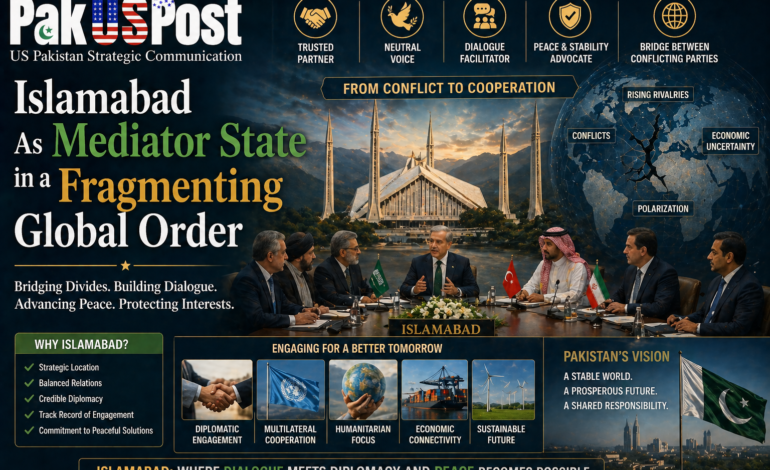
Within the Islamic world, Pakistan also occupies a layered position. It maintains deep cultural and political ties with Gulf states, while also engaging with Iran, Türkiye, and Central Asian republics. However, intra Islamic world politics are increasingly influenced by divergent strategic alignments, particularly between Gulf Arab states and Iran, and between different interpretations of political Islam and economic modernisation models. Pakistan’s ability to navigate these tensions is central to its broader non aligned posture.
The emergence of issue based coalitions further complicates the landscape. Rather than fixed alliances, states are increasingly forming temporary coalitions around specific issues such as climate change, digital governance, maritime security, and energy transition. Pakistan’s participation in such coalitions remains uneven, reflecting both institutional capacity limitations and strategic ambiguity. Strengthening engagement in issue based diplomacy could provide an avenue for greater relevance within the new non aligned moment.
At the domestic level, the ability to sustain a nonaligned posture depends on economic resilience, institutional continuity, and policy predictability. Without these foundations, external diversification risks becoming reactive rather than strategic. Economic instability reduces diplomatic leverage, while institutional fragmentation weakens negotiation capacity. In such conditions, non-alignment becomes symbolic rather than operational.
The broader international environment suggests that the new nonaligned moment is still in formation. It is not a coherent system but a transitional phase characterised by overlapping uncertainties. Great power competition is intensifying, but it is no longer producing clear bloc structures. Instead, it is generating a mosaic of partial alignments, contested spaces, and fluid partnerships. In this context, middle powers have both increased agency and increased vulnerability.
For Pakistan, the strategic question is whether it can transform its geographic centrality into structured diplomatic advantage. This requires moving beyond reactive engagement with external powers towards a deliberate strategy of multi vector diplomacy. It also requires strengthening internal coherence so that external engagements are supported by consistent domestic policy frameworks.
Ultimately, the new non aligned moment is not about standing outside the global system but about navigating within it without becoming structurally subordinated. It is about managing complexity rather than avoiding it. For Pakistan, this means recognising that non alignment is no longer a position but a process, one that must be continuously constructed through economic policy, diplomatic engagement, and narrative discipline.
In a fragmented world order, survival and influence will depend not on choosing between East and West, or between competing blocs, but on mastering the art of strategic simultaneity. The countries that succeed in this environment will be those that can engage multiple systems without being captured by any single one. Pakistan’s future in this emerging order will depend on whether it can convert its historical experience of alignment into a more adaptive form of non-alignment suited to the realities of a post Western, post unipolar world.
A Public Service Message